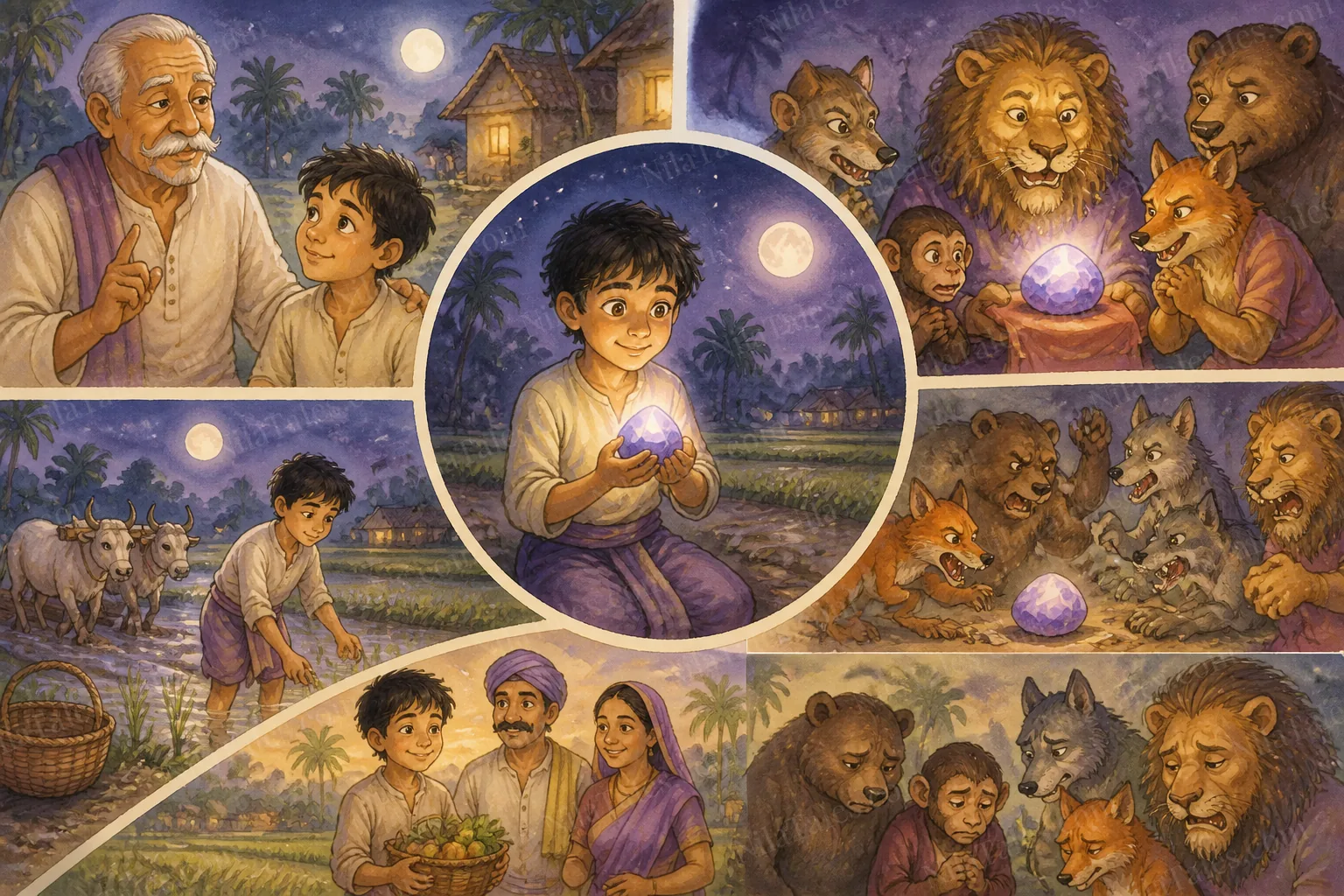
In a beautiful village surrounded by lush green fields lived a boy named Kadhir. Kadhir was hardworking and always helped his parents with the farming. His grandfather used to tell him often, "Wealth earned through hard work is permanent, but wealth gained through shortcuts is like a passing shadow."
One afternoon, while Kadhir was grazing his sheep near the edge of the forest, he noticed something sparkling under an ancient banyan tree. As he approached, he saw a beautiful blue stone. The moment he touched it, the tree spoke in a gentle voice, "Young boy, this is a magic stone. If you ask for your true needs, it will provide them."
Since Kadhir was a simple boy, he had no desire for unnecessary luxuries. He simply took the stone home and kept it safe. One day, his friend Ravi visited him. Kadhir shared the secret of the magic stone with him. The next day, while Kadhir was away tending to his sheep, Ravi took the stone and brought it to the village square.
"This stone gives anything you ask for!" Ravi shouted to the crowd. The villagers were excited and greedy. One man asked for heaps of gold, and a woman asked for precious jewels. Within hours, the entire village was filled with gold and diamonds. Everyone abandoned their farms and spent their time enjoying their newfound wealth.
However, within a few weeks, things took a turn for the worse. Since no one was working in the fields, there was no one to plant or harvest crops. Food supplies began to vanish. The villagers were rich in gold, but they were starving. They realized that gold could not fill an empty stomach.
Terrified and hungry, the villagers ran to Kadhir. "Kadhir, please help us! We made a terrible mistake," they pleaded.
Kadhir looked at them calmly and said, "The wealth we have was not earned by our hands. How can it stay with us? Let us go to the magic stone and ask it to take back everything we asked for."
The villagers went to the stone and asked it to take back all the gold and jewels. In an instant, the treasures vanished. The villagers returned to their farms and resumed their hard work. From that day on, they lived happily, valuing the food earned through their own sweat and toil rather than chasing empty riches.
Moral
Wealth earned through labor is lasting; greed leads to ruin.