
The Gift from the Skyy
The story illustrates that life and greenery depend entirely on the rain falling from the clouds, as per the Kural. If no drop falls from the clouds, not even the green blade of grass will be seen

Adith's First Letter
The story uses the analogy of the first letter of the alphabet to explain that God is the primordial source of the world. As the letter A is the first of all letters, so the eternal God is first in the world

The Light of Truth
The story illustrates how focusing on divine virtues protects a person from being swayed by the darkness of bad deeds. The two-fold deeds that spring from darkness shall not adhere to those who delight in the true praise of God

The Light of True Knowledge
The story reflects the Kural's message that learning is meaningless if it does not lead one to honor the ultimate source of pure knowledge. What Profit have those derived from learning, who worship not the good feet of Him who is possessed of pure knowledge ?

Words vs. Deeds
The story illustrates the Kural's warning against those who parade empty words instead of proving themselves through action. Call not him a man who parades forth his empty words Call him the chaff of men

The Flower of the Heart
The story illustrates how surrendering one's ego and mind to the Divine leads to a flourishing and lasting life. They who are united to the glorious feet of Him who passes swiftly over the flower of the mind, shall flourish long above all worlds

Kadir and the Magic of Words
The story illustrates how meaningless chatter can lead to being ignored and how purposeful speech carries real value. Speak what is useful, and speak not useless words

The Secret of a Peaceful Heart
The story illustrates how being free from the extremes of desire and dislike—much like the Divine described in the Kural—protects a person from emotional suffering. To those who meditate the feet of Him who is void of desire or aversion, evil shall never come

Aadi's Inner Strength
The story illustrates how overcoming sensory cravings (the candy) in favor of virtue leads to a more fulfilling life, reflecting the Kural. Those shall long proposer who abide in the faultless way of Him who has destroyed the five desires of the senses

The Key to Peace
The story illustrates that anxiety can only be truly eased by connecting with the incomparable Divine power mentioned in the Kural. Anxiety of mind cannot be removed, except from those who are united to the feet of Him who is incomparable

The Lighthouse of Virtue
The story illustrates that while vice is a turbulent sea that drowns the soul, virtue acts as an anchor that protects one through life's challenges. None can swim the sea of vice, but those who are united to the feet of that gracious Being who is a sea of virtue

Kannan and the Magic Mirror
The story illustrates that human intellect is useless if it lacks the humility to acknowledge the supreme divine power, just as a sense organ is useless without sensation. The head that worships not the feet of Him who is possessed of eight attributes, is as useless as a sense without the power of sensation

The Boat of Faith
The story uses the metaphor of a boat to represent divine connection as the only way to navigate life's challenges. None can swim the great sea of births but those who are united to the feet of God

The Strength of Virtue
The story illustrates how a wife's virtue provides the moral compass for her husband's success. If his wife be eminent (in virtue), what does (that man) not possess ? If she be without excellence, what does (he) possess ?

The Gift of the Rain
The story illustrates how rain is the essential force that preserves all life, mirroring the Kural's teaching. By the continuance of rain the world is preserved in existence; it is therefore worthy to be called ambrosia

The Gift of the Rain
The story illustrates how rain is both the creator of food and a source of life-sustaining nourishment. Rain produces good food, and is itself food

The Silent Skies
The story illustrates the Kural's warning that if the clouds fail to rain, the whole world will suffer from hunger. If the cloud, withholding rain, deceive (our hopes) hunger will long distress the sea-girt spacious world

The Breath of the Earth
The story illustrates that human effort in farming is futile without the essential gift of rain. If the abundance of wealth imparting rain diminish, the labour of the plough must cease

Mari and the Gift of Rain
The story shows how the absence of rain led Mari to ruin, while its arrival brought him back to fortune, mirroring the Kural. Rain by its absence ruins men; and by its existence restores them to fortune

The Generous Cloud
The story mirrors the Kural by showing that even a vast sea loses its essence if the clouds that take its water do not return it as rain. Even the wealth of the wide sea will be diminished, if the cloud that has drawn (its waters) up gives them not back again (in rain)

The Silent Prayer of the Raindrops
The story illustrates that if the rain fails, the cycle of worship and life stops, mirroring the Kural's warning. If the heaven dry up, neither yearly festivals, nor daily worship will be offered in this world, to the celestials

The Gift of the Rain
The story illustrates that without rain, there is no sustenance, and without sustenance, humans cannot practice the virtues of charity and spiritual devotion. If rain fall not, penance and alms-deeds will not dwell within this spacious world

The Sweetness of a Grumpy Smile
The story shows how Meera's anger was not hurtful but a sweet expression of their bond, mirroring the Kural. Like water in the shade, dislike is delicious only in those who love

The Gift from the Clouds
The story illustrates that human activities and life itself are fundamentally dependent on the cycle of rain, mirroring the Kural's wisdom. If it be said that the duties of life cannot be discharged by any person without water, so without rain there cannot be the flowing of water

The Power of Silence
The story illustrates how a person's profound and well-thought-out words reveal their inner greatness to the world, just as the Kural suggests. The hidden words of the men whose words are full of effect, will shew their greatness to the world

The Shadow of Peace
The story illustrates the Kural's teaching that the ultimate purpose of wisdom is to praise those who have transcended worldly desires to live a life of pure conduct. The end and aim of all treatise is to extol beyond all other excellence, the greatness of those who, while abiding in the rule of conduct peculiar to their state, have abandoned all desire

The Limitless Calm
The story illustrates that the spiritual depth of an ascetic is so vast that it cannot be quantified, much like the infinite number of souls. To describe the measure of the greatness of those who have forsaken the two-fold desires, is like counting the dead

The Light of True Peace
The story illustrates the Kural's teaching that those who understand the dual nature of life and embrace virtue shine brightly in the world. The greatness of those who have discovered the properties of both states of being, and renounced the world, shines forth on earth (beyond all others)

Kari's Masterful Control
The story illustrates how using wisdom to guide our senses (sight, hearing, etc.) leads to meaningful achievements, mirroring the Kural's teaching. He who guides his five senses by the hook of wisdom will be a seed in the world of heaven

Arjun and the Power Within
The story illustrates that self-control over the five senses is a greater power than physical or material strength, reflecting Kural 25. Indra, the king of the inhabitants of the spacious heaven, is himself, a sufficient proof of the strength of him who has subdued his five senses

Kavin and the Golden Thread
The story contrasts Ravi's avoidance of difficulty with Kavin's perseverance, illustrating that great people are defined by their ability to do what is hard. The great will do those things which is difficult to be done; but the mean cannot do them

The Windows to the World
The story illustrates that knowing the world requires a profound understanding of the five senses, as stated in the Kural. The world is within the knowledge of him who knows the properties of taste, sight, touch, hearing and smell

The Strength of Silence
The story illustrates that a person of high character possesses a quiet authority that can command respect and change hearts through their dignity. The anger of those who have ascended the mountain of goodness, though it continue but for a moment, cannot be resisted

The Mark of a Kind Heart
The story illustrates that a person's character is defined by their compassion toward all creatures, reflecting the Kural's essence. The virtuous are truly called Anthanar; because in their conduct towards all creatures they are clothed in kindness

The Treasure of Kindness
The story illustrates that doing good deeds leads to both material wealth and spiritual contentment, mirroring the Kural. Virtue will confer heaven and wealth; what greater source of happiness can man possess ?

The Seed of Goodness
The story illustrates that while performing good deeds is essential, neglecting them leads to the loss of all progress made through virtue. There can be no greater source of good than (the practice of) virtue; there can be no greater source of evil than the forgetfulness of it

The Ripples of Kindness
The story illustrates that virtue should not be a sporadic act but a continuous practice in all aspects of life. As much as possible, in every way, incessantly practise virtue

The Pure Heart
The story illustrates that performing good deeds for recognition is empty, whereas having a pure, selfless intention is the essence of virtue, as per the Kural. Let him who does virtuous deeds be of spotless mind; to that extent is virtue; all else is vain show

The Light Within
The story illustrates Kural 35 by showing how jealousy, desire, anger, and bitter speech obstruct a person's character and virtue. That conduct is virtue which is free from these four things, viz, malice, desire, anger and bitter speech

The Shadow of Kindness
The story illustrates that performing good deeds immediately ensures they return to support us in our times of need. Defer not virtue to another day; receive her now; and at the dying hour she will be your undying friend

The Shadow of the Kind King
The relationship between the bearer and the rider serves as a living testament to the King's virtue, mirroring the Kural's imagery. The fruit of virtue need not be described in books; it may be inferred from seeing the bearer of a palanquin and the rider therein

The Tiny Seeds of Kindness
The story illustrates that consistent daily virtue acts as a shield and a guide, ensuring a meaningful and protected life path. If one allows no day to pass without some good being done, his conduct will be a stone to block up the passage to other births

The True Treasure
The story illustrates that pleasure derived from dishonest means is fleeting and lacks true value, whereas virtue brings lasting peace. Only that pleasure which flows from domestic virtue is pleasure; all else is not pleasure, and it is without praise

The Right Choice
The story illustrates that virtue lies in choosing the duty that must be done and avoiding the distraction that leads to error. That is virtue which each ought to do, and that is vice which each should shun

The Pillar of Kindness
The story illustrates that a true householder is one who provides firm support to virtuous people in society. He will be called a (true) householder, who is a firm support to the virtuous of the three orders in

The Shadow of Kindness
The story illustrates the Kural by showing how Maran fulfills the duties of a virtuous householder by aiding the forsaken, the poor, and the bereaved. He will be said to flourish in domestic virtue who aids the forsaken, the poor, and the dead

A Home Built on Love and Virtue
The story illustrates that the true purpose and reward of family life come from practicing love and virtue together. If the married life possess love and virtue, these will be both its duty and reward

The Five Pillars of Harmony
The story illustrates the Kural's teaching that a householder must protect five things: the divine, the ancestors, guests, relatives, and oneself. The chief (duty of the householder) is to preserve the five-fold rule (of conduct) towards the manes, the Gods, his guests, his relations and himself

The Golden Legacy
The story illustrates the Kural's teaching that fearing vice in wealth and sharing food ensures a lineage that never fails. His descendants shall never fail who, living in the domestic state, fears vice (in the acquisition of property) and shares his food (with others)

The Garden of Virtue
The story illustrates that performing one's domestic duties with righteousness fulfills the purpose of life, making asceticism unnecessary. What will he who lives virtuously in the domestic state gain by going into the other, (ascetic) state ?

The Secret of a Happy Home
The story illustrates that while striving for success is important, the person who manages their domestic life with virtue and happiness is the greatest of all. Among all those who labour (for future happiness) he is greatest who lives well in the household state

The Strength of Kindness
The story illustrates that a householder who supports an ascetic while living virtuously performs a service greater than that of an ascetic alone. The householder who, not swerving from virtue, helps the ascetic in his way, endures more than those who endure penance

The Harmony of Home
The story illustrates that domestic life becomes a true virtue when it is lived honorably and without being a source of social reproach. The marriage state is truly called virtue The other state is also good, if others do not reproach it

The Sacred Home
The story illustrates how a couple living in harmony and virtue, even during hardship, achieves a divine quality of life. He who on earth has lived in the conjugal state as he should live, will be placed among the Gods who dwell in heaven

The Strength of the Home
The story illustrates how a spouse who manages resources wisely according to their partner's capacity is a true help in domestic life. She who has the excellence of home virtues, and can expend within the means of her husband, is a help in the domestic state

The Light of the Home
The story illustrates that even the greatest man cannot find true fulfillment if his domestic life lacks the essential qualities of a virtuous wife. If the wife be devoid of domestic excellence, whatever (other) greatness be possessed, the conjugal state, is nothing

The Strength of a Steadfast Heart
The story illustrates how a woman's inner strength and steadfastness provide the foundation for a family's resilience. What is more excellent than a wife, if she possess the stability of chastity ?

The Rainmaker's Heart
The story illustrates how a wife's sincere devotion to her husband's welfare is as powerful as a prayer to the heavens. If she, who does not worship God, but who rising worships her husband, say, "let it rain," it will rain

The Strength of Malar
The story illustrates the Kural by showing how a wife guards herself, cares for her husband during hardship, and maintains the family's reputation. She is a wife who unweariedly guards herself, takes care of her husband, and preserves an unsullied fame

The Strength of Malika's Heart
The story illustrates that just as guards protect a prison, a person's own integrity is their greatest shield. What avails the guard of a prison ? The chief guard of a woman is her chastity

The Light of Devotion
The story illustrates how a woman's reverence and support for her husband during hardships lead to spiritual and worldly excellence. If women shew reverence to their husbands, they will obtain great excellence in the world where the gods flourish

The Strength of Honor
The story illustrates how a partner's good reputation empowers a person to face the world with confidence. The man whose wife seeks not the praise (of chastity) cannot walk with lion-like stately step, before those who revile them

The True Treasures of a Home
The story illustrates how a supportive wife stabilizes a home and how well-raised children are the ultimate pride of a family. The excellence of a wife is the good of her husband; and good children are the jewels of that goodness

The Greatest Treasure
The story illustrates that material riches are temporary, but raising a wise child is the ultimate lifelong benefit. Among all the benefits that may be acquired, we know no greater benefit than the acquisition of intelligent children

The True Treasure
The story illustrates that children with virtuous character protect their parents from the hardships of life, mirroring the Kural's promise. The evils of the seven births shall not touch those who abtain children of a good disposition, free from vice

The True Treasure
The story illustrates that a parent's true prosperity comes through the good deeds and character of their children. Men will call their sons their wealth, because it flows to them through the deeds which they (sons) perform on their behalf

The Strength of a Kind Heart
The story illustrates that neglecting a guest is the ultimate poverty, while bearing with the ignorant is the ultimate strength. To neglect hospitality is poverty of poverty To bear with the ignorant is might of might

Sweeter Than Ambrosia
The story illustrates that the love and presence of a child make even the simplest meal more precious than divine nectar. The rice in which the little hand of their children has dabbled will be far sweeter (to the parent) than ambrosia

The Sweetest Melody
The story illustrates that while musical instruments are beautiful, the innocent speech of a child provides a unique joy that surpasses them. "The pipe is sweet, the lute is sweet," say those who have not heard the prattle of their own children

The Greatest Wealth
The story illustrates how a child's physical affection and their innocent chatter provide immense comfort and joy to parents. The touch of children gives pleasure to the body, and the hearing of their words, pleasure to the ear

The Greatest Gift
The story illustrates that a father's greatest contribution is providing the education that allows his child to hold a place of honor among the learned. The benefit which a father should confer on his son is to give him precedence in the assembly of the learned

The Greatest Treasure
The story illustrates that while material wealth is temporary, a child's education and wisdom bring lasting joy to society, reflecting the Kural. That their children should possess knowledge is more pleasing to all men of this great earth than to themselves

A Mother's Greatest Joy
The story illustrates that hearing one's child praised for their wisdom brings more joy to a mother than their birth. The mother who hears her son called "a wise man" will rejoice more than she did at his birth

The Father's Pride
The story illustrates that a son's virtuous character makes others wonder what great penance the father performed to deserve such a child. (So to act) that it may be said "by what great penance did his father beget him," is the benefit which a son should render to his father

The Language of Tears
The story illustrates that even when we try to hide our feelings, our deep affection reveals itself through our emotions. Is there any fastening that can shut in love ? Tears of the affectionate will publish the love that is within

The Gift of the Heart
The story illustrates the contrast between the selfish hoarding of the wealthy boy and the selfless sharing of the kind boy, mirroring the Kural. Those who are destitute of love appropriate all they have to themselves; but those who possess love consider even their bones to belong to others

The Invisible Thread of Love
The story illustrates that the union of souls in a relationship is the result of the love and virtue practiced by individuals. They say that the union of soul and body in man is the fruit of the union of love and virtue (in a former birth)

The Seed of Love
The story illustrates how Kavi's love for his plant created a desire in Leo to connect, leading to an immeasurable friendship, mirroring the Kural. Love begets desire: and that (desire) begets the immeasureable excellence of friendship

The Peace of Love
The story illustrates that the ultimate reward in life is the tranquility and joy found through a life of love. These are the fruits of tranquil life of love

The Compass of Love
The story illustrates how love and empathy act as a corrective force, helping a person move from wrongdoing to righteousness. The ignorant say that love is an ally to virtue only, but it is also a help to get out of vice

The Boy and the Sun-Dried Worm
The story illustrates that performing duties without compassion is as destructive to one's spirit as the sun is to a bone-less creature. Virtue will burn up the soul which is without love, even as the sun burns up the creature which is without bone, ie worms

The Garden Without a Scent
The story illustrates that material wealth and a beautiful home are meaningless without the warmth of love, mirroring the Kural's metaphor. The domestic state of that man whose mind is without love is like the flourishing of a withered tree upon the parched desert

The Gift of a Smile
The story illustrates that the manner in which we speak and our facial expression matters more than the value of the gift itself. Sweet speech, with a cheerful countenance is better than a gift made with a joyous mind

The Light Within
The story illustrates that physical abilities and talents (external members) are hollow without the presence of love (the internal member). Of what avail are all the external members (of the body) to those who are destitute of love, the internal member

The Heart that Breathes
The story illustrates that true life comes from love, whereas a person without it is merely a physical existence. That body alone which is inspired with love contains a living soul: if void of it, (the body) is bone overlaid with skin

The Shadow of Justice
The story reflects the Kural by showing how Ravi's conscience warned him that acting unfairly would lead to his downfall. Let him whose mind departing from equity commits sin well consider thus within himself, "I shall perish."

The Harvest of Kindness
The story illustrates the Kural's wisdom that the entire design of domestic life and earning property is meant for the noble act of helping guests and others. The whole design of living in the domestic state and laying up (property) is (to be able) to exercise the benevolence of hospitality

The Sweetness of Sharing
The story illustrates that even if one possesses something precious, it is wrong to deny it to a guest. It is not fit that one should wish his guests to be outside (his house) even though he were eating the food of immortality

The Wealth of Kindness
The story illustrates that hospitality protects a household from the ravages of poverty, as per the Kural. The domestic life of the man that daily entertains the guests who come to him shall not be laid waste by poverty

The Wealth of Honesty
The story illustrates that those who live with justice and fairness are not viewed as poor by the world, but as truly great individuals. The great will not regard as poverty the low estate of that man who dwells in the virtue of equity

The Gift of a Smile
The story illustrates that true abundance comes from the spirit of hospitality and a cheerful attitude toward guests. Lakshmi with joyous mind shall dwell in the house of that man who, with cheerful countenance, entertains the good as guests

The Harvest of Kindness
The story illustrates that a person who prioritizes hospitality and lives on the remains of their generosity finds a spiritual abundance that transcends material loss. Is it necessary to sow the field of the man who, having feasted his guests, eats what may remain ?

The Heart of Hospitality
The story illustrates the Kural's teaching that a person who serves the present guest and looks out for future guests is worthy of heaven. He who, having entertained the guests that have come, looks out for others who may yet come, will be a welcome guest to the inhabitants of heaven

The Immeasurable Joy of Giving
The story illustrates that the true value of benevolence is seen in the satisfaction and happiness of the guest. The advantages of benevolence cannot be measured; the measure (of the virtue) of the guests (entertained) is the only measure

The Treasure of Kindness
The story illustrates that those who only focus on accumulating wealth without practicing hospitality will find themselves without support when they truly need it. Those who have taken no part in the benevolence of hospitality shall (at length lament) saying, "we have laboured and laid up wealth and are now without support."

The Rich Man's Empty Heart
The story illustrates that hoarding wealth while refusing to help others is a sign of foolishness, as per the Kural. That stupidity which excercises no hospitality is poverty in the midst of wealth It is the property of the stupid

The Wilting Flower and the Warm Welcome
The story illustrates how a guest feels unwelcome when the host turns their face away, just as the Anicham flower wilts when touched. As the Anicham flower fades in smelling, so fades the guest when the face is turned away

The Language of Love
The story illustrates that pleasant speech is a natural outcome of a virtuous person who possesses genuine affection and lacks deceit. Sweet words are those which imbued with love and free from deceit flow from the mouth of the virtuous

The Magic of a Smile and a Kind Word
The story illustrates that virtue is not just about the truth of words, but the kindness expressed through a pleasant face and a sincere heart. Sweet speech, flowing from the heart (uttered) with a cheerful countenance and a sweet look, is true virtue

The Magic of Kind Words
The story illustrates how pleasant speech attracts goodwill, which acts as a shield against poverty and distress. Sorrow-increasing poverty shall not come upon those who use towards all, pleasure-increasing sweetness of speech

The True Ornament
The story illustrates that material possessions are secondary to the beauty of a humble character and pleasant speech. Humility and sweetness of speech are the ornaments of man; all others are not (ornaments)

The Magic of Kind Words
The story illustrates the Kural by showing how replacing harshness with sweet, useful speech reduces negativity and increases virtue. If a man, while seeking to speak usefully, speaks also sweetly, his sins will diminish and his virtue increase

The Magic of Kind Words
The story illustrates the Kural's teaching that speech should be both useful (imparting benefit) and pleasing (ceasing not to please). That speech which, while imparting benefits ceases not to please, will yield righteousness (for this world) and merit (for the next world)

The Magic of Kind Words
The story illustrates how avoiding hurtful speech and choosing kindness can mend relationships and bring lasting joy. Sweet speech, free from harm to others, will give pleasure both in this world and in the next

The Magic of Kind Words
The story illustrates how sweet speech yields pleasure and why one should avoid harsh words, as per the Kural. Why does he use harsh words, who sees the pleasure which sweet speech yields ?

The Sweetness of Kind Words
The story illustrates that using unpleasant words when pleasant ones are available is as foolish as eating unripe fruit when ripe fruit is present. To say disagreeable things when agreeable are at hand is like eating unripe fruit when there is ripe

The Little Bird and the Kind Boy
The story illustrates that helping someone who is in a state of total need is a deed so great that even heaven and earth cannot equal it. (The gift of) heaven and earth is not an equivalent for a benefit which is conferred where none had been received

The Gift of Timing
The story illustrates that the value of a favor is determined by when it is given, matching the Kural's wisdom. A favour conferred in the time of need, though it be small (in itself), is (in value) much larger than the world

The Depth of Kindness
The story illustrates how help given without considering the return is immeasurably vast, just like the sea. If we weigh the excellence of a benefit which is conferred without weighing the return, it is larger than the sea

The Gift of Memory and Forgiveness
The story illustrates the wisdom of holding onto gratitude while letting go of resentment immediately. It is not good to forget a benefit; it is good to forget an injury even in the very moment (in which it is inflicted)

The Tiny Pencil and the Great Heart
The story illustrates how a small gift (millet seed) is perceived as a great blessing (palmyra fruit) by those who truly need it. Though the benefit conferred be as small as a millet seed, those who know its advantage will consider it as large as a palmyra fruit

The True Value of a Gift
The story illustrates that the true measure of a benefit is the character and growth of the recipient, reflecting the Kural's teaching. The benefit itself is not the measure of the benefit; the worth of those who have received it is its measure

The Anchor in the Storm
The story illustrates the Kural's teaching about cherishing the kindness and friendship of those who acted as a support during times of adversity. Forsake not the friendship of those who have been your staff in adversity Forget not be benevolence of the blameless

The Gift of Kindness
The story illustrates the Kural's teaching that wise people remember the help received during times of distress for a lifetime. (The wise) will remember throughout their seven-fold births the love of those who have wiped away their affliction

The Memory of Kindness
The story illustrates that the memory of a benefit once received can diminish the sting of a recent injury or mistake. Though one inflict an injury great as murder, it will perish before the thought of one benefit (formerly) conferred

The Debt of the Heart
The story illustrates that while one can recover from many errors, betraying or forgetting a benefit received is an unforgivable moral lapse. He who has killed every virtue may yet escape; there is no escape for him who has killed a benefit

The Balanced Scale
The story illustrates the Kural's teaching that impartiality toward friends, strangers, and enemies is a supreme virtue. That equity which consists in acting with equal regard to each of (the three) divisions of men [enemies, strangers and friends] is a pre-eminent virtue

The Shadow of Integrity
The story illustrates that a person of rectitude builds a legacy that protects and prospers their future generations. The wealth of the man of rectitude will not perish, but will bring happiness also to his posterity

The Golden Coin and the Honest Carpenter
The story illustrates the Kural's teaching to forsake any advantage that lacks equity or fairness immediately. Forsake in the very moment (of acquisition) that gain which, though it should bring advantage, is without equity

The Fruit of the Tree
The story illustrates that a person's virtue or lack thereof is reflected through the qualities of their offspring, as stated in Kural 114. The worthy and unworthy may be known by the existence or otherwise of good offsprings

Aditya's Balanced Heart
The story illustrates that loss and gain are inevitable, and the mark of a wise person is emotional stability during both. Loss and gain come not without cause; it is the ornament of the wise to preserve evenness of mind (under both)

The Balanced Scale
The story illustrates the Kural by showing how the grandfather acts like an even scale, refusing to lean towards one side, thus maintaining justice. To incline to neither side, but to rest impartial as the even-fixed scale is the ornament of the wise

The Mirror of Truth
The story illustrates that clear and honest speech is only possible when one's mind is free from personal prejudice or favoritism. Freedom from obliquity of speech is rectitude, if there be (corresponding) freedom from bias of mind

Arjun's Golden Rule
The story illustrates the Kural by showing how Arjun chooses to protect someone else's property with the same diligence he would use for his own. The true merchandize of merchants is to guard and do by the things of others as they do by their own

Kavanchi's Golden Lesson
The story illustrates how losing control leads to loss, while gaining self-restraint brings respect and rewards. Self-control will place (a man) among the Gods; the want of it will drive (him) into the thickest darkness (of hell)

The Greatest Treasure
The story illustrates how resisting immediate temptation builds character, reflecting the Kural's teaching that self-restraint is the ultimate good. Let self-control be guarded as a treasure; there is no greater source of good for man than that

Kari's Golden Choice
The story illustrates that preserving one's character is more important than any material gain, reflecting the Kural. Propriety of conduct leads to eminence, it should therefore be preserved more carefully than life

Kavimathi's Inner Strength
The story illustrates that true distinction comes from the ability to control one's emotions and impulses. Knowing that self-control is knowledge, if a man should control himself, in the prescribed course, such self-control will bring him distinction among the wise

The Mountain Within
The story shows how Arjun's self-restraint in a moment of provocation reflects the greatness described in the Kural. More lofty than a mountain will be the greatness of that man who without swerving from his domestic state, controls himself

The Wealth of Kindness
The story illustrates that while humility is good for everyone, it becomes a supreme virtue when practiced by those who have much to be proud of. Humility is good in all; but especially in the rich it is (the excellence of) higher riches

The Shadow in the Mind
The story illustrates that the intention to steal is as harmful to one's character as the act itself. Even the thought (of sin) is sin; think not then of crafiily stealing the property of another

The Lesson of the Tortoise
The story illustrates how controlling one's senses, much like a tortoise retracting into its shell, provides lasting protection and strength. Should one throughout a single birth, like a tortoise keep in his five senses, the fruit of it will prove a safe-guard to him throughout the seven-fold births.

Kavin and the Golden Rule of Speech
The story illustrates how thoughtless speech can hurt others and lead to regret, reflecting the Kural's warning about guarding one's tongue. Whatever besides you leave unguarded, guard your tongue; otherwise errors of speech and the consequent misery will ensue

Karikalan's Single Word
The story illustrates how one harmful utterance can negate all the virtues a person possesses. If a man's speech be productive of a single evil, all the good by him will be turned into evil

The Scar of Words
The story illustrates the Kural's wisdom that verbal insults cause deeper, more permanent damage than physical burns. The wound which has been burnt in by fire may heal, but a wound burnt in by the tongue will never heal

Kadir and the Test of Patience
The story illustrates how Kadir's ability to guard against anger allowed virtue and a new opportunity to enter his life, mirroring the Kural. Virtue, seeking for an opportunity, will come into the path of that man who, possessed of learning and self-control, guards himself against anger

Smart or Wise?
The story illustrates that academic knowledge is incomplete without the social grace and decorum mentioned in the Kural. Those who know not how to act agreeably to the world, though they have learnt many things, are still ignorant

Kavira's Integrity
The story illustrates that while many virtues and talents are good, maintaining proper conduct is the ultimate support for a person. Let propriety of conduct be laboriously preserved and guarded; though one know and practise and excel in many virtues, that will be an eminent aid

The True Measure of Greatness
The story illustrates that propriety of conduct defines a person's true status, whereas bad behavior diminishes even the highest birth. Propriety of conduct is true greatness of birth, and impropriety will sink into a mean birth

Wisdom and Character
The story illustrates that while forgetting knowledge is a temporary setback that can be fixed by re-learning, losing one's moral conduct destroys a person's true worth. A Brahman though he should forget the Vedas may recover it by reading; but, if he fail in propriety of conduct even his high birth will be destroyed

The Brightness of Character
The story illustrates that just as envy leads to loss, a lack of proper conduct prevents a person from achieving true stature and respect. Just as the envious man will be without wealth, so will the man of destitute of propriety of conduct be without greatness

Karthik's True Victory
The story illustrates how a person with a firm mind chooses integrity over a dishonest win, knowing the misery of guilt, as per the Kural. Those firm in mind will not slacken in their observance of the proprieties of life, knowing, as they do, the misery that flows from the transgression from them

Kari's Honest Choice
The story illustrates that integrity brings respect and success, whereas dishonesty leads to a loss of reputation. From propriety of conduct men obtain greatness; from impropriety comes insufferable disgrace

The Seeds of Goodness
The story illustrates that good behavior leads to virtue, while bad behavior leads to sorrow. Propriety of conduct is the seed of virtue; impropriety will ever cause sorrow

The Power of Words
The story illustrates that decorum involves controlling one's speech to avoid causing pain to others, even during moments of anger. Those who study propriety of conduct will not speak evil, even forgetfully

The Mirror of Character
The story illustrates that desiring what belongs to another is a sign of a lack of virtue and understanding of right and wrong. The folly of desiring her who is the property of another will not be found in those who know (the attributes of) virtue and (the rights of) property

The Shadow of Envy
The story illustrates that desiring another person's domestic life is a sign of extreme foolishness, as per the Kural. Among all those who stand on the outside of virtue, there are no greater fools than those who stand outside their neighbour's door

The Man Without a Shadow
The story illustrates that coveting or attempting to disrupt another's marital harmony leads to a loss of character and soul. Certainly they are no better than dead men who desire evil towards the wife of those who

The Shadow of Guilt
The story illustrates the four consequences mentioned in the Kural: hatred, sin, fear, and disgrace. Hatred, sin, fear, disgrace; these four will never leave him who goes in to his neighbour's wife

The True Measure of Greatness
The story illustrates that even the most powerful person loses all value if they disrespect the sanctity of another's family. However great one may be, what does it avail if, without at all considering his guilt, he goes unto the wife of another ?

The Shadow of a Thought
The story illustrates that even the intention to covet another's wife brings an everlasting stain on one's character, as per the Kural. He who thinks lightly of going into the wife of another acquires guilt that will abide with him imperishably and for ever

Karthik and the Test of Respect
The story illustrates the Kural's teaching that a virtuous person is one who does not desire the affection of a woman who belongs to another household. He who desires not the womanhood of her who should walk according to the will of another will be praised as a virtuous house-holder

Kannan and the Strength of Character
The story illustrates that real dignity comes from the self-control of not coveting what belongs to another's household. That noble manliness which looks not at the wife of another is the virtue and dignity of the great

The Path of True Peace
The story illustrates the Kural's teaching that avoiding coveting what belongs to another's household leads to a life of virtue. Is it asked, "who are those who shall obtain good in this world surrounded by the terror-producing sea ?" Those who touch not the shoulder of her who belongs to another

The Boundary of Respect
The story illustrates that even if a person fails in other virtues, maintaining respect for others' spouses is a fundamental moral duty. Though a man perform no virtuous deeds and commit (every) vice, it will be well if he desire not the womanhood of her who is within the limit (of the house) of another

The Strength of the Earth
The story illustrates the Kural by comparing the boy's patience to the earth's ability to endure being dug up without retaliation. To bear with those who revile us, just as the earth bears up those who dig it, is the first of virtues

The Strength of Forgiveness
The story illustrates that while bearing an insult is a virtue, letting go of the memory of that insult is the highest form of patience and peace. Bear with reproach even when you can retaliate; but to forget it will be still better than that

The Strength of Silence
The story illustrates that controlling one's temper and practicing patience preserves one's dignity and greatness, as per the Kural. If you desire that greatness should never leave, you preserve in your conduct the exercise of patience

The Treasure of Patience
The story illustrates that while angry people are easily dismissed, patient people are as precious as gold, reflecting the Kural. (The wise) will not at all esteem the resentful They will esteem the patient just as the gold which they lay up with care

The Vanishing Gold
The story illustrates Kural 283, showing how dishonest gains are temporary and lead to total loss. The property, which is acquired by fraud, will entirely perish, even while it seems to increase

The Gift of Patience
The story illustrates how the momentary satisfaction of venting anger is short-lived, whereas the lasting respect earned through patience endures forever. The pleasure of the resentful continues for a day The praise of the patient will continue until (the final destruction of) the world

The Strength of Kindness
The story illustrates that responding to injury with virtue rather than retaliation preserves one's character and heals relationships. Though others inflict injuries on you, yet compassionating the evil (that will come upon them) it will be well not to do them anything contrary to virtue

The Power of Calm
Arjun's refusal to retaliate against Vikram's arrogance allowed his kindness to win Vikram's heart. Let a man by patience overcome those who through pride commit excesses

The Strength of Silence
By not reacting to Rohan's insults, Arjun demonstrated the inner purity and strength described in Kural 159. Those who bear with the uncourteous speech of the insolent are as pure as the ascetics

The Strength of Silence
The story illustrates that while controlling physical urges like hunger is difficult, maintaining composure against verbal insults is a higher form of patience. Those who endure abstinence from food are great, next to those who endure the uncourteous speech of others

The Weight of Words
The story illustrates how vain and useless speech can lead others to view a person as lacking virtue, directly reflecting Kural 193. That conversation in which a man utters forth useless things will say of him "he is without virtue."

Kadir and Nila’s Bright Colors
The story illustrates that maintaining a mind free from envy is just as essential to one's character as behaving with proper conduct. Let a man esteem that disposition which is free from envy in the same manner as propriety of conduct

The Light of a Kind Heart
The story illustrates that envy is a burden to the self, and true greatness lies in being happy for others' achievements. Amongst all attainable excellences there is none equal to that of being free from envy towords others

The Shadow of Envy
The story illustrates that envy prevents a person from achieving true virtue and personal prosperity, matching the Kural's teaching. Of him who instead of rejoicing in the wealth of others, envies it, it will be said "he neither desires virtue not wealth."

Kiran and the Shadow of Envy
The story illustrates that wise people avoid unrighteous acts because they understand the misery and loss of peace that envy brings. (The wise) knowing the misery that comes from transgression will not through envy commit unrighteous deeds

The Shadow of Envy
The story illustrates that envy acts as an internal enemy that destroys one's peace and progress, even in the absence of external foes. To those who cherish envy that is enough Though free from enemies that (envy) will bring destruction

The Cost of Envy
The story illustrates Kural 166, showing how envy leads to social isolation and eventual destitution. He who is envious at a gift (made to another) will with his relations utterly perish destitute of food and rainment

The Shadow of Envy
The story illustrates how jealousy distracts a person from their own growth, leading to the loss of their existing wealth and peace. Lakshmi envying (the prosperity) of the envious man will depart and introduce him to her sister

The Shadow of Envy
The story illustrates how envy leads to destructive actions that ultimately ruin the envious person's own life and resources. Envy will destroy (a man's) wealth (in his world) and drive him into the pit of fire (in the world to come.)

The True Treasure
The story illustrates that a person with an envious mind lacks true prosperity, whereas a good person's character is their real wealth. The wealth of a man of envious mind and the poverty of the righteous will be pondered

The Shadow of Envy
The story illustrates that those consumed by envy never achieve true greatness, while those free from it naturally rise high. Never have the envious become great; never have those who are free from envy been without greatness

The Echo of Kindness
The story illustrates that actions directed toward others eventually return to the doer, mirroring the Kural's warning. Let him not do evil to others who desires not that sorrows should pursue him

The Shadow of Greed
The story illustrates how Ravi's attempt to grab someone else's property led to the immediate loss of his family's respect and stability, mirroring the Kural. If a man departing from equity covet the property (of others), at that very time will his family be destroyed and guilt be incurred

The Golden Coin
The story illustrates that those who value fairness over profit will never stoop to disgraceful acts. Those who blush at the want of equity will not commit disgraceful acts through desire of the profit that may be gained

The Golden Fruit and True Happiness
The story illustrates that chasing small, selfish pleasures through wrong means prevents one from achieving higher, lasting joy. Those who desire the higher pleasures (of heaven) will not act unjustly through desire of the trifling joy. (in this life.)

The Treasure of Contentment
The story illustrates that wise people do not feel 'destitute' to justify coveting others' possessions, reflecting the Kural's teaching on conquering desire. The wise who have conquered their senses and are free from crime, will not covet (the things of others), with the thought "we are destitute."

The Bright Boy and the Golden Trap
The story illustrates how Arjun's vast knowledge became meaningless and harmful when he allowed greed to dictate his actions, mirroring Kural 175. What is the advantage of extensive and accurate knowledge if a man through covetousness act senselessly towards all ?

Somu's Test of Honesty
The story illustrates how the desire for another's wealth can lead a virtuous person astray, and how choosing honesty over greed prevents ruin. If he, who through desire of the virtue of kindness abides in the domestic state ie, the path in which it may be obtained, covet (the property of others) and think of evil methods (to obtain it), he will perish

The Bitter Harvest
The story illustrates that wealth obtained by desiring what belongs to others lacks true value and honor, mirroring the Kural. Desire not the gain of covetousness In the enjoyment of its fruits there is no glory

The True Treasure
The story illustrates that true wealth is not material accumulation, but the peace of mind gained by not coveting others' belongings. If it is weighed, "what is the indestructibility of wealth," it is freedom from covetousness

The Treasure of Honesty
The story illustrates that prosperity (Lakshmi) seeks out those who understand virtue and do not desire the property of others. Lakshmi, knowing the manner (in which she may approach) will immediately come to those wise men who, knowing that it is virtue, covet not the property of others

The Treasure of Contentment
The story illustrates that seeking others' possessions regardless of consequences brings destruction, while avoiding such greed brings true victory. To covet (the wealth of another) regardless of consequences will bring destruction That greatness (of mind) which covets not will give victory

The Silent Strength
The story shows that even if a person makes mistakes, their refusal to backbite earns them respect, aligning with the Kural. Though one do not even speak of virtue and live in sin, it will be well if it be said of him "he does not backbite."

The Two-Faced Smile
The story illustrates that spreading rumors behind someone's back and then acting friendly to their face is a profound violation of virtue. To smile deceitfully (in another's presence) after having reviled him to his destruction (behind his back) is a greater evil than the commission of (every other) sin and the destruction of (every) virtue

The Weight of Whispers
The story illustrates that backbiting and lying for personal gain lead to social and spiritual ruin, echoing the Kural's warning. Death rather than life will confer upon the deceitful backbiter the profit which (the treatises on) virtue point out

Words That Wander
The story illustrates the Kural's warning that speaking ill of someone in their absence, especially when you wouldn't say it to them directly, leads to regret and broken trust. Though you speak without kindness before another's face speak not in his absence words which regard not the evil subsequently resulting from it

The Mask of Kindness
The story illustrates that praising virtue is meaningless if one engages in backbiting, reflecting the Kural's warning about the emptiness of a person's character. The emptiness of that man's mind who (merely) praises virtue will be seen from the meanness of reviling another behind his back

The Echo of Whispers
The story illustrates how Kavi's habit of spreading others' faults led people to discover and highlight his own shortcomings. The character of the faults of that man who publishes abroad the faults of others will be sought out and published

The Broken Bond of Whispers
The story illustrates how spreading rumors and speaking ill of others can alienate even the closest friends, directly reflecting the Kural's warning. Those who know not to live in friendship with amusing conversation will by back-biting estrange even their relatives

The Broken Secret
The story illustrates that someone who lacks the integrity to protect a friend's privacy cannot be trusted by anyone. What will those not do to strangers whose nature leads them to publish abroad the faults of their intimate friends ?

The Strength of Kindness
The story illustrates that while gossipers try to pull people down, the virtuous person's character is upheld by the world through their good deeds. The world through charity supports the weight of those who reproach others observing their absence

The Mirror of Truth
The story illustrates the Kural's wisdom that if we observed our own faults as we observe others', no evil would happen to humanity. If they observed their own faults as they observe the faults of others, would any evil happen to men ?

The Weight of Empty Words
The story illustrates how constant vain speech causes people to disregard a person's words, reflecting the Kural's warning. He who to the disgust of many speaks useless things will be despised by all

The Weight of Empty Words
The story illustrates that public gossip or meaningless talk in a crowd is more damaging to a person's character than private conflicts. To speak useless things in the presence of many is a greater evil than to do unkind things towards friends

The Weight of Empty Words
The story illustrates how vain and useless speech can harm both the listener and the speaker's virtue. The words devoid of profit or pleasure which a man speaks will, being inconsistent with virtue,

The Loss of Respect
The story illustrates that even a good person loses their eminence if they indulge in useless or boastful speech. If the good speak vain words their eminence and excellence will leave them

The Value of Silence
The story illustrates the Kural's teaching that wise people should avoid vain and useless speech. Let the wise if they will, speak things without excellence; it will be well for them not to speak useless things

The Weight of Words
The story illustrates that just as heavy stones create meaningful ripples, wise people only speak when their words hold value and purpose. The wise who seek after rare pleasures will not speak words that have not much weight in them

The Echo of Silence
The story illustrates how empty talk creates confusion, whereas wise people avoid useless speech to maintain clarity and virtue. Those wise men who are without faults and are freed from ignorance will not even forgetfully speak things that profit not

The Weight of a Wrong Choice
The story illustrates that while wrongdoers fear no consequences, excellent people fear the internal stain of committing a sin. Those who have experience of evil deeds will not fear, but the excellent will fear the pride of sin

More Dangerous Than Fire
The story illustrates that while fire causes physical pain, bad actions cause lasting damage to one's character and life. Because evil produces evil, therefore should evil be feared more than fire

The Greatest Wisdom
The story illustrates that true intelligence lies in not reciprocating evil with evil, reflecting Kural 203. So shalt thou wisdom's highest law, 'tis said, fulfil

Kiran and the Shadow of Malice
The story illustrates that harboring ill will toward others eventually consumes one's own peace and success, reflecting the Kural's warning. Even though forgetfulness meditate not the ruin of another Virtue will meditate the ruin of him who thus meditates

The Honest Farmer
The story illustrates that attempting to solve poverty through evil deeds only results in greater loss, mirroring the Kural's warning. Commit not evil, saying, "I am poor": if you do, you will become poorer still

The Priceless Gift of Kindness
The story illustrates that helping others is a supreme virtue that surpasses all other worldly possessions. It is difficult to obtain another good equal to benevolence either in this world or in that of the gods

The Shadow of a Mistake
The story illustrates the Kural's warning that while we might avoid human enemies, the 'enmity of sin' or bad deeds will relentlessly pursue our conscience. However great be the enmity men have incurred they may still live The enmity of sin will incessantly pursue and kill

The Shadow of a Mistake
The story illustrates that bad actions bring a constant sense of guilt and unrest, much like a shadow that stays attached to its owner. Destruction will dwell at the heels of those who commit evil even as their shadow that leaves them not

The Strength of Kindness
The story illustrates that the power of helping someone overcome their suffering is superior to the power of self-discipline through endurance. The power of those who perform penance is the power of enduring hunger It is inferior to the power of those who remove the hunger (of others)

Kavin's Mirror of Truth
The story illustrates that true self-love manifests as the strength to avoid even the smallest wrongdoing to maintain one's integrity. If a man love himself, let him not commit any sin however small

Kari's Honest Choice
The story illustrates that staying away from wrongdoings and being truthful protects one from the internal and external destruction mentioned in the Kural. Know ye that he is freed from destruction who commits no evil, going to neither side of the right path

The Little Boy and the Giving Clouds
The story mirrors the Kural by comparing human benevolence to the clouds, which provide rain to the world without seeking any repayment. Benevolence seeks not a return. What does the world give back to the clouds ?

The Harvest of Kindness
The story illustrates Kural 212, showing that the purpose of wealth acquired through perseverance is to practice benevolence toward the worthy. All the wealth acquired with perseverance by the worthy is for the exercise of benevolence

The Living Legacy
The story illustrates that those who fulfill their social duties and help others are truly alive, while those who live only for themselves are as good as dead. He truly lives who knows (and discharges) the proper duties (of benevolence) He who knows them not will be reckoned among the dead

The Overflowing Lake
The story illustrates the Kural by comparing a wise man's wealth to a full city tank that exists to provide for the community. The wealth of that man of eminent knowledge who desires to exercise the benevolence approved of by the world, is like the full waters of a city-tank

The Tree in the Village Square
The story illustrates that wealth held by a benevolent person serves the community just like a ripe tree in a public space. The wealth of a man (possessed of the virtue) of benevolence is like the ripening of a fruitful tree in the midst of a town

The Healing Tree
The story illustrates that wealth becomes a powerful healing force, much like a medicinal tree, only when it is used by a benevolent person to help others. If wealth be in the possession of a man who has the great excellence (of benevolence), it is like a tree which as a medicine is an infallible cure for disease

The Heart of Gold
The story reflects the Kural by showing that wise people do not withhold kindness even when they are in a state of poverty. The wise who know what is duty will not scant their benevolence even when they are without wealth

The True Wealth of Somu
The story illustrates that being 'poor' is not a lack of money, but a lack of the capacity or willingness to be benevolent, as per the Kural. The poverty of a benevolent man, is nothing but his inability to exercise the same

The Wise Planner
The story illustrates that being wise means understanding and preparing for future consequences, rather than acting blindly in the moment. The wise are those who know beforehand what will happen; those who do not know this are the unwise

The Price of Kindness
The story illustrates that even if helping others results in personal loss, that loss is a worthy price to pay for virtue. If it be said that loss will result from benevolence, such loss is worth being procured even by the sale of one's self

The Gift of the Heart
The story illustrates that giving with the expectation of a return is a transaction, whereas giving to the needy without any expectation is true virtue. To give to the destitute is true charity All other gifts have the nature of (what is done for) a measured return

The Gift of Dignity
The story illustrates that begging, even if it seems like an easy way to survive, is a loss of dignity, whereas giving is a noble act regardless of one's circumstances. To beg is evil, even though it were said that it is a good path (to heaven) To give is good, even though it were said that those who do so cannot obtain heaven

The Heart of Giving
The story illustrates the Kural by showing a character who chooses to give despite scarcity, instead of using 'lack of resources' as a mean excuse. (Even in a low state) not to adopt the mean expedient of saying "I have nothing," but to give, is the characteristic of the mad of noble birth

The Smile of Giving
The story illustrates that the value of giving is realized when the giver witnesses the happiness and pleasant countenance of the receiver. To see men begging from us in disagreeable, until we see their pleasant countenance

The Best Way to Save
The story illustrates that true wealth is found in relieving the suffering of others rather than just hoarding money. The removal of the killing hunger of the poor is the place for one to lay up his wealth

The Treasure That Never Fades
The story illustrates that while physical possessions perish, the fame earned through virtue remains everlasting. There is nothing that stands forth in the world imperishable, except fame, exalted in solitary greatness

The Gift of Fullness
The story illustrates that those who habitually give food to others are protected from the suffering of hunger, as per the Kural. The fiery disease of hunger shall never touch him who habitually distributes his food to others

The Garden of Renown
The story illustrates that when a person's talents and virtues do not earn them a reputation for the benefit of others, their resources and vitality diminish, just as the Kural states. The ground which supports a body without fame will diminish in its rich produce

The Secret of True Joy
The story illustrates the Kural by contrasting Maran, who hoards and loses peace, with Kathir, who finds immense happiness through the act of giving. Do the hard-eyed who lay up and lose their possessions not know the happiness which springs from the pleasure of giving ?

The Value of Honor
The story illustrates that true success and lasting fame come from maintaining one's dignity and integrity, rather than seeking wealth through dishonorable means. Those live who live without disgrace Those who live without fame live not

The Secret of the Sweetest Meal
The story illustrates that eating only to satisfy one's own hunger without sharing is a hollow experience. Solitary and unshared eating for the sake of filling up one's own riches is certainly much more

The Sweetness of Giving
The story illustrates that while death is unpleasant, the act of giving provides a sense of fulfillment that transcends the fear of death. Nothing is more unpleasant than death: yet even that is pleasant where charity cannot be exercised

The Greatest Treasure
The story illustrates that giving to others brings a lasting joy and reputation that material goods cannot. Give to the poor and live with praise There is no greater profit to man than that

The Echo of Kindness
The story illustrates that while people may talk about many things, the lasting praise belongs to the one who gives to the poor. Whatsoever is spoken in the world will abide as praise upon that man who gives alms to the poor

The Echo of Kindness
The story illustrates that if a person achieves widespread fame through virtuous deeds on earth, the praise of the gods becomes secondary to the legacy left behind among people. If one has acquired extensive fame within the limits of this earth, the world of the Gods will no longer praise those sages who have attained that world

The Treasure That Never Fades
The story illustrates how wise people sacrifice physical comfort to build a lasting reputation (fame) that survives death. Prosperity to the body of fame, resulting in poverty to the body of flesh and the stability to the former arising from the death of the latter, are achievable only by the wise

The Shadow of Goodness
The story illustrates that life is meaningful only when we live with virtues that bring honor and benefit to others, reflecting the Kural's essence. If you are born (in this world), be born with qualities conductive to fame From those who are destitute of them it will be better not to be born

The Mirror of Merit
The story illustrates that instead of being upset by critics or those who don't value us, we should reflect on our own shortcomings and work towards becoming worthy of praise. Why do those who cannot live with praise, grieve those who despise them, instead of grieving themselves for their own inability

The Echo of a Name
The story illustrates that living only for oneself leads to a forgotten life, whereas living to earn a good reputation creates immortality. Not to beget fame will be esteemed a disgrace by the wise in this world

The Richest Heart
The story illustrates that while material wealth can be possessed by anyone, the wealth of compassion is what truly enriches a person's soul. The wealth of kindness is wealth of wealth, in as much as the wealth of property is possessed by the basest of men

The Greatest Path
The story illustrates that even when people follow different paths or tenets, compassion remains the most effective and righteous aid. (Stand) in the good path, consider, and be kind. Even considering according to the conflicting tenets of the different sects, kindness will be your best aid, (in the acquisition of heavenly bliss.)

The Light of Kindness
The story illustrates that those who harbor kindness in their hearts will never fall into the darkness of misery or wretchedness. They will never enter the world of darkness and wretchedness whose minds are the abode of kindness

The Shield of Kindness
The story illustrates the Kural's wisdom that acts of compassion and protecting life create a shield that wards off potential evils. (The wise) say that the evils, which his soul would dread, will never come upon the man who exercises kindness and protects the life (of other creatures)

The Shadow of Kindness
The story illustrates how compassion protects the kindhearted from suffering, reflecting the Kural. This great rich earth over which the wind blows, is a witness that sorrow never comes upon the kindhearted

The Echo of Kindness
The story illustrates how those who lack compassion neglect virtue and eventually face the consequences of their actions, as per the Kural. (The wise) say that those who neglect kindness and practise cruelties, neglected virtue (in their former birth), and forgot (the sorrows which they must suffer.)

The Wealth of Kindness
The story illustrates that just as physical resources are needed to survive in this world, kindness is the essential resource needed to live a meaningful life. As this world is not for those who are without wealth, so that world is not for those who are without kindness

The Wealth of the Heart
The story illustrates that financial loss is temporary, but the loss of compassion is an irreversible state of being destitute. Those who are without wealth may, at some future time, become prosperous; those who are destitute of kindness are utterly destitute; for them there is no change

The Light of Kindness
The story illustrates that intelligence without empathy is empty, mirroring the Kural's comparison of a heartless person's virtue to the illusions of the ignorant. If you consider, the virtue of him who is without kindness is like the perception of the true being by him who is without wisdom

The Little Ant and the Big Lesson
The story illustrates the Kural by showing how remembering one's own moments of weakness and fear can foster empathy and prevent the abuse of power over others. When a man is about to rush upon those who are weaker than himself, let him remember how he has stood (trembling) before those who are stronger than himself

The Seed of Compassion
The story illustrates that consuming others to sustain oneself contradicts the essence of compassion. How can he be possessed of kindness, who to increase his own flesh, eats the flesh of other creatures

The Seed of Kindness
The story mirrors the Kural by showing that just as wealth is lost without stewardship, true kindness is absent in those who lack empathy for living creatures. As those possess no property who do not take care of it, so those possess no kindness who feed on flesh

The Eyes of Compassion
The story illustrates the Kural's teaching that a person who enjoys eating flesh without regard for the creature's life possesses a heart as hardened as a soldier's mind focused only on combat. Like the (murderous) mind of him who carries a weapon (in his hand), the mind of him who feasts with pleasure on the body of another (creature), has no regard for goodness

The Heart of Kindness
The story illustrates the Kural's teaching that kindness is the preservation of life, and therefore, consuming flesh is contrary to true virtue. If it be asked what is kindness and what its opposite, the answer would be preservation and destruction of life; and therefore it is not right to feed on the flesh (obtained by taking away life)

The Harvest of Kindness
The story illustrates the Kural's teaching that abstaining from meat preserves the sanctity of life and prevents the spiritual burden of causing harm. Not to eat flesh contributes to the continuance of life; therefore if a man eat flesh, hell will not open its mouth (to let him escape out, after he has once fallen in)

The Voice of Compassion
The story illustrates that the trade of living beings for money exists only because of the human demand for meat, reflecting the Kural's logic. If the world does not destroy life for the purpose of eating, then no one would sell flesh for the sake of money

The Mirror of Compassion
The story illustrates the Kural's teaching that if we recognize flesh as part of a living being's body (like a wound), we will naturally abstain from eating it. If men should come to know that flesh is nothing but the unclean ulcer of a body, let them abstain from eating it

The Seed of Compassion
The story illustrates the Kural's teaching that wise people refrain from eating flesh because they recognize it as something once inseparable from a living soul. The wise, who have freed themselves from mental delusion, will not eat the flesh which has been severed from an animal

Kathir and the Golden Fruit
The story illustrates how Kathir's intent to defraud others resulted in the loss of his harvest and his reputation, mirroring the Kural's warning. The eager desire of defrauding others will, when it brings forth its fruit, produce undying sorrow

The Heartbeat of Kindness
The story illustrates that avoiding the killing of animals is more meritorious than performing grand sacrifices. Not to kill and eat (the flesh of) an animal, is better than the pouring forth of ghee etc, in a thousand sacrifices

The Kind Truth
The story illustrates that truth is not just about being factual, but about ensuring our words do not cause malice or unnecessary pain to others. Truth is the speaking of such words as are free from the least degree of evil (to others)

The Crown of Kindness
The story illustrates how compassion and non-violence toward all creatures earn the respect and love of the entire natural world. All creatures will join their hands together, and worship him who has never taken away life, nor eaten flesh

The Silent Prayer of Service
The story illustrates that providing for ascetics is a form of penance for those living in the world. It is to provide food etc, for the ascetics who have abandoned (the desire of earthly possessions) that other persons have forgotten (to practise) austerity ?

The Strength of Kindness
The story illustrates Kural 261 by showing how Kavi bears his own physical pain without letting it manifest as anger or causing distress to his friend. The nature of religious discipline consists, in the endurance (by the ascetic) of the sufferings which it brings on himself, and in abstaining from giving pain to others

The Strength Within
The story illustrates that great austerities require a pre-existing mental strength that is cultivated through practice, rather than being achieved through sudden effort. Austerities can only be borne, and their benefits enjoyed, by those who have practised them (in a former birth); it will be useless for those who have not done so, to attempt to practise them (now)

The Power of Inner Peace
The story illustrates that the power of one's disciplined life (penance) can neutralize enemies and elevate friends, as per the Kural. If (the ascetic) desire the destruction of his enemies, or the aggrandizement of his friends, it will be effected by (the power of) his austerities

The Harvest of Kindness
The story illustrates how performing virtuous deeds and maintaining discipline leads to the fulfillment of one's desires and future well-being. Religious dislipline is practised in this world, because it secures the attainment of whatever one may wish to enjoy (in the world to come)

Karikalan's True Wealth
The story illustrates how chasing worldly desires leads to ruin, while fulfilling one's duty leads to true success. Those discharge their duty who perform austerities; all others accomplish their own destruction, through the entanglement of the desire (of riches and sensual pleasure)

The Glow of Gold
Just as gold is purified by fire, Leo's perseverance through physical hardship brought out the brilliance in his art. Just as gold is purified as heated in the fire, will those shine, who have endured the burning of pain (in frequent austerities)

The Master of Calm
The story illustrates that true power and respect come from self-control and mastering one's inner impulses. All other creatures will worship him who has attained the control of his own soul

The Strength Within
The story illustrates how the power of spiritual and mental discipline allows a person to transcend even the fear of death and extreme danger. Those who have attained the power which religious discipline confers, will be able also to pass the limit of Yama, (the God of death)

The Disciplined Farmer and the Greedy Dreamer
The story illustrates that wealth follows those who practice self-restraint (austerity), while those who lack it remain in want. Because there are few who practise austerity and many who do not, there are many destitute and few rich in this world

The Man with Two Faces
The story illustrates how a person's internal deceit creates a disharmony that manifests in their physical presence, reflecting the Kural's wisdom. The five elements (of his body) will laugh within him at the feigned conduct of the deceitful minded man

The True Light
The story reflects the Kural by showing that a saintly appearance is useless if the mind harbors conscious sin. What avails an appearance (of sanctity) high as heaven, if his mind suffers (the indulgence) of conscious sin

The Brave Mask
The story mirrors the Kural by showing how a person without inner strength (the boy) uses an outward symbol (the cloak) to pretend to be powerful, much like a cow under a tiger skin. The assumed appearance of power, by a man who has no power (to restrain his senses and perform austerity), is like a cow feeding on grass covered with a tiger's skin

The Mask of Kindness
The story mirrors the Kural by showing how a person uses a righteous persona to hide sinful deeds, much like a hunter in a thicket. He who hides himself under the mask of an ascetic and commits sins, like a sportsman who conceals himself in the thicket to catch birds

The Mask of the Fake Sage
The story illustrates how those who fake renunciation to gain respect will eventually face the pain of their own dishonesty. The false conduct of those who say they have renounced all desire will one day bring them sorrows that will make them cry out, "Oh! what have we done, what have we done."

The Mask of Peace
The story illustrates Kural 276 by showing how Silas uses the appearance of asceticism to hide his selfish desires, making him more cold-hearted than those who actually possess nothing. Amongst living men there are none so hard-hearted as those who without to saking (desire) in their heart, falsely take the appearance of those who have forsaken (it)

The Bright Berry and the Hidden Dark
The story illustrates the Kural's warning that some people appear bright and attractive like a red berry, but possess a dark and deceitful nature within. (The world) contains persons whose outside appears (as fair) as the (red) berry of the Abrus, but whose inside is as black as the nose of that berry

The Man with the Hidden Heart
The story illustrates the Kural's warning about people who perform outward religious acts while hiding impure intentions in their hearts. There are many men of masked conduct, who perform their ablutions, and (make a show) of

The True Measure
Just as a curved bow is used for shooting but a straight lute is used for music, the story shows that true character is revealed through deeds rather than outward appearance. As, in its use, the arrow is crooked, and the curved lute is straight, so by their deeds, (and not by their appearance) let (the uprightness or crookedness of) men be estimated

The True Radiance
The story illustrates that true virtue comes from avoiding wrongdoing rather than adopting the physical appearance of a saint. There is no need of a shaven crown, nor of tangled hair, if a man abstain from those deeds which the wise have condemned

The Smallest Grain of Truth
The story illustrates that true integrity lies in resisting the urge to cheat, even when the amount is insignificant, which is the core essence of Kural 281. Let him, who desires not to be despised, keep his mind from (the desire of) defrauding another of the smallest thing

The True Test of Kindness
The story illustrates that kindness is absent in those who wait for someone's forgetfulness to seize their property. The study of kindness and the exercise of benevolence is not with those who watch for another's forgetfulness, though desire of his property

The Weight of Honesty
The story illustrates that dishonesty leads to internal unrest and loss of character, reflecting the Kural's warning about the instability of those who seek to cheat. They cannot walk steadfastly, according to rule, who eagerly desire to defraud others

The True Masterpiece
The story contrasts Vikram's deceptive 'black knowledge' (fraud) with Arjun's rectitude, showing that true greatness cannot coexist with fraud. That black-knowledge which is called fraud, is not in those who desire that greatness which is called rectitude

The Mirror of the Heart
The story illustrates how Kavi's virtue brings him peace, while Rohan's deceit creates a heavy, restless burden in his mind, mirroring the Kural. Deceit dwells in the mind of those who are conversant with fraud, even as virtue in the minds of those who are conversant with rectitude

The Shadow of Deceit
The story illustrates that those who rely solely on fraud will inevitably face ruin through their own dishonest actions. Those, who are acquainted with nothing but fraud, will perish in the very commission of transgression

The Light of Honesty
The story illustrates that fraud causes physical and mental distress (the body failing), while integrity brings divine and worldly harmony. Even their body will fail the fraudulent; but even the world of the gods will not fail those who are free from fraud

The Shadow of Anger
The story illustrates how holding onto anger breeds further negativity and how forgetting it brings peace, reflecting the Kural. Forget anger towards every one, as fountains of evil spring from it

Kavin's Kind Little Lie
The story illustrates the Kural's wisdom that a lie becomes truthful in nature if its sole purpose is to achieve a faultless good. Even falsehood has the nature of truth, if it confer a benefit that is free from fault

The Heavy Heart of Karikalan
The story illustrates how the guilt of a lie acts as an internal punishment, mirroring the Kural. Let not a man knowingly tell a lie; for after he has told the lie, his mind will burn him (with the memory of his guilt)

The Light of Truth
The story illustrates that maintaining an honest mind and truthful conduct leads to universal respect and love. He who, in his conduct, preserves a mind free from deceit, will dwell in the minds of all men

The Value of Truth
The story illustrates that honesty from the heart holds more spiritual value than external acts of charity or penance. He, who speaks truth with all his heart, is superior to those who make gifts and practise austerities

Kadir and the Weight of a Lie
The story illustrates that avoiding falsehood prevents suffering and naturally leads a person toward a life of virtue and honor. There is no praise like the praise of never uttering a falsehood: without causing any suffering, it will lead to every virtue

Kadir and the Broken Plate
The story illustrates that even if one does not practice many other virtues, the simple act of being truthful is sufficient for a good life. If a man has the power to abstain from falsehood, it will be well with him, even though he practise no other virtue

The Boy and the Endless Hunger
The story illustrates that desire is inherently insatiable, and overcoming it leads to an unshakeable state of contentment. The removal of desire, whose nature it is never to be satisfied, will immediately confer a nature that can never be changed

The Light of Truth
The story illustrates the Kural's wisdom that physical cleanliness is external, while mental purity is achieved through honesty. Purity of body is produced by water and purity of mind by truthfulness

The Light of Truth
The story illustrates that while physical lights provide visibility, only the truth provides the clarity and guidance that wise people value. All lamps of nature are not lamps; the lamp of truth is the lamp of the wise

Kadir and the Mirror of Truth
The story illustrates that while lies may seem like an easy escape, only truth brings true peace and excellence to one's character. Amidst all that we have seen (described) as real (excellence), there is nothing so good as truthfulness

The Test of Temper
The story illustrates that the value of self-control is proven when one has the opportunity to cause injury but chooses to restrain themselves instead. He restrains his anger who restrains it when it can injure; when it cannot injure, what does it matter whether he restrain it, or not ?

The Seed of Fortune
The story illustrates how a person's circumstances can either drive them to work harder or lead them into a state of lethargy, reflecting Kural 371. Perseverance comes from a prosperous fate, and idleness from an adverse fate

Karthik and the Fire Within
The story illustrates that anger is harmful to the individual's own character and peace, mirroring the Kural's warning. Anger is bad, even when it cannot injure; when it can injure; there is no greater evil

The Storm Inside
The story illustrates how anger acts as a destructive force that removes joy and causes harm, reflecting the Kural's warning about anger being a great foe. What other foe to man works such annoy?

Kavin and the Storm of Anger
The story illustrates how uncontrolled anger acts as a self-destructive force, mirroring the Kural's warning that anger kills the person who harbors it. If a man would guard himself, let him guard against anger; if he do not guard it, anger will kill him

The Raft of Friendship and the Fire of Anger
The story illustrates how a single moment of rage can destroy years of companionship, mirroring the Kural. The fire of anger will burn up even the pleasant raft of friendship

Karikalan's Stormy Temper
The story illustrates that treating anger as a strength leads to inevitable self-destruction, much like the Kural suggests. Destruction will come upon him who ragards anger as a good thing, as surely as the hand of him who strikes the ground will not fail

The Fire Within
The story illustrates that even when someone causes us immense pain, restraining our anger is the wisest path. Though one commit things against you as painful (to bear) as if a bundle of fire had been thrust upon you, it will be well, to refrain, if possible, from anger

Arjun and the Calm Heart
The story illustrates that by controlling anger, one maintains the mental clarity and peace necessary to achieve their goals and maintain relationships. If a man never indulges anger in his heart, he will at once obtain whatever he has thought of

The Two Windows to the World
The story illustrates that reading and arithmetic are essential tools for navigating life, just as eyes are essential for sight. Letters and numbers are the two eyes of man

The Fire Within
The story illustrates that those consumed by anger are like the dead, while those who master it find true life, reflecting Kural 310. Those, who give way to excessive anger, are no better than dead men; but those, who are freed from it, are equal to those who are freed (from death)

Kathir and the Golden Choice
The story illustrates that a person of character chooses not to harm others for personal gain, reflecting the Kural's essence. It is the determination of the spotless not to cause sorrow to others, although they could (by so causing) obtain the wealth which confers greatness

The Strength of Kindness
The story illustrates the Kural's teaching that a person of pure character chooses not to retaliate against those who cause them harm. It is the determination of the spotless not to do evil, even in return, to those who have cherished enmity and done them evil

The Weight of Anger
The story illustrates that causing suffering to someone who hasn't committed a grave wrong leads to irremediable regret, mirroring the Kural. In an ascetic inflict suffering even on those who hate him, when he has not done them any evil, it will afterwards give him irretrievable sorrow

The Victory of Kindness
The story illustrates the Kural's teaching that responding to evil with kindness is more powerful than retaliation, as it touches the offender's conscience. The (proper) punishment to those who have done evil (to you), is to put them to shame by showing them kindness, in return and to forget both the evil and the good done on both sides

The True Meaning of Wisdom
The story illustrates that knowledge is only valuable when it is applied to alleviate the suffering of others, just as the Kural teaches. What benefit has he derived from his knowledge, who does not endeavour to keep off pain from another as much as from himself ?

Kiran and the Broken Toy
The story illustrates the Kural by showing that avoiding harmful actions is more important than avoiding personal trouble. Let not a man consent to do those things to another which, he knows, will cause sorrow

Kavimathi's Gentle Heart
The story illustrates the Kural's teaching that avoiding even the smallest act of harm toward others is the supreme virtue. It is the chief of all virtues not knowingly to do any person evil, even in the lowest degree, and at any time

Kari's Lesson
The story illustrates the Kural by showing that empathy comes from recognizing that pain is universal to all living beings. Why does a man inflict upon other creatures those sufferings, which he has found by experience are sufferings to himself ?

The Wise Farmer's Shield
The story illustrates that those who foresee potential troubles and take action early can avoid devastating consequences. No terrifying calamity will happen to the wise, who (foresee) and guard against coming evils

The Echo of Actions
The story illustrates how the harm Aryan caused Leo in the morning returned to him in the evening, mirroring the Kural. If a man inflict sorrow upon others in the morning, it will come upon him unsought in the very evening

The Echo of Kindness
The story illustrates that causing pain to others leads to inner turmoil, reflecting the Kural's teaching on avoiding evil to find peace. Sorrow will come upon those who cause pain to others; therfore those, who desire to be free from sorrow, give no pain to others

The Rhythm of Life
The story illustrates that avoiding the destruction of life is the essence of all righteous conduct. Never to destroy life is the sum of all virtuous conduct The destruction of life leads to every evil

The Joy of Sharing
The story illustrates that the essence of virtue lies in sharing what we have and showing compassion to all creatures. The chief of all (the virtues) which authors have summed up, is the partaking of food that has been shared with others, and the preservation of the mainfold life of other creatures

Kavimathi's Compassion
The story illustrates that avoiding harm to living beings is the foremost good, followed by the importance of truth. Not to destroy life is an incomparably (great) good next to it in goodness ranks freedom from falsehood

The Path of Kindness
The story illustrates Kural 324 by showing that a righteous life is defined by the conscious effort to avoid causing harm or death to any creature. Good path is that which considers how it may avoid killing any creature

The Gentle Heart
The story illustrates the Kural by showing how Arjun overcomes a selfish impulse by empathizing with the fear and pain of another living being. Of all those who, fearing the permanence of earthly births, have abandoned desire, he is the chief who, fearing (the guilt of) murder, considers how he may avoid the destruction of life

The Shield of Kindness
The story illustrates that a person committed to non-violence lives a life protected from the fear of death. Yama, the destroyer of life, will not attack the life of him, who acts under the determination of never destroying life

The Price of a Life
The story illustrates the Kural by showing a character choosing the sanctity of life over personal gain or survival. Let no one do that which would destroy the life of another, although he should by so doing, lose his own life

The Dream and the Awakening
The story illustrates the Kural's wisdom that death is a state of sleep and birth is the act of waking up. Death is like sleep; birth is like awaking from it

The True Gift
The story illustrates that even if an act of killing is thought to bring great benefits, it is morally wrong and brings dishonor to virtuous people. The advantage which might flow from destroying life in sacrifice, is dishonourable to the wise (who renounced the world), even although it should be said to be productive of great good

The Eyes of Compassion
The story illustrates that those who find pleasure in killing or harming others possess a base and lowly mind. To minds of them who what is vileness know

The Seed of Kindness
The story illustrates the Kural's teaching that harming or killing animals leads to a life of suffering, poverty, and ill health in the future. (The wise) will say that men of diseased bodies, who live in degradation and in poverty, are those who separated the life from the body of animals (in a former birth)

The Butterfly's Flight
The story illustrates how trying to hold onto something temporary (the butterfly) as if it were permanent leads to sadness, reflecting the Kural's warning against ignorance. That ignorance which considers those things to be stable which are not so, is dishonourable (to the wise)

The Gathering and the Show
The story illustrates the Kural's metaphor of wealth being like an assembly that gathers for a show and disperses once the show is over. The acquisition of wealth is like the gathering together of an assembly for a theatre; its expenditure is like the breaking up of that assembly

The Treasure That Never Fades
The story illustrates that while physical wealth is perishable, the virtues we practice are imperishable. Wealth is perishable; let those who obtain it immediately practise those (virtues) which are imperishable

The Secret of the Sandglass
The story illustrates how time, which seems ordinary to the ignorant, acts as a tool that cuts through life's opportunities. Time, which shows itself (to the ignorant) as if it were something (real) is in the estimation of the wise (only) a saw which cuts down life

The Golden Hour
The story illustrates the importance of acting promptly before circumstances change, mirroring the Kural's warning about the fleeting nature of opportunity. Let virtuous deeds be done quickly, before the hiccup comes making the tongue silent

The Lesson of the Changing Tide
The story illustrates the Kural's wisdom by showing how Leo's material possessions vanish, reflecting the instability of life. This world possesses the greatness that one who yesterday was is not today

The Golden Moment
The story illustrates how being preoccupied with future possibilities causes one to miss the reality of the present moment. Innumerable are the thoughts which occupy the mind of (the unwise), who know not that they shall live another moment

The Bird and the Empty Shell
The story uses the metaphor of a bird leaving its egg to illustrate the Kural's teaching on the temporary nature of the soul's attachment to the body. The love of the soul to the body is like (the love of) a bird to its egg which it flies away from and leaves empty

The True Home
The story illustrates the Kural's concept that the soul's presence in the body is temporary, much like a traveler seeking a permanent home. It seems as if the soul, which takes a temporary shelter in a body, had not attained a home

Arjun and the Magic Stone
The story illustrates that suffering arises from attachment; once the attachment is renounced, the pain disappears. Whatever thing, a man has renounced, by that thing; he cannot suffer pain

The Right Time for Everything
The story illustrates that one should enjoy worldly pleasures while they have the desire for them, but once the decision to renounce is made, one should not return to them. After a man has renounced (all things), there will still be many things in this world (which he may enjoy); if he should desire them, let him, while it is time abandon (the world)

Arjun's True Freedom
The story illustrates the Kural's teaching that renunciation requires overcoming the pull of the five senses and abandoning all previous attachments. Let the five senses be destroyed; and at the same time, let everything be abandoned that (the ascetic) has (formerly) desired

The Weight of Gold
The story illustrates how material wealth can disrupt the resolve of someone seeking spiritual or higher goals. To be altogether destitute is the proper condition of those who perform austerities; if they possess anything, it will change (their resolution) and bring them back to their confused state

Dev and the True Freedom
The story illustrates that before seeking higher spiritual goals, one must be able to manage their physical self and worldly attachments. What means the addition of other things those who are attempting to cut off (future) births, when even their body is too much (for them)

The Greatness of Letting Go
The story illustrates how overcoming the ego of 'I' and 'Mine' allows a person to rise above petty conflicts and find inner peace. Shall enter realms above the powers divine

Kari's Lost Toy
The story illustrates how clinging to a lost object or desire keeps a person trapped in continuous suffering. Sorrows will never let go their hold of those who give not up their hold of desire

The Secret of Peace
The story illustrates the Kural's teaching that those entangled in desires wander in confusion, while those who renounce them find true absorption and peace. Those who have entirely renounced (all things and all desire) have obtained (absorption into God); all others wander in confusion, entangled in the net of (many) births

The Little Wooden Toy
The story illustrates that letting go of desire prevents the suffering caused by the instability of worldly things. At the moment in which desire has been abandoned, (other) births will be cut off; when that has not been done, instability will be seen

The Higher Aim
The story illustrates the Kural's wisdom: by attaching oneself to a higher, selfless purpose (the desire of the desireless), one naturally lets go of worldly attachments. Desire the desire of Him who is without desire; in order to renounce desire, desire that desire

The Shimmering Illusion
The story illustrates how being deceived by appearances leads to a loss of wisdom, mirroring the Kural's warning about confusing the unreal with the real. Inglorious births are produced by the confusion (of mind) which considers those things to be real which are not real

The True Treasure
The story illustrates that material riches are temporary, while knowledge is an eternal asset. Learning is the true imperishable riches; all other things are not riches

The Lens of Truth
The story illustrates how seeing things with clarity and truthfulness removes the 'darkness' of misconceptions and leads to true peace. A clear, undimmed vision of things will deliver its possessors from the darkness of future births, and confer the felicity (of heaven)

The Clear Mind and the Starry Sky
The story illustrates that removing internal doubt brings one closer to spiritual clarity and peace. Heaven is nearer than earth to those men of purified minds who are freed from from doubt

Seeing vs. Knowing
The story illustrates that sensory knowledge and facts are hollow without the deeper realization of the true nature of reality. Even those who have all the knowledge which can be attained by the five senses, will derive no benefit from it, if they are without a knowledge of the true nature of things

The Shimmering Stone
The story illustrates the Kural by showing that appearances can be deceiving and that one must seek the essence of things. (True) knowledge is the perception concerning every thing of whatever kind, that that thing is the true thing

The Search for the Eternal Light
The story illustrates the Kural's teaching that those who realize the ultimate truth transcend the repetitive cycle of worldly desires. They, who in this birth have learned to know the True Being, enter the road which returns not into this world

The Search for Eternal Light
The story illustrates that once a person thoroughly understands the Ultimate Truth through deep contemplation, the cycle of rebirth and worldly confusion ceases. Let it not be thought that there is another birth for him whose mind having thoroughly considered (all it has been taught) has known the True Being

The Light Beyond the Shadows
The story illustrates that true knowledge comes from overcoming the illusions of material desire and finding inner clarity. True knowledge consists in the removal of ignorance; which is (the cause of) births, and the perception of the True Being who is (the bestower of) heaven

The Shadow of Desires and the True Light
The story illustrates that relying on transient desires leads to suffering, while connecting to the ultimate reality brings liberation. He who so lives as to know Him who is the support of all things and abandon all desire, will be freed from the evils which would otherwise cleave to him and destroy (his efforts after absorption)

The Secret of Peace
The story illustrates how controlling desire, anger, and mental confusion leads to a life free from the 'evils' or troubles mentioned in the Kural. If the very names of these three things, desire, anger, and confusion of mind, be destroyed, then will also perish evils (which flow from them)

Kavin and the Endless Wish
The story illustrates how desire acts as a seed that leads to an endless cycle of cravings, reflecting the Kural. (The wise) say that the seed, which produces unceasing births, at all times, to all creatures, is desire

The Secret to True Peace
The story illustrates that by desiring the state of being desireless, one attains true peace and freedom from the cycle of cravings. If anything be desired, freedom from births should be desired; that (freedom from births) will be attained by desiring to be without desire

Anbu's True Treasure
The story illustrates that constant craving leads to restlessness, while contentment is the ultimate excellence. There is in this world no excellence equal to freedom from desire; and even in that world, there is nothing like it

Kadir and the Mirror of Desires
The story illustrates that true mental purity is achieved by letting go of endless desires, which is the fruit of living truthfully. Purity (of mind) consists in freedom from desire; and that (freedom from desire) is the fruit of the love of truth

The Secret of True Peace
The story illustrates that being free from the cycle of craving is the only way to achieve true liberation, as per the Kural. They are said to be free (from future birth) who are freed from desire; all others (who, whatever else they may be free from, are not freed from desire) are not thus free

Kavini and the Shimmering Trap
The story illustrates how uncontrolled desire can deceive a person and destroy their inner peace, reflecting the Kural's warning. It is the chief duty of (an ascetic) to watch against desire with (jealous) fear; for it has power to deceive (and destroy) him

The Sculptor's Secret
The story illustrates that by curbing excessive desires and focusing on the task at hand, one naturally attains the greatness they seek. If a man thoroughly cut off all desire, the deeds, which confer immortality, will come to him, in the path in which he seeks them

The Endless Ladder of Want
The story illustrates how desire acts as a cycle of increasing suffering, mirroring the Kural. There is no sorrow to those who are without desire; but where that is, (sorrow) will incessantly come, more and more

Arjun and the Golden Toy
The story illustrates that desire is a form of sorrow, and true, unshakeable happiness arrives only when desire is conquered. Even while in this body, joy will never depart (from the mind, in which) desire, that sorrow of sorrows, has been destroyed

The Wheel of Time
The story illustrates how prosperity fosters learning and growth, while hardship can lead to irrationality and poor judgment. An adverse fate produces folly, and a prosperous fate produces enlarged knowledge

The Masterpiece and the Mistake
The story illustrates that despite exhaustive study of polished treatises, the outcome is often shaped by the hand of fate, as per the Kural. Although (a man) may study the most polished treatises, the knowledge which fate has decreed to him will still prevail

The Different Paths of Two Friends
The story illustrates the Kural's teaching that people's differences in wealth and knowledge are shaped by their inherent nature and fate. There are (through fate) two different natures in the world, hence the difference (observable in men) in (their acquisition of) wealth, and in their attainment of knowledge

The Turning Tide
The story illustrates how circumstances regarding wealth and luck can flip unexpectedly, mirroring the Kural. In the acquisition of property, every thing favourable becomes unfavourable, and (on the other hand) everything unfavourable becomes favourable, (through the power of fate)

The Farmer's Lesson
The story illustrates that fate determines what stays and what goes, mirroring the Kural's teaching on the inevitability of destiny. Whatever is not conferred by fate cannot be preserved although it be guarded with most painful care; and that, which fate has made his, cannot be lost, although one should even take it and throw it away

The Treasure and the Tide
The story illustrates that mere accumulation of wealth does not guarantee happiness; true enjoyment comes through the alignment of fate and purposeful use. Even those who gather together millions will only enjoy them, as it has been determined by the disposer (of all things)

The Strength to Stay
The story reflects the Kural by showing how people often seek to renounce life due to suffering, but if fate permits them to endure, they find a new path. The destitute will renounce desire (and become ascetics), if (fate) do not make them suffer the hindrances to which they are liable, and they pass away

The Seasons of the Heart
The story illustrates that since both prosperity and adversity are part of fate, one should maintain emotional balance. How is it that those, who are pleased with good fortune, trouble themselves when evil comes, (since both are equally the decree of fate) ?

The Unstoppable River
The story illustrates that human efforts to bypass a situation often become part of the inevitable outcome, mirroring the Kural. What is stronger than fate ? If we think of an expedient (to avert it), it will itself be with us before (the thought)

Little Aryan's Grand Victory
The story illustrates the six pillars of a great leader mentioned in Kural 381 through a child's adventure. He who possesses these six things, an army, a people, wealth, ministers, friends and a fortress, is a lion among kings

The Prince's Four Treasures
The story illustrates the four qualities mentioned in the Kural: fearlessness, liberality, wisdom, and energy. Never to fail in these four things, fearlessness, liberality, wisdom, and energy, is the kingly character

The Prince's Three Treasures
The story illustrates the three essential qualities of a ruler mentioned in the Kural: vigilance, learning, and bravery. These three things, viz, vigilance, learning, and bravery, should never be wanting in the ruler of a country

Prince Aditya's True Strength
The story illustrates the Kural's teaching that a true leader avoids vice and never abandons righteousness. He is a king who, with manly modesty, swerves not from virtue, and refrains from vice

Kadir and the Golden Harvest
The story illustrates the four pillars of the Kural: acquiring wealth, storing it, protecting it from loss, and distributing it for the common good. He is a king who is able to acquire (wealth), to lay it up, to guard, and to distribute it

King Aryan’s Golden Words
The story illustrates how King Aryan moved from being an intimidating ruler to an accessible and gentle leader, mirroring the Kural's teaching that a king's greatness lies in his accessibility and soft speech. The whole world will exalt the country of the king who is easy of access, and who is free from harsh language

The King of Kind Words
The story illustrates that true leadership and respect come from treating others with kindness and generosity, rather than just exercising power. The world will praise and submit itself to the mind of the king who is able to give with affability, and to protect all who come to him

King Aryan's Promise
The story illustrates that true leadership comes from performing one's duties and protecting the subjects, which earns divine respect. That king, will be esteemed a God among men, who performs his own duties, and protects (his subjects).

The Crown of Patience
The story shows how King Vikram's ability to endure bitter words instead of reacting with anger earns him the respect of his people, reflecting the Kural. The whole world will dwell under the umbrella of the king, who can bear words that embitter the ear

The Light of King Aryan
The story illustrates the four pillars of a great king: giving, justice, kindness, and looking after the citizens. He is the light of kings who has there four things, beneficence, benevolence, rectitude, and care for his people

Kari's True Wisdom
The story illustrates that learning is incomplete unless one understands the subject deeply and lives according to the principles learned. Let a man learn thoroughly whatever he may learn, and let his conduct be worthy of his learning

The True Vision
The story illustrates that without learning, one is blind to the truth, just as the Kural suggests. The learned are said to have eyes, but the unlearned have (merely) two sores in their face

The Gift of a Warm Goodbye
The story illustrates the Kural by showing how Arjun learns to transform his interactions from mere transactions to meaningful connections that leave a lasting positive impact. It is the part of the learned to give joy to those whom they meet, and on leaving, to make them think (Oh! when shall we meet them again.)

The Treasure of Wisdom
The story illustrates that those without learning are like the destitute standing before the wealthy, depending on others for guidance. The unlearned are inferior to the learned, before whom they stand begging, as the destitute before the wealthy

The Deep Well and the Growing Mind
The story uses the metaphor of digging a well to show that true wisdom comes from deep, persistent study, just as water flows more abundantly from a deeper well. Water will flow from a well in the sand in proportion to the depth to which it is dug, and knowledge will flow from a man in proportion to his learning

The Key to the World
The story illustrates that a learned person finds belonging anywhere, reflecting the Kural's message that knowledge removes the feeling of being an outsider. How is it that any one can remain without learning, even to his death, when (to the learned man) every country is his own (country), and every town his own (town) ?

Anbarasu's Eternal Treasure
The story illustrates how learning acquired in one lifetime provides lasting value and guidance throughout one's existence. The learning, which a man has acquired in one birth, will yield him pleasure during seven births

The Glow of Knowledge
The story shows how Arjun's motivation to learn shifts from personal gain to social benefit, mirroring the Kural. The learned will long (for more learning), when they see that while it gives pleasure to themselves, the world also derives pleasure from it

The Boy Who Knew Too Little
The story illustrates the Kural's warning that speaking in an assembly without depth of knowledge is futile and meaningless. To speak in an assembly (of the learned) without fullness of knowledge, is like playing at chess (on a board) without squares

The Boy Who Wanted to Lead
The story illustrates how Arjun's empty attempts at speaking reflect the Kural's message about the futility of the unlearned trying to command attention. The desire of the unlearned to speak (in an assembly), is like a woman without breasts desiring (the enjoyment of ) woman-hood

The Power of Silence
The story illustrates that even if one lacks formal knowledge, maintaining silence before the learned allows for growth and respect, mirroring Kural 403. The unlearned also are very excellent men, if they know how to keep silence before the learned

The Wise Choice
The story illustrates that while Arjun's natural observations were good, they couldn't replace the structured expertise required for a complex task, reflecting the Kural. Although the natural knowledge of an unlearned man may be very good, the wise will not accept for true knowledge

The Shadow of False Pride
The story illustrates how a person's false sense of superiority vanishes the moment they attempt to share their ignorance in a knowledgeable assembly. The self-conceit of an unlearned man will fade away, as soon as he speaks in an assembly (of

The Garden of Wisdom
The story illustrates that just as barren land is useless without the right care and knowledge, a person without learning lacks purpose and value. The unlearned are like worthless barren land: all that can be said of them is, that they exist

Beauty and Wisdom
The story illustrates that physical appearance is hollow without the substance of knowledge, mirroring the Kural's metaphor of the earthen doll. The beauty and goodness of one who is destitute of knowledge by the study of great and exquisite works, is like (the beauty and goodness) of a painted earthen doll

The Treasure of Wisdom
The story illustrates that money without wisdom is unstable and leads to greater misery than being poor but knowledgeable. Wealth, gained by the unlearned, will give more sorrow than the poverty which may come upon the learned

The True Treasure
The story illustrates that even if someone is born into a high status, they lack true dignity if they are unlearned, whereas the learned are respected regardless of their background. The unlearned, though born in a high caste, are not equal in dignity to the learned; though they may have been born in a low caste

The Light of Wisdom
The story illustrates that those without learning are like animals beside humans when they are in the company of the wise. As beasts by the side of men, so are other men by the side of those who are learned in celebrated works

Kadir and the Treasure of Listening
The story illustrates that while material wealth is temporary, the wisdom gained through hearing is permanent and superior. Wealth (gained) by the ear is wealth of wealth; that wealth is the chief of all wealth

King Aryan's Compassionate Choice
The story reflects the Kural by showing that when there is no 'food for the ear' (information/guidance), a leader must ensure there is 'food for the stomach' (physical sustenance). When there is no food for the ear, give a little also to the stomach

Kavin and the Wisdom of Listening
The story illustrates how paying attention to even minor instructions can prevent mistakes and build character. Let a man listen, never so little, to good (instruction), even that will bring him great dignity

The Feast of the Ears
The story illustrates that the knowledge gained through listening is superior to physical food. Those who in this world enjoy instruction which is the food of the ear, are equal to the Gods, who enjoy the food of the sacrifices

Kari's Guiding Light
The story illustrates that listening to learned people acts as a guiding light when one lacks formal education during crises. Although a man be without learning, let him listen (to the teaching of the learned); that will be to him a staff in adversity

The Slippery Path and the Guiding Words
The story illustrates how wise words provide stability and direction, much like a staff helps someone navigate a slippery slope. The words of the good are like a staff in a slippery place

The Echo of Wisdom
The story illustrates how speaking without complete understanding leads to errors, reflecting the Kural's teaching on the importance of diligent listening. Not even when they have imperfectly understood (a matter), will those men speak foolishly, who have profoundly studied and diligently listened (to instruction)

The Boy Who Listened with His Heart
The story illustrates that hearing sounds is useless if one does not absorb the lessons or instructions provided, reflecting the Kural's essence. The ear which has not been bored by instruction, although it hears, is deaf

The Gift of Guidance
The story illustrates that learning from wise guidance transforms a person's character and their way of speaking to others. It is a rare thing to find modesty, a reverend mouth- with those who have not received choice instruction

The Search for Truth
The story illustrates the Kural by showing how Arjun learns not to blindly believe rumors but to seek evidence and truth for himself. To discern the truth in every thing, by whomsoever spoken, is wisdom

The King's Listening Ear
The story illustrates the Kural's message that relying on hearsay (the ear) instead of direct perception (the taste/essence) leads to a failure in judging true quality. What does it matter whether those men live or die, who can judge of tastes by the mouth, and not by the ear ?

Kari's Unbreakable Fortress
The story illustrates how impulsive actions (lack of wisdom) cause harm, while wisdom acts as a shield for one's character and future. Wisdom is a weapon to ward off destruction; it is an inner fortress which enemies cannot destroy

Kathir's Wise Choice
The story illustrates the Kural by showing how Kathir resists a tempting but wrong impulse to do something productive and safe. Not to permit the mind to go where it lists, to keep it from evil, and to employ it in good, this is wisdom

The Secret of the Wooden Box
The story illustrates the Kural by showing Arjun's journey from superficial hearing to deep understanding and clear communication. To speak so as that the meaning may easily enter the mind of the hearer, and to discern the subtlest thought which may lie hidden in the words of others, this is wisdom

The Constant Friendship
The story illustrates that gaining a mentor's friendship is important, but maintaining it with consistency—rather than being hot and cold like a flower—is the mark of true wisdom. To secure the friendship of the great is true wisdom; it is (also) wisdom to keep (that friendship unchanged, and) not opening and closing (like the lotus flower)

Leo's New Perspective
The story illustrates that understanding and adapting to the ways of others is the essence of wisdom, as per the Kural. To live as the world lives, is wisdom

Kavin's Lesson in Wisdom
The story illustrates that ignoring potential risks is folly, while acknowledging them is the mark of a wise person. Not to fear what ought to be feared, is folly; it is the work of the wise to fear what should be feared

The True Treasure
The story illustrates that material possessions are useless without the wisdom to use or protect them, reflecting the Kural's essence. Those who possess wisdom, possess every thing; those who have not wisdom, whatever they may possess, have nothing

The True Greatness of Prince Aryan
The story illustrates how the protagonist overcomes the three flaws mentioned in the Kural to achieve true leadership. Truly great is the excellence of those (kings) who are free from pride, anger, and lust

The Crown and the Conscience
The story illustrates the three faults mentioned in Kural 432: avarice, undignified pride, and low pleasures. Avarice, undignified pride, and low pleasures are faults in a king

The Little Crack and the Big Heart
The story illustrates how a person with a conscience treats a tiny fault (the crack) with the seriousness of a great tree. Those who fear guilt, if they commit a fault small as a millet seed, will consider it to be as large as a palmyra tree

Prince Maaran and the Small Mistake
The story illustrates that even small flaws can cause great damage if not guarded against, mirroring the Kural's warning. Guard against faults as a matter (of great consequence; for) faults are a deadly enemy

Ashok's Small Mistake
The story illustrates the Kural by showing how Ashok's failure to address a minor flaw (the fence gap) led to the total loss of his prosperity, much like straw perishing in a fire. The prosperity of him who does not timely guard against faults, will perish like straw before fire

Kavin and the Magic Mirror
The story illustrates the Kural by showing that before judging or managing the mistakes of others, one must first cleanse their own character of flaws. What fault will remain in the king who has put away his own evils, and looks after the evils of others

The Hoarder's Lost Fortune
The story illustrates how Arthur's refusal to spend his wealth on necessary causes led to the eventual loss of his fortune. The wealth of the avaricious man, who does not expend it for the purposes for which he ought to expend it will waste away and not continue

The Golden Trap
The story illustrates that avarice (greed) is a unique and supreme fault that isolates the soul, reflecting the Kural. Griping avarice is not to be reckoned as one among other faults; (it stands alone - greater than all)

The True Beauty of Talent
The story illustrates the Kural's teaching that one should not boast about their own abilities and should avoid wasting time on useless pursuits like seeking vanity. Let no (one) praise himself, at any time; let him not desire to do useless things

The Greatest Treasure
The story illustrates that gaining the wisdom of a great person requires more than just asking; it requires respect and a lasting bond. To cherish great men and make them his own, is the most difficult of all difficult things

King Aryan's Quiet Strength
The story illustrates that by keeping personal pleasures private and controlled, a leader prevents enemies from finding weaknesses to exploit. If (a king) enjoys, privately the things which he desires, the designs of his enemies will be useless

The Right Choice
The story illustrates the Kural's advice to choose companions based on their moral character and mature wisdom rather than just their abilities. Let (a king) ponder well its value, and secure the friendship of men of virtue and of mature knowledge

The Wise Friend and the Rainy Season
The story illustrates the Kural's wisdom by showing that true leaders or successful people are those who surround themselves with wise individuals who both prevent crises and solve them effectively. Let (a king) procure and kindly care for men who can overcome difficulties when they occur, and guard against them before they happen

The Strength of Connection
The story illustrates that true strength is not in isolation, but in the ability to harmonize with and gain the support of great individuals. So to act as to make those men, his own, who are greater than himself is of all powers the highest

The King's Eyes
The story illustrates that just as a king relies on his eyes to see, he must rely on ministers with clear vision and integrity to lead the kingdom. As a king must use his ministers as eyes (in managing his kingdom), let him well examine their character and qualifications before he engages them

The Shield of Wisdom
The story illustrates that by seeking guidance from wise and capable people, one builds a strength that no enemy can break. There will be nothing left for enemies to do, against him who has the power of acting (so as to secure) the fellowship of worthy men

The Shield of Truth
The story illustrates that having companions who have the courage to rebuke one's mistakes provides a shield against downfall. Who are great enough to destroy him who has servants that have power to rebuke him ?

The Mirror of Friendship
The story illustrates that while wisdom seems to be an internal quality, it is actually manifested and shaped by the companions one keeps. Wisdom appears to rest in the mind, but it really exists to a man in his companions

Prince Maaran and the Voice of Truth
The story illustrates that a leader without critics or advisors who can rebuke him will eventually face downfall. The king, who is without the guard of men who can rebuke him, will perish, even though there be no one to destroy him

The Garden Without Seeds
The story illustrates that just as a garden cannot exist without seeds, a great undertaking cannot be sustained without the necessary foundational resources (capital). There can be no gain to those who have no capital; and in like manner there can be no permanence to

The True Strength of Friendship
The story illustrates that abandoning a virtuous friend to please a crowd causes more harm than the temporary sting of being disliked by others. It is tenfold more injurious to abandon the friendship of the good, than to incur the hatred of the many

The Gold and the Coal
The story illustrates that people of high character avoid bad company, while those with low minds try to associate with them. (True) greatness fears the society of the base; it is only the low - minded who will regard them as friends

The Changing Stream
The story illustrates that just as water takes on the color of the soil or substances it flows through, a person's nature is influenced by their associates. As water changes (its nature), from the nature of the soil (in which it flows), so will the character of men resemble that of their associates

The Rabbit and the Clever Fox
The story illustrates that choosing companions based solely on affection without using one's intellect leads to folly and danger. Yields all his being up to folly's blind control

Karikalan's New Friends
The story illustrates that while intelligence is an internal quality, a person's behavior and character are heavily influenced by their associates, as per the Kural. The power of knowing is from the mind; (but) his character is from that of his associates

The Gift of Good Company
The story illustrates how choosing virtuous friends helps a person maintain both mental integrity and righteous conduct, as per the Kural. Chaste company is the staff on which come, these two things, viz, purity of mind and purity of conduct

The Boy Who Defied Fate
The story illustrates that those who work tirelessly without fear can overcome any obstacles, even those perceived as destiny. They who labour on, without fear and without fainting will see even fate (put) behind their back

The Choice of a Pure Heart
The story illustrates that staying true to one's values and avoiding bad company ensures good deeds and a respected legacy. To the pure-minded there will be a good posterity By those whose associates are pure, no deeds will be done that are not good

A Pure Heart and True Friends
The story illustrates that maintaining personal integrity and choosing virtuous companions leads to social praise and prosperity, mirroring the Kural. Goodness of mind will give wealth, and good society will bring with it all praise, to men

The Farmer and the Golden Promise
The story illustrates that wise people do not gamble with their essential resources (principal) just to chase a potential profit. Wise men will not, in the hopes of profit, undertake works that will consume their principal

The Strength of Good Company
The story illustrates that even a good person can lose their reputation and integrity if they associate with the wrong crowd. Yet good companionship is confirmation strong

The Mirror of Friendship
The story illustrates that while goodness starts within, it is strengthened by being around virtuous people, just as the Kural teaches. Future bliss is (the result) of goodness of mind; and even this acquires strength from the society of the good

Karikalan's Careful Plan
The story illustrates the Kural's wisdom that one should avoid starting an endeavor without complete clarity to prevent the shame of failure. Those who fear reproach will not commence anything which has not been (thoroughly considered) and made clear to them

The Shadow and the Light
The story illustrates how the company of good people brings growth and the company of wicked people brings regret, mirroring Kural 460. There is no greater help than the company of the good; there is no greater source of sorrow than the company of the wicked

Kathir and the Big Dream
The story illustrates the Kural's advice to weigh the risks, the immediate acquisitions, and the long-term benefits before committing to a path. Let a man reflect on what will be lost, what will be acquired and (from these) what will be his ultimate gain, and (then, let him) act

The Secret to a Beautiful Garden
The story illustrates that by reflecting and consulting experienced people before acting, even difficult tasks become achievable. There is nothing too difficult to (be attained by) those who, before they act, reflect well themselves, and thoroughly consider (the matter) with chosen friends

King Maaran's Hasty Decision
The story illustrates the Kural's warning that a leader who goes to war without assessing his own abilities inadvertently helps his enemy prosper. One way to promote the prosperity of an enemy, is (for a king) to set out (to war) without having thoroughly weighed his ability (to cope with its chances)

The Right Choice
The story illustrates the Kural by showing the consequences of avoiding wrong actions and fulfilling necessary duties. He will perish who does not what is not fit to do; and he also will perish who does not do what it is fit to

Plan Before You Play
The story illustrates that starting a task without prior thought leads to failure, echoing the Kural's warning against post-action deliberation. Consider, and then undertake a matter; after having undertaken it, to say "We will consider," is folly

The Shaky Tower
The story illustrates that if the fundamental approach is flawed, collective effort cannot guarantee success. The work, which is not done by suitable methods, will fail though many stand to uphold it

The Wrong Kind of Kindness
The story illustrates that performing a good action without considering the specific disposition or emotional state of the recipient leads to failure. There are failures even in acting well, when it is done without knowing the various dispositions of men

Kari's Quick Choice
The story illustrates that acting without considering the long-term consequences or the quality of one's character leads to social disapproval. Let a man reflect, and do things which bring no reproach; the world will not approve, with him, of things which do not become of his position to adopt

Arjun's Wise Decision
The story illustrates Kural 471 by showing how Arjun evaluates the difficulty of the task, his own ability, the resistance of the roots (enemy/obstacle), and the help of his friends (allies) before taking action. Let (one) weigh well the strength of the deed (he purposes to do), his own strength, the strength of his enemy, and the strength of the allies (of both), and then let him act

The Path to Victory: The Power of Planning
The story illustrates that knowing one's strength and the nature of the task before acting leads to certain achievement. There is nothing which may not be accomplished by those who, before they attack (an enemy), make themselves acquainted with their own ability, and with whatever else is (needful) to be known, and

The Boy and the Fragile Boat
Aryan's attempt to sail a weak boat reflects the Kural's warning about those who rush into battles without knowing their strength. There are many who, ignorant of their (want of) power (to meet it), have haughtily set out to war, and broken down in the midst of it

The Lion's False Pride
The story illustrates how overestimating one's abilities and excessive self-flattery lead to isolation and failure. He will quickly perish who, ignorant of his own resources flatters himself of his greatness, and does

The Weight of Beauty
The story mirrors the Kural by showing that even light objects, when accumulated excessively, can break the foundation (the axle). The axle tree of a bandy, loaded only with peacocks' feathers will break, if it be greatly overloaded

The Reward of Patience
The story illustrates the Kural by showing how Arjun's initial haste failed, but his eventual patience and timing led to success. They who thoughtfully consider and wait for the (right) time (for action), may successfully meditate (the conquest of) the world

The Limit of Ambition
The story illustrates how the rabbit's attempt to go beyond the safe branch mirrors the Kural's warning about overextending oneself. There will be an end to the life of him who, having climbed out to the end of a branch, ventures to go further

Karthik and the Dream Garden
The story illustrates that resolving to do a task is meaningless unless it is executed promptly and steadily, as per the Kural. An act that has been firmly resolved on must be as firmly carried out without delay

The Wise Giver
The story illustrates the Kural's teaching that one should measure their ability and give accordingly to preserve their wealth and future capacity to help. Let a man know the measure of his ability (to give), and let him give accordingly; such giving is the way to preserve his property

The Little Seed of Wisdom
The story illustrates that controlling outgoings is more important than the size of one's income, mirroring the Kural. Even though the income (of a king) be small, it will not cause his (ruin), if his outgoings be not larger than his income

The Vanishing Treasure
The story illustrates how a person who lives without understanding the measure of their resources may appear wealthy, but is actually heading toward inevitable destruction. The prosperity of him who lives without knowing the measure (of his property), will perish, even while it seems to continue

The Mirror of the Heart
The story illustrates how Leo's facial expressions betrayed his internal guilt, mirroring the Kural's teaching that the face reflects the mind. As the mirror reflects what is near so does the face show what is uppermost in the mind

The Wise Giver
The story illustrates that giving away wealth without considering one's own resources leads to ruin, mirroring the Kural's warning. The measure of his wealth will quickly perish, whose liberality weighs not the measure of his property

The Right Moment
Just as a crow can overpower an owl during the day, the story shows that timing is the key to overcoming obstacles. A crow will overcome an owl in the day time; so the king who would conquer his enemy must have (a suitable) time

The Right Moment
The story illustrates that timing is crucial; acting in accordance with the current situation leads to success. Acting at the right season, is a cord that will immoveably bind success (to a king)

The Right Moment
The story illustrates the Kural's teaching that even great ambitions require the wisdom of choosing the correct timing and setting to succeed. Though (a man) should meditate (the conquest of) the world, he may accomplish it if he acts in the right time, and at the right place

The Right Moment
The story illustrates that success depends on using the appropriate means at the most opportune moment, as per the Kural. Is there anything difficult for him to do, who acts, with (the right) instruments at the right time ?

The Strength of Patience
The story mirrors the Kural by showing that an energetic person's decision to hold back is not weakness, but a strategic preparation for a powerful strike. The self-restraint of the energetic (while waiting for a suitable opportunity), is like the drawing back of a fighting-ram in order to butt

The Strength of Silence
The story illustrates the Kural by showing how Arjun controls his immediate impulse to anger, preventing conflict through patience. The wise will not immediately and hastily shew out their anger; they will watch their time, and restrain it within

The Strength of Silence
The story illustrates that instead of reacting impulsively to an enemy, one should maintain composure until the natural consequences of the enemy's actions bring them down. If one meets his enemy, let him show him all respect, until the time for his destruction is come; when that is come, his head will be easily brought low

The Golden Moment
The story illustrates that when a unique chance presents itself, one should not settle for easy tasks but strive for the difficult, meaningful goals that the opportunity allows. If a rare opportunity occurs, while it lasts, let a man do that which is rarely to be accomplished (but for such an opportunity)

The Lesson of the Patient Heron
The story illustrates the Kural's wisdom of exercising self-control and waiting for the opportune moment, just like a heron. At the time when one should use self-control, let him restrain himself like a heron; and, let him like it, strike, when there is a favourable opportunity

The Wise King and the Hidden Path
The story illustrates the Kural's wisdom that one should not engage an opponent or start a task until the proper ground or situation is identified. Let not (a king) despise (an enemy), nor undertake any thing (against him), until he has obtained (a suitable) place for besieging him

The Strong Fortress and the Brave Prince
The story illustrates that even powerful leaders gain immense advantages by attacking from a fortified or strategic position. Even to those who are men of power and expedients, an attack in connection with a fortification will yield many advantages

Kavin and the Broken Bridge
The story illustrates that success comes from identifying the right place to exert effort and acting strategically rather than relying solely on raw power. Even the powerless will become powerful and conquer, if they select a proper field (of action), and guard themselves, while they make war on their enemies

The Right Spot for Success
The story mirrors the Kural by showing that rushing into a task without assessing the suitability of the environment leads to failure, whereas choosing the right 'place' ensures success. If they who draw near (to fight) choose a suitable place to approach (their enemy), the latter, will have to relinquish the thought which they once entertained, of conquering them

Karikalan and the Secret of Strength
The story illustrates that like a crocodile, one's power is tied to their environment; leaving one's domain leads to vulnerability. In deep water, a crocodile will conquer (all other animals); but if it leave the water, other animals will conquer it

The Right Place for Everything
The story illustrates that just as a chariot cannot run on water and a ship cannot move on land, skills must match the environment. Wide chariots, with mighty wheels, will not run on the ocean; neither will ships that the traverse ocean, move on the earth

Kavin and the Courageous Path
The story illustrates that fearlessness combined with selecting the right place and method for action leads to success without needing external aid. You will need no other aid than fearlessness, if you thoroughly reflect (on what you are to do), and select (a suitable) place for your operations

The Mighty King and the Narrow Path
The story illustrates how a large army loses its advantage when forced into a small space, mirroring the Kural. The power of one who has a large army will perish, if he goes into ground where only a small army can act

The Strength of the Soil
The story illustrates that even if a place lacks physical defenses, the connection of the people to their land makes them formidable opponents. It is a hazardous thing to attack men in their own country, although they may neither have power nor a good fortress

Strength and Strategy
The story illustrates that even a powerful elephant can be defeated by a small fox if it finds itself in a disadvantageous position like mud. A fox can kill a fearless, warrior-faced elephant, if it go into mud in which its legs sink down

The King's Test
The story illustrates Kural 501 by showing how the King evaluated the candidates based on their virtue, love of money, love of pleasure, and their reaction to the fear of losing life. Let (a minister) be chosen, after he has been tried by means of these four things, viz,-his virtue, (love of) money, (love of) sexual pleasure, and tear of (losing) life

The Right Choice
The story illustrates the Kural by showing that a ruler should select someone based on their character, lack of faults, and the moral hesitation to do wrong. (The king's) choice should (fall) on him, who is of good family, who is free from faults, and who has the modesty which fears the wounds (of sin)

The Endless Horizon
The story reflects the Kural's message that even the most learned individuals possess gaps in their knowledge. When even men, who have studied the most difficult works, and who are free from faults, are (carefully) examined, it is a rare thing to find them without ignorance

The Right Choice
The story illustrates the Kural by showing how the elder weighed the strengths and weaknesses of both candidates to make a balanced decision. Let (a king) consider (a man's) good qualities, as well as his faults, and then judge (of his character) by that which prevails

The True Measure
The story illustrates that greatness is not about status or wealth, but about the quality of one's actions. A man's deeds are the touchstone of his greatness and littleness

The Shadow Without a Root
The story illustrates the Kural's warning that people without social ties may act without fear of shame or consequence. Let (a king) avoid choosing men who have no relations; such men have no attachment, and thereforehave no fear of crime

The Hidden Face of Trust
The story illustrates the Kural's warning that choosing someone without proper investigation brings trouble that affects even one's descendants. Sorrow that will not leave even his posterity will come upon him chooses a stranger whose character he has not known

The Right Choice, The Right Task
The story illustrates the Kural's wisdom of careful selection followed by appropriate delegation of duties. Let (a king) choose no one without previous consideration; after he has made his choice, let him unhesitatingly select for each such duties as are appropriate

The Right Choice
The story illustrates the two pitfalls mentioned in the Kural: impulsive hiring without scrutiny and unnecessary doubt in proven talent. To make choice of one who has not been examined, and to entertain doubts respecting one who has been chosen, will produce irremediable sorrow

Kadir's Wise Choice
The story reflects the Kural by showing how Kadir evaluates both the immediate gain (evil/short-term) and the long-term benefit (good) before acting. He should be employed (by a king), whose nature leads him to choose the good, after having weighed both the evil and the good in any undertaking

Aditya, the Master Builder
The story reflects the Kural by showing how Aditya increased the value of the project, managed resources wisely, and prevented loss through foresight. Let him do (the king's) work who can enlarge the sources (of revenue), increase wealth and considerately prevent the accidents (which would destroy it)

The True Leader
The story illustrates the four qualities mentioned in Kural 513: love, knowledge, clarity of thought, and lack of greed, showing how they define a great leader. Let the choice (of a king) fall upon him who largely possesses these four things, love, knowledge, a clear mind and freedom from covetousness

The Changing Heart of Maaran
The story reflects the Kural by showing that even a highly tested and capable person can change their behavior when the type of work or situation changes. Even when (a king) has tried them in every possible way, there are many men who change, from the nature of the works (in which they may be employed)

The Strength of Skill, Not Just Friendship
The story illustrates that important responsibilities must be entrusted to those with competence and endurance, rather than being given based on personal ties. (A king's) work can only be accomplished by a man of wisdom and patient endurance; it is not of a nature to be given to one from mere personal attachment

The Right Choice
The story illustrates the Kural's wisdom of evaluating the agent, the deed, and the time before commencing a task. Let (a king) act, after having considered the agent (whom he is to employ), the deed (he desires to do), and the time which is suitable to it

The Right Choice, The Great Success
The story reflects the Kural's wisdom of analyzing a person's capability and means before entrusting them with a duty. After having considered, "this man can accomplish this, by these means", let (the king) leave with him the discharge of that duty

The Right Song for the Right Soul
The story illustrates the Kural by showing that when a person is placed in a role that matches their inherent talent, they flourish and benefit society. Having considered what work a man is fit for, let (the king) employ him in that work

The True Ally
The story illustrates that doubting a person who is diligently performing their duties leads to the loss of success and stability. Prosperity will leave (the king) who doubts the friendship of the man who steadily labours in the discharge of his duties

The Shadow of Integrity
The story illustrates that the morality of the people depends on the vigilance and integrity of those in power, mirroring the Kural. Let a king daily examine the conduct of his servants; if they do not act crookedly, the world will not act crookedly

The Unfading Bond
The story illustrates that kinship remains constant and kind even when a person's material possessions are lost. Even when (a man's) property is all gone, relatives will act towards him with their accustomed (kindness)

The Circle of Kindness
The story illustrates how giving to others and using gentle speech helps a person build a strong community of relatives and friends. He will be surrounded by numerous relatives who manifests generosity and affability

The Greatest Wealth
The story illustrates how the emotional and practical support of family acts as a foundation for overcoming adversity and achieving greater success. If (a man's) relatives remain attached to him with unchanging love, it will be a source of everincreasing wealth

The Lonely Pond
The story illustrates the Kural by showing that wealth becomes useless and purposeless if one does not connect with their family and community. The wealth of one who does not mingle freely with his relatives, will be like the filling of water in a

The True Wealth
The story illustrates that wealth is only beneficial when it allows a person to enjoy the company and support of their relatives. To live surrounded by relatives, is the advantage to be derived from the acquisition of wealth

The Wealth of Kindness
The story illustrates that those who give freely and control their anger gain the most relatives in the world. No one, in all the world, will have so many relatives (about him), as he who makes large gift, and does not give way to anger

The Sweetness of Sharing
The story mirrors the Kural by showing that keeping things to oneself leads to loneliness, while sharing with family, like crows sharing food, brings true joy. The crows do not conceal (their prey), but will call out for others (to share with them) while they eat it; wealth will be with those who show a similar disposition (towards their relatives)

Under the Shadow of Justice
The story illustrates that a leader should reward people based on their abilities rather than their family ties. Many relatives will live near a king, when they observe that he does not look on all alike, but that he looks on each man according to his merit

The Bridge of Friendship
The story illustrates how friends who drifted apart due to a misunderstanding reunite once they realize there was no real fault in the other. Those who have been friends and have afterwards forsaken him, will return and join themselves (to him), when the cause of disagreement is not to be found in him

The Return of Maaran
The story reflects the Kural by showing a leader who, instead of holding a grudge against someone who left, fulfills their request and warmly reintegrates them. When one may have left him, and for some cause has returned to him, let the king fulfil the object (for which he has come back) and thoughtfully receive him again

Lost in the Joy
The story illustrates how being intoxicated by joy can lead to a loss of mindfulness and responsibility, reflecting the Kural's warning. More evil than excessive anger, is forgetfulness which springs from the intoxication of great joy

The Lesson of Forgetfulness
The story illustrates how neglecting responsibilities and details through forgetfulness leads to the loss of one's hard-earned reputation. Forgetfulness will destroy fame, even as constant poverty destroys knowledge

The Fragile Vase
The story illustrates that haste and lack of foresight prevent one from achieving lasting fame, mirroring the Kural's teaching that thoughtlessness denies one glory. Thoughtlessness will never acquire fame; and this tenet is upheld by all treatises in the world

Kari's Careful Creation
The story illustrates that just as a coward's defenses are useless, a thoughtless person's advantages cannot prevent failure. Just as the coward has no defence (by whatever fortifications ha may be surrounded), so the thoughtless has no good (whatever advantages he may possess)

Kadir and the Little Savings Box
Kadir's failure to save for unforeseen calamities directly illustrates the Kural's warning about the regret of the thoughtless. The thoughtless man, who provides not against the calamities that may happen, will afterwards repent for his fault

The Value of Vigilance
The story illustrates how a single moment of forgetfulness can cause damage, echoing the Kural's emphasis on unfailing thoughtfulness. There is nothing comparable with the possession of unfailing thoughtfulness at all times; and towards all persons

Kari's Great Determination
The story illustrates that even the most daunting tasks can be completed through steady endeavor and careful attention. There is nothing too difficult to be accomplished, if a man set about it carefully, with unflinching endeavour

The Path of Goodness
The story illustrates that following virtuous paths brings lasting joy, while neglecting them leads to a lack of true fulfillment. Let (a man) observe and do these things which have been praised (by the wise); if he neglects and fails to perform them, for him there will be no (happiness) throughout the seven births

The Lesson of the Wilted Garden
The story illustrates the Kural's wisdom that even when one is elated with success, they must remember those or things that might suffer due to neglect. Let (a king) think of those who have been ruined by neglect, when his mind is elated with joy

The Power of Remembering
The story illustrates that obtaining what we think of becomes easy only if we can retain that thought in our minds. It is easy for (one) to obtain whatever he may think of, if he can again think of it

The Scales of Justice
The story reflects the Kural's teaching that a leader must investigate crimes deeply and act with complete impartiality, regardless of personal relationships. To examine into (the crimes which may be committed), to show no favour (to any one), to desire to act with impartiality towards all, and to inflict (such punishments) as may be wisely resolved on,

The Rain and the Righteous Ruler
The story draws a parallel between the life-giving nature of rain and the prosperity brought by a fair ruler, mirroring the Kural. When there is rain, the living creation thrives; and so when the king rules justly, his subjects thrive

The Shield of Justice
The story illustrates how the King's authority acts as the support for moral values and wisdom. The sceptre of the king is the firm support of the Vedas of the Brahmin, and of all virtues therein described

The King and His True Strength
The story illustrates that while a spear (weapon) provides physical might, it is the king's sceptre (justice) that brings true success and stability. It is not the javelin that gives victory, but the king's sceptre, if it do no injustice

The King of Hearts
The story illustrates that true authority comes from empathy and service, reflecting the Kural's teaching that the world embraces a king who rules with affection. The world will constantly embrace the feet of the great king who rules over his subjects with love

The King of Fair Justice
The story demonstrates that a leader's fair decisions create an environment where natural blessings and agricultural abundance thrive. Rain and plentiful crops will ever dwell together in the country of the king who sways his sceptre with justice

The Shield of Justice
The story illustrates that while a leader protects the world, the integrity of their justice protects the leader. The king defends the whole world; and justice, when administered without defect, defends the king

King Aryan and the Closed Doors
The story illustrates how a ruler's refusal to hear complaints leads to a loss of authority and respect. The king who gives not facile audience (to those who approach him), and who does not examine and pass judgment (on their complaints), will perish in disgrace

The True Guardian
The story reflects the Kural's teaching that a ruler's duty is to safeguard his subjects from injury and to punish wrongdoing. In guarding his subjects (against injury from others), and in preserving them himself; to punish crime

The King and the Garden of Change
The story illustrates the Kural by comparing a king's judgment to a gardener pulling weeds; the goal is to remove the 'weed' (the crime/bad habit) without destroying the 'crop' (the person's life). For a king to punish criminals with death, is like pulling up the weeds in the green corn

The Shadow of Justice
The story illustrates that systemic injustice by a leader causes more widespread suffering than an individual act of violence. The king who gives himself up to oppression and acts unjustly (towards his subjects) is more cruel than the man who leads the life of a murderer

The Shadow of the Sceptre
The story illustrates how a ruler using his authority to demand goods is perceived as a threat, much like a robber with a weapon. The request (for money) of him who holds the sceptre is like the word of a highway robber who stands with a weapon in hand and says "give up your wealth"

The King and the Leaking Boat
The story illustrates that a ruler must examine and rectify wrongs daily to prevent the downfall of the nation. The country of the king who does not daily examine into the wrongs done and distribute justice, will daily fall to ruin

The King and the Lost Trust
The story illustrates how the King's hasty and unfair decision led to the loss of both his prosperity and his people, mirroring Kural 554. The king, who, without reflecting (on its evil consequences), perverts justice, will lose at once both his wealth and his subjects

The Shade of Kindness
The story illustrates that the world prospers through kindness, while those without it add no value to the world. The prosperity of the world springs from the kindliness, the existence of those who have no (kindliness) is a burden to the earth

The Tears of the People
The story illustrates how the suffering of the people leads to the downfall of a ruler's prosperity. Will not the tears, shed by a people who cannot endure the oppression which they suffer (from their king), become a saw to waste away his wealth ?

The King of Justice
The story shows that Vikram's fame endured only because he chose justice over mere power, reflecting the Kural's essence. Righteous government gives permanence to (the fame of) kings; without that their fame will have no endurance

The Land Without Rain
The story illustrates that just as rain is essential for life on earth, kindness is essential for the survival and happiness of people under a ruler. As is the world without rain, so live a people whose king is without kindness

The Burden of Wealth
The story illustrates how property becomes a liability and a source of misery when the governing authority is unfair. Property gives more sorrow than poverty, to those who live under the sceptre of a king without justice

The True Treasure
The story shows that material possessions are meaningless without the drive and energy to utilize them, mirroring the Kural's essence. Energy makes out the man of property; as for those who are destitute of it, do they (really) possess what they possess ?

The King and the Silent Clouds
The story illustrates how a leader's lack of justice can lead to natural calamities, reflecting the Kural. If the king acts contrary to justice, rain will become unseasonable, and the heavens will withhold their showers

The Neglected Duty
The story illustrates that a leader's neglect leads to the loss of both economic stability (cattle) and cultural/intellectual heritage (knowledge). If the guardian (of the country) neglects to guard it, the produce of the cows will fail, and the men of six duties viz, the Brahmins will forget the vedas

The Wise Leader of Dharmapuri
The story illustrates the Kural by showing how a leader investigates a situation thoroughly before imposing a corrective punishment that prevents future wrongdoing. He is a king who having equitably examined (any injustice which has been brought to his notice), suitably punishes it, so that it may not be again committed

The Shadow of Wisdom
Kavi's mistake of acting out of vanity to prove his intelligence reflects the Kural's teaching that boasting about one's wisdom is actually a lack of it. What is called want of wisdom is the vanity which says, "We are wise"

King Vikram and the Missing Jewel
The story demonstrates the Kural's wisdom by showing how a leader must seek the full truth before making a judgment or punishment. Let the king, who desires that his prosperity may long remain, commence his preliminary enquires with strictness, and then punish with mildness

The King of Shadows
The story illustrates that leadership based on terror leads to isolation and the inevitable downfall of the leader. The cruel-sceptred king, who acts so as to put his subjects in fear, will certainly and quickly come to ruin

The King Who Lost His Heart
The story shows how Vikram's harsh words and lack of empathy led the people to label him a tyrant, which directly caused the downfall of his reign, reflecting the Kural. The king who is spoken of as cruel will quickly perish; his life becoming shortened

The Wealth of a Shadow
The story illustrates how Vikram's sternness and lack of accessibility made his wealth meaningless, reflecting the Kural's warning. The great wealth of him who is difficult of access and possesses a sternness of countenance, is like that which has been obtained by a devil

The King of Cold Words
The story illustrates how a leader's lack of empathy and gentle speech leads to the loss of his prosperity. The abundant wealth of the king whose words are harsh and whose looks are void of kindness, will instantly perish instead of abiding long, with him

The Strength of Kindness
The story illustrates how the King's harshness was a weakness, reflecting the Kural's warning about losing power through cruelty. Severe words and excessive punishments will be a file to waste away a king's power for destroying (his enemies)

King Vikram and the Lesson of Responsibility
The story illustrates the Kural by showing how Vikram's failure to oversee his minister's work and his subsequent anger led to a loss of harmony. The prosperity of that king will waste away, who without reflecting (on his affairs himself), commits them to his ministers, and (when a failure occurs) gives way to anger, and rages against them

The Prince and the Unprepared Fortress
The story illustrates that a leader who fails to prepare defenses during peace will succumb to fear and ruin during war. The king who has not provided himself with a place of defence, will in times of war be seized with fear and quickly perish

The King and the Foolish Advisor
The story illustrates how foolish ministers act as a 'cruel scepter' that leads a ruler to ruin. The earth bears up no greater burden than ignorant men whom a cruel sceptre attaches to itself (as the ministers of its evil deeds)

The Prince's True Jewel
The story illustrates that a leader's true strength lies not in material wealth, but in the compassion and grace they show to others. The world exists through that greatest ornament (of princes), a gracious demeanour

The Dawn of Diligence
The story illustrates how abandoning idleness can transform a person's reputation and restore family honor, directly reflecting the Kural. When a man puts away idleness, the reproach which has come upon himself and his family will disappear

The Eyes of Kindness
The story illustrates that just as a song needs harmony, our actions and gaze need kindness to have true value. Of what avail is a song if it be inconsistent with harmony ? what is the use of eyes which possess no kindliness

The Light in the Eyes
The story illustrates that eyes are only truly beautiful when they reflect compassion, matching the Kural's teaching. Beyond appearing to be in the face, what good do they do, those eyes in which is no well-regulated kindness ?

The True Sparkle
The story illustrates that eyes are only beautiful when they convey kindness, otherwise, they are just physical organs. Kind looks are the ornaments of the eyes; without these they will be considered (by the wise) to be merely two sores

The Wealthy Heart and the Silent Trees
The Kural compares people who lack empathy to trees; trees exist and provide shade, but they cannot 'see' or feel the plight of others. The story shows how Vikram learns to move beyond mere existence to true human empathy. They resemble the trees of the earth, who although they have eyes, never look kindly (on others)

The Eyes of Kindness
The story illustrates that physical sight is meaningless without the ability to look at others with compassion, mirroring the Kural. Men without kind looks are men without eyes; those who (really) have eyes are also not devoid of kind looks

King Aryan and the Secret Messenger
The story illustrates that a leader cannot achieve conquest without valuing the insights provided by spies or informants. There is no way for a king to obtain conquests, who knows not the advantage of discoveries made by a spy

The Truth in Three Voices
The story illustrates the Kural's wisdom that a leader should rely on information only when three different sources provide the same account. Let a king employ spies so that one may have no knowledge of the other; and when the information of three agrees together, let him receive it

Kindness with Justice
The story reflects the Kural's teaching that a ruler must show kindness while ensuring that administration and justice remain intact. The world is theirs (kings) who are able to show kindness, without injury to their affairs, (administration of justice)

The Strength of Kindness
The story illustrates Kural 579 by showing how patience and kindness towards someone who has caused us grief is the ultimate character trait. Patiently to bear with, and show kindness to those who grieve us, is the most excellent of all dispositions

The Strength of Kindness
The story illustrates the Kural by showing how Ethan 'swallows the poison' of his friend's harsh words to maintain a virtuous and friendly character. Those who desire (to cultivate that degree of) urbanity which all shall love, even after swallowing the poison served to them by their friends, will be friendly with them

The Prince's Two Eyes
The story illustrates that a leader needs both real-time intelligence (the scout) and proven wisdom (the books) to govern effectively. Let a king consider as his eyes these two things, a spy and a book (of laws) universally esteemed

The Prince and the Search for Truth
The story illustrates the Kural's teaching that a person in authority must actively and swiftly seek to understand the reality of a situation to lead effectively. 'Tis duty of the king to learn with speed

Maaran and the Hidden Truth
The story illustrates the Kural's wisdom that a true detective or guardian must observe all people—employees, relatives, and enemies alike—to be effective. He is a spy who watches all men, to wit, those who are in the king's employment, his relatives, and his enemies

The Silent Observer
The story illustrates the Kural's teaching that a successful spy must assume a non-suspicious appearance, face others without fear, and keep their mission a secret. A spy is one who is able to assume an appearance which may create no suspicion (in the minds of others), who fears no man's face, and who never reveals (his purpose)

The Silent Observer
The story illustrates the Kural's teaching about a spy who adopts the guise of an ascetic to gather information without ever revealing his true identity. He is a spy who, assuming the appearance of an ascetic, goes into (whatever place he wishes), examines into (all, that is needful), and never discovers himself, whatever may be done to him

The Silent Secret
The story illustrates how public praise for a spy can compromise the security of the state, mirroring Kural 590. Let not a king publicly confer on a spy any marks of his favour; if he does, he will divulge his own secret

Kavin and the Lost Bell
The story illustrates the Kural by showing how Kavin discovers what was hidden and presents the truth with absolute certainty. A spy is one who is able to discover what is hidden and who retains no doubt concerning what he has known

The Second Look
The story illustrates the Kural's wisdom that a leader should not act on a single spy's report without verification from another. Let not a king receive the information which a spy has discovered and made known to him, until he has examined it by another spy

The True Treasure
The story illustrates that while physical riches are temporary, inner strength and intellect are permanent assets. The possession of (energy of) mind is true property; the possession of wealth passes away and abides not

The Voice of Truth
The story illustrates that a minister's true loyalty lies in providing sound advice to a misguided leader, as per Kural 638. Although the king be utterly ignorant, it is the duty of the minister to give (him) sound advice

The Unstoppable Spirit
The story illustrates that material loss is temporary, but the enduring energy of a person is an indestructible asset. They who are possessed of enduring energy will not trouble themselves, saying, "we have lost our property."

The Path of Persistence
The story illustrates that wealth follows a person who possesses constant, tireless effort. Wealth will find its own way to the man of unfailing energy

The Lotus and the Mind
The story uses the metaphor of the lotus stem and water depth to illustrate that human greatness is proportional to the depth of one's mind and character. The stalks of water-flowers are proportionate to the depth of water; so is men's greatness proportionate to their minds

Arjun's Grand Vision
The story illustrates that if one maintains a high standard of thought and purpose, even a setback caused by fate cannot truly diminish their greatness. In all that a king thinks of, let him think of his greatness; and if it should be thrust from him (by fate), it will have the nature of not being thrust from him

The Unshakable Spirit
The story mirrors the Kural by showing how Arjun, much like the elephant that stands firm despite being wounded, refuses to give up when his hard work is destroyed. The strong minded will not faint, even when all is lost; the elephant stands firm, even when wounded by a shower of arrows

The True Joy of Giving
The story illustrates that without a noble mind, one cannot achieve the satisfaction and pride that comes from practicing liberality. Those who have no (greatness of) mind, will not acquire the joy of saying in the world, "we have excercised liaberality"

Strength is Not Just Size
The story mirrors the Kural by showing that even a large elephant with sharp tusks can feel fear when faced with a tiger. Although the elephant has a large body, and a sharp tusk, yet it fears the attack of the tiger

The Spark Within
The story illustrates that without mental energy and initiative, a person is merely a biological entity, much like a tree. Energy is mental wealth; those men who are destitute of it are only trees in the form of men

Ashok's Lost Spark
The story illustrates how laziness acts as a destructive force against a family's reputation and livelihood. By the darkness, of idleness, the indestructible lamp of family (rank) will be extinguished

The Trap of Laziness
The story illustrates how idleness in a person of high responsibility leads to a loss of control and eventual subjugation by others. If idleness take up its abode in a king of high birth, it will make him a slave of his enemies

The Spark of Diligence
The story illustrates Kural 602 by showing how overcoming laziness leads to personal and familial success. Let those, who desire that their family may be illustrious, put away all idleness from their conduct

The Lazy Brother and the Wake-up Call
The story illustrates how Ravi's inaction led to the decay of his resources and the potential downfall of his family's legacy. The (lustre of the) family of the ignorant man, who acts under the influence of destructive laziness will perish, even before he is dead

The Cost of Laziness
The story illustrates how laziness leads to the decay of both personal character and family prosperity, mirroring the Kural's warning. Family (greatness) will be destroyed, and faults will increase, in those men who give way to laziness, and put forth no dignified exertions

Ashok's Wake-up Call
The story illustrates how the four traits mentioned in the Kural can lead to the loss of opportunities and personal growth. Procrastination, forgetfulness, idleness, and sleep, these four things, form the vessel which is desired by those destined to destruction

The Golden Coins and the Sleeping Prince
The story illustrates that even king-like riches cannot benefit an idle person, mirroring the Kural's teaching. It is a rare thing for the idle, even when possessed of the riches of kings who ruled over the whole earth, to derive any great benefit from it

The Lazy Brother and the Blooming Garden
The story illustrates how those who lack the drive to work hard eventually face the ridicule of others, as stated in the Kural. Those who through idleness, and do not engage themselves in dignified exertion, will subject

The Prince Who Outran Laziness
The story illustrates the Kural's wisdom that an industrious leader attains the vastness of the world by overcoming idleness. The king who never gives way to idleness will obtain entire possession of (the whole earth) passed over by him who measured (the worlds) with His foot

The Unfinished Masterpiece
The story illustrates how giving up in the middle of an effort leads to failure, reflecting the Kural's warning. Take care not to give up exertion in the midst of a work; the world will abandon those who abandon their unfinished work

Kavin and the Great Mountain
The story illustrates that the perceived difficulty of a task vanishes when one commits to the effort required to master it. Yield not to the feebleness which says, "this is too difficult to be done"; labour will give the greatness (of mind) which is necessary (to do it)

The Glow of Hard Work
The story illustrates that the splendor of being charitable is only truly realized when it is rooted in the effort and labor used to acquire wealth. The lustre of munificence will dwell only with the dignity of laboriousness or efforts

The Generous Dreamer
The story illustrates that giving without earning is unsustainable, much like a sword in the hands of someone without the strength to wield it. The liberality of him, who does not labour, will fail, like the manliness of a hermaphrodite, who has a sword in its hand

The Pillar of the Family
The story illustrates how choosing hard work over personal comfort provides stability and removes suffering for one's loved ones. He who desires not pleasure, but desires labour, will be a pillar to sustain his relations, wiping away their sorrows

Kadir and the Lazy Brother
The story illustrates Kural 616 by showing how Kadir's labor leads to abundance and Maran's laziness leads to loss. Labour will produce wealth; idleness will bring poverty

The Secret of the Golden Harvest
The story illustrates that prosperity (Lakshmi) follows the industrious, while adversity (Mudevi) stays with the lazy, as per the Kural. They say that the black Mudevi (the goddess of adversity) dwells with laziness, and the Latchmi (the goddess of prosperity) dwells with the labour of the industrious

The Colors of Courage
The story illustrates that while external circumstances (fate) are beyond our control, the real disgrace is failing to use our intelligence to make an effort. Adverse fate is no disgrace to any one; to be without exertion and without knowing what should be known, is disgrace

Kadir and the Forgotten Garden
The story illustrates that while destiny might seem to block our path, physical labor and determination will eventually bring success. Although it be said that, through fate, it cannot be attained, yet labour, with bodily exertion, will yield its reward

Kadir and the Magic of a Smile
The story illustrates the Kural's wisdom that smiling during adversity is the most effective way to push away sadness. If troubles come, laugh; there is nothing like that, to press upon and drive away sorrow

Kadir and the Light of Hope
The story illustrates that even in the face of overwhelming disasters, a positive and wise mindset provides the strength to overcome them. A flood of troubles will be overcome by the (courageous) thought which the minds of the wise will entertain, even in sorrow

Kadir and the Dry Season
The story illustrates that by maintaining hope and resilience, one prevents hardship from becoming an unbearable burden. They give sorrow to sorrow, who in sorrow do not suffer sorrow

Karthik's Courage
The story illustrates that by actively struggling against adversity instead of surrendering, one can overcome even the greatest hardships. Troubles will vanish (i.e., will be troubled) before the man who (struggles against difficulties) as a

The Prince and the Hidden Shadow
The story illustrates the Kural's wisdom that an internal traitor causes more ruin than external enemies. Far better are seventy crores of enemies (for a king) than a minister at his side who intends (his) ruin

Kadir and the Light of Perseverance
The story illustrates how Kadir faces consecutive setbacks but stays true to his goal, mirroring the Kural's teaching that persistence dissolves troubles. The troubles of that man will be troubled (and disappear) who, however thickly they may come upon him, does not abandon (his purpose)

The Farmer's Quiet Strength
The story illustrates that those who control their desires and save wealth when they have it will not feel helpless when they face hardship. Will those men ever cry out in sorrow, "we are destitute" who, (in their prosperity), give not way to (undue desire) to keep their wealth

The Strength Within
The story illustrates that great individuals do not view bodily pain as a reason to give up or lose hope. The great will not regard trouble as trouble, knowing that the body is the butt of trouble

The Little Sapling and the Wise Grandfather
The story illustrates the Kural by showing how Arjun learns to accept distress as a natural occurrence rather than a personal tragedy. That man never experiences sorrow, who does not seek for pleasure, and who considers distress to be natural (to man)

Kavin's Bright Hope
The story illustrates that finding mental joy in the prospect of better times prevents sorrow from overwhelming a person during hardships. He does not suffer sorrow, in sorrow who does not look for pleasure in pleasure

Karthik and the Gift of Hardship
The story demonstrates how embracing difficulty with a positive mindset leads to greatness and respect. The elevation, which even his enemies will esteem, will be gained by him, who regards pain as pleasure

The Fox's False Smile
The story illustrates the Kural's wisdom that we should not fear enemies who threaten us openly like a sword, but rather fear those who pretend to be our friends. Fear not foes (who say they would cut) like a sword; (but) fear the friendship of foes (who seemingly

The Secret of the Perfect Garden
The story mirrors the Kural by showing that Sam's success came from his careful selection of tools, timing, method, and preparation for difficulties. The minister is one who can make an excellent choice of means, time, manner of execution, and the difficult undertaking (itself)

The Strength of a Leader
The story illustrates that a true minister must possess firmness (Vankkan Kudikaathal) alongside knowledge and diligence to protect the state. The minister is one who in addition to the aforesaid five things excels in the possession of firmness,

Anbumani, the Peacemaker
The story illustrates the three qualities of a minister mentioned in Kural 633: creating discord among foes, maintaining friendships, and restoring broken ties. The minister is one who can effect discord (among foes), maintain the good-will of his friends and restore to friendship those who have seceded (from him)

The Wise Counselor
The story illustrates the three qualities of a minister: deep understanding, efficient execution, and the ability to give reassuring advice. The minister is one who is able to comprehend (the whole nature of an undertaking), execute it in the best manner possible, and offer assuring advice (in time of necessity)

The Wise Counselor
The story reflects the Kural's teaching that a great minister understands the ruler's duties and offers expert advice to achieve the best outcome. He is the best helper (of the king) who understanding the duties, of the latter, is by his special learning, able to tender the fullest advice, and at all times conversant with the best method (of

The Boy with the Bright Mind
The story illustrates how learning (books) and natural wit (acuteness) work together to solve complex problems, mirroring the Kural. What (contrivances) are there so acute as to resist those who possess natural acuteness in addition to learning ?

Beyond the Rulebook
The story illustrates that knowing the theoretical method is not enough; one must also understand the practical realities of the world to act effectively. Though you are acquainted with the (theoretical) methods (of performing an act), understand the ways of the world and act accordingly

The Plan and the Skill
The story illustrates that even a well-conceived project will fail if the leader lacks executive ability. Those ministers who are destitute of (executive) ability will fail to carry out their projects, although they may have contrived aright

The Magic of Kind Words
The story illustrates that the ability to speak kindly is a superior virtue compared to any other quality, as per the Kural. The possession of that goodness which is called the goodness of speech is (even to others) better than any other goodness

Aruvi and the Weight of Words
The story illustrates that since speech can lead to both prosperity and ruin, a leader or advisor must be extremely cautious with their words. Since (both) wealth and evil result from (their) speech, ministers should most carefully guard themselves against faultiness therein

The Magic of Kind Words
The story illustrates how gentle and sincere speech can mend broken relationships and win over others. The (minister's) speech is that which seeks (to express) elements as bind his friends (to himself) and is so delivered as to make even his enemies desire (his friendship)

Kavin and the Art of Speaking
The story illustrates that effective communication depends on understanding the listener's capacity and context. Understand the qualities (of your hearers) and (then) make your speech; for superior to it, there is neither virtue nor wealth

Arjun's Careful Words
The story illustrates the Kural's wisdom by showing how speaking without preparation leads to embarrassment, while speaking with certainty leads to success. Deliver your speech, after assuring yourself that no counter speech can defeat your own

The Prince's Golden Words
The story illustrates the Kural's teaching that a wise person must grasp the meaning of what others say and speak in a way that makes others desire to listen. It is the opinion of those who are free from defects in diplomacy that the minister should speak so as to make his hearers desire (to hear more) and grasp the meaning of what he hears himself

The Unshakeable Voice
The story demonstrates that mastery over speech, combined with confidence and lack of fear, makes a person invincible to manipulation. It is impossible for any one to conquer him by intrique who possesses power of speech, and is neither faulty nor timid

Kavin and the Magic of Words
The story illustrates that the ability to present thoughts in a structured and pleasing manner leads to influence and acceptance. If there be those who can speak on various subjects in their proper order and in a pleasing manner, the world would readily accept them

The Magic of Few Words
The story illustrates the Kural's wisdom that those who cannot speak effectively in a few words often try to hide behind a flood of unnecessary words. They will desire to utter many words, who do not know how to speak a few faultless ones

The Flower Without Fragrance
The story illustrates that possessing knowledge without the ability to express it is as futile as a scentless flower. Those who are unable to set forth their acquirements (before others) are like flowers blossoming in a cluster and yet without fragrance

The Secret of the Masterpiece
The story illustrates that while external support (tools/wealth) is helpful, the quality and dedication of one's own work (action) is what leads to true mastery and fulfillment. The efficacy of support will yield (only) wealth; (but) the efficacy of action will yield all that is desired

The True Reward
The story illustrates that fame without utility is hollow, reflecting the Kural's advice to seek actions that yield both glory and good results. Ministers should at all times avoid acts which, in addition to fame, yield no benefit (for the future)

Kari's Dream and the Shadow of Victory
The story illustrates that achieving a goal through dishonest or unkind means ruins the very reputation one seeks to build. Those who say, "we will become (better)" should avoid the performance of acts that would destroy (their fame)

The Light of Integrity
The story illustrates that a person of sound judgment will never commit a disgraceful act, even when threatened with danger or loss. Those who have infallible judgement though threatened with peril will not do acts which have brought disgrace (on former ministers)

Arjun's Peaceful Choice
The story illustrates the Kural's wisdom that a person in a position of responsibility should avoid actions that lead to self-reproach and guilt. Let a minister never do acts of which he would have to grieve saying, "what is this I have done"; (but) should he do (them), it were good that he grieved not

The Minister's Honor
The story illustrates the Kural's teaching that a person in power must not commit shameful acts that invite the contempt of the wise, even if it means seeing their own mother suffer. Though a minister may see his mother starve; let him do not act which the wise would (treat with contempt)

The Weight of Gold
The story illustrates that true peace comes from integrity, even if it means living with less. Far more excellent is the extreme poverty of the wise than wealth obtained by heaping up of sinful

The Bitter Taste of a Wrong Victory
The story illustrates that even if one succeeds in forbidden or dishonest acts, the resulting guilt and sorrow negate the achievement, mirroring the Kural. The actions of those, who have not desisted from doing deeds forbidden (by the great), will, even if they succeed, cause them sorrow

The Path of Truth
The story illustrates that cheating leads to eventual loss and regret, while staying truthful leads to long-term prosperity. All that has been obtained with tears (to the victim) will depart with tears (to himself); but what has been by fair means; though with loss at first, will afterwards yield fruit

The Clay Horse
The story illustrates the Kural's metaphor: just as adding water to a wet clay vessel to preserve it actually causes it to collapse, using ill-gotten wealth to serve a noble cause (like a minister protecting a king) leads to ultimate failure. (For a minister) to protect (his king) with wealth obtained by foul means is like preserving a vessel of wet clay by filling it with water

Kari's Unshakable Will
The story illustrates that the ability to complete a task effectively stems from mental determination rather than external resources. Firmness in action is (simply) one's firmness of mind; all other (abilities) are not of this nature

Arjun's Resilience
The story illustrates the two pillars of wisdom: avoiding harmful decisions and maintaining courage in the face of unsuccessful outcomes. Not to perform a ruinous act, and not to be discouraged by the ruinous termination of an act, are the two maxims which, the wise say, from the principles of those who have investigated the subject

The Secret of the Masterpiece
The story illustrates the Kural's wisdom that announcing a task prematurely leads to irremediable sorrow if things go wrong. So to perform an act as to publish it (only) at its termination is (true) manliness; for to announce it beforehand, will cause irremediable sorrow

Words and Deeds
The story illustrates that true wisdom lies in action, not just in words. To say (how an act is to be performed) is (indeed) easy for any one; but far difficult it is to do according to what has been said

The Minister's Strength
The story illustrates how a minister's wise advice, when successfully implemented through the king's authority, earns widespread respect. The firmness in action of those who have become great by the excellence (of their counsel) will, by attaining its fulfilment in the person of the king, be esteemed (by all).

The Potter's Promise
The story illustrates that planning is only half the battle; true success requires the steadfastness to see the plan through to the end. If those who have planned (an undertaking) possess firmness (in executing it) they will obtain what they have desired even as they have desired it

The Little Hero of the Grand Festival
The story illustrates the Kural by showing how a small linchpin is essential to a massive chariot, just as a small person can be indispensable. Let none be despised for (their) size; (for) the world has those who resemble the linch-pin of the big rolling car

The Bitter Seed and the Sweet Fruit
The story illustrates the Kural's wisdom that even if an action causes initial sorrow or struggle, performing it with firmness leads to ultimate happiness. Though it should cause increasing sorrow (at the outset), do with firmness the act that yield bliss (in the end)

The Finish Line
The story illustrates that no matter how much talent a person has, they will not be respected if they lack the firmness of action to finish a task. The great will not esteem those who esteem not firmness of action, whatever other abilities the latter may possess

The Cost of Delay
The story illustrates that while planning is important, the failure to execute a decision promptly leads to loss. Consultation ends in forming a resolution (to act); (but) delay in the execution of that resolve is an evil

Kari's Big Lesson
The story illustrates the wisdom of distinguishing between leisure and essential duties. Sleep over such (actions) as may be slept over; (but) never over such as may not be slept over

The Clever Way Forward
The story illustrates the Kural's teaching that if a direct confrontation is unsuccessful, one should seek an alternative, more effective strategy. Whenever it is possible (to overcome your enemy) the act (of fighting) is certainly good; if not, endeavour to employ some more successful method

The Unextinguished Spark
The story illustrates how incomplete actions and unresolved hostility act like hidden embers that eventually cause significant damage. When duly considered, the incomplete execution of an undertaking and hostility will grow and destroy one like the (unextinguished) remnant of a fire

Kavin and the Golden Sunflower
The story illustrates the Kural's wisdom by showing how Kavin's failure was due to ignoring the five essential elements of action: money, means, time, execution, and place. Do an act after a due consideration of the (following) five, viz money, means, time, execution and place

Karikalan's Grand Plan
The story illustrates the Kural by showing how Karikalan evaluated the exertion, the obstacles, and the profit before acting. An act is to be performed after considering the exertion required, the obstacles to be encountered, and the great profit to be gained (on its completion)

The Secret of Success
The story illustrates that when performing an act, one should consult the person who knows the inner workings and methods of that act. The method of performance for one who has begun an act is to ascertain the mind of him who knows the secret thereof

The Right Way to Build
The story illustrates that using an uncontrolled or aggressive method to achieve a task is as counterproductive as using a rutting elephant to catch another. To make one undertaking the means of accomplishing another (similar to it) is like making one rutting elephant the means of capturing another

The New Ally
The story illustrates the Kural's wisdom by showing that building an alliance with a rival provides greater strategic advantage than focusing solely on existing friends. One should rather hasten to secure the alliance of the foes (of one's foes) than perform good offices to one's friends

The Messenger of Peace
The story illustrates how a leader, fearing for the well-being of his people, chooses to reconcile with a superior power to avoid conflict. Ministers of small states, afraid of their people being frightened, will yield to and acknowledge their superior foes, if the latter offer them a chance of reconciliation

The Messenger of Kindness
The story illustrates that an ambassador's success depends on their innate affection and the virtuous qualities they carry from their upbringing, as per the Kural. The qualification of an ambassador are affection (for his relations) a fitting birth, and the possession of attributes pleasing to royalty

The Heart of the Messenger
The story illustrates the three essential qualities mentioned in the Kural: devotion to the sovereign, expertise in affairs, and skillful speech. Love (to his sovereign), knowledge (of his affairs), and a discriminating power of speech (before other sovereigns) are the three sine qua non qualifications of an ambassador

The Power of Words
The story illustrates that a skilled envoy wins through intellect and ethical reasoning among the learned, rather than through force. To be powerful in politics among those who are learned (in ethics) is the character of him who speaks

The Perfect Messenger
The story illustrates the Kural's teaching that a successful envoy must possess three qualities: learning, an attractive bearing, and steady sense/judgment. He may go on a mission (to foreign rulers) who has combined in him all these three viz, (natural) sense, an attractive bearing and well-tried learning

The Gentle Messenger
The story illustrates the Kural's wisdom that an effective envoy avoids harshness and uses pleasant, concise speech to achieve a peaceful and beneficial outcome. He is an ambassador who (in the presence of foreign rulers) speaks briefly, avoids harshness, talks so as to make them smile, and thus brings good (to his own sovereign)

The Wise Messenger
The story illustrates the Kural by showing how Arjun uses his learning, remains unafraid of angry looks, and employs the right words at the right time. He is an ambassador who having studied (politics) talks impressively, is not afraid of angry looks, and knows (to employ) the art suited to the time

The Wise Messenger
The story illustrates the Kural's teaching that an effective messenger must consider the occasion, the place, and the decorum before speaking. He is chief (among ambassadors) who understands the proper decorum (before foreign princes), seeks the (proper) occasion, knows the (most suitable) place, and delivers his message after (due)

The Brave Messenger
The story illustrates the Kural's requirement for an envoy: purity of intent, support from others, and boldness, all rooted in truth. The qualifications of him who faithfully delivers his (sovereign's) message are purity, the support (of foreign ministers), and boldness, with truthfulness in addition to the (aforesaid) three

The Silent Messenger
The story illustrates the Kural's wisdom that a messenger must have the firmness to avoid saying anything that could harm their leader's reputation. He alone is fit to communicate (his sovereign's) reply, who possesses the firmness not to utter even inadvertently what may reflect discredit (on the latter)

The Fearless Messenger
The story illustrates the Kural by showing Arul's willingness to face danger to fulfill his duty and ensure his King's prosperity through peace. He is the ambassador who fearlessly seeks his sovereign's good though it should cost him his life (to deliver his message)

Walking Near the Flame
The story illustrates the Kural's metaphor of avoiding the heat of a fire while remaining close enough to serve, representing how to behave around volatile leaders. Thus let them act who dwell beneath of warlike kings the palace-roof

The King's Dream and the Wise Minister
The story illustrates that by not denying the king's desire but providing a practical path to achieve it, the minister ensures the king's success and the kingdom's wealth. For ministers not to cover the things desired by their kings will through the kings themselves yield them everlasting wealth

The Fragile Trust
The story illustrates that once a leader's suspicion is triggered by an error, repairing that reputation is an uphill battle, mirroring the Kural. Ministers who would save themselves should avoid (the commission of) serious errors for if the king's suspicion is once roused, no one can remove it

The Whispers in the Court
The story illustrates how whispering and smiling in the presence of a leader undermines authority and trust. While in the presence of the sovereign, ministers should neither whisper to nor smile at others

The Silent Observer
The story illustrates the Kural's teaching that a minister should not overhear or pry into the King's secret counsel. (When the king is engaged) in secret counsel (with others), ministers should neither over-hear anything whatever nor pry into it with inquisitive questions, but (wait to) listen when it is divulged (by

The Wise Words of Maaran
The story reflects the Kural by showing how the minister understood the King's temperament and waited for a favorable moment to suggest a desirable path without causing offense. Knowing the (king's disposition and seeking the right time, (the minister) should in a pleasing manner suggest things such as are desirable and not disagreeable

The Wise Counselor
The story illustrates the Kural's teaching that a minister must prioritize the welfare of the ruler over mere compliance with their requests. Ministers should (always) give agreeable advice but on no occasion recommend useless actions, though requested (to do so)

Arjun's Pride and True Greatness
The story illustrates how Arjun's shift from healthy confidence to arrogant stubbornness mirrors the Kural's teaching on greatness and meanness. Freedom from conceit is (the nature of true) greatness; (while) obstinacy therein is (that of) meanness

The Light of the Throne
The story illustrates that ministers should respect the dignity of the position and the wisdom of the person, regardless of their age or family relationship. Ministers should behave in accordance with the (Divine) light in the person of kings and not despise them saying, "He is our junior (in age) and connected with our family!"

The Trap of Familiarity
The story illustrates how a minister's misuse of familiarity with the king to perform improper acts leads to downfall, as per the Kural. The (foolish) claim with which a minister does unbecoming acts because of his (long) familiarity (with the king) will ensure his ruin

The True Wise Man
The story illustrates that a wise person does not perform disagreeable actions out of fear of the ruler's reaction, but acts with firm judgment for the greater good. Those whose judgement is firm will not do what is disagreeable (to the sovereign) saying (within

The Language of Silence
The story illustrates how Aditya understood the King's unspoken anxiety through his expressions, mirroring the Kural. The minister who by looking (at the king) understands his mind without being told (of it), will be a perpetual ornament to the world which is surrounded by a never-drying sea

The Language of Silence
The story illustrates the Kural's teaching that one who can ascertain what is within a person's mind without doubt is to be esteemed as a god-like figure. He is to be esteemed a god who is able to ascertain without a doubt what is within (one's mind)

The Language of Silence
The story illustrates the Kural's wisdom that a leader should possess the insight to read subtle signs and provide help even before it is explicitly requested. The king should ever give whatever (is asked) of his belongings and secure him who, by the indications (of his own mind) is able to read those of another

The Language of the Heart
The story illustrates the Kural by showing that while Kavin and Arjun appear identical, their mental capacity to perceive unstated needs makes them fundamentally different. Those who understand one's thoughts without being informed (thereof) and those who do not, may (indeed) resemble one another bodily; still are they different (mentally)

The Eyes That See More
The story illustrates that sight is meaningless if it cannot interpret the subtle indications and non-verbal cues of others, reflecting Kural 705. Of what use are the eyes amongst one's members, if they cannot by their own indications dive those of another ?

The Language of the Face
The story demonstrates how facial expressions precede and reveal our internal emotional state, regardless of what we say. Is there anything so full of knowledge as the face ? (No) it precedes the mind, whether (the latter is) pleased or vexed

The Language of Silence
The story illustrates how a wise advisor can understand a leader's inner state simply by observing their countenance, as per the Kural. If the king gets those who by looking into his mind can understand (and remove) what has occurred (to him) it is enough that he stand looking at their face

The Language of Eyes
The story illustrates the Kural's wisdom that a wise minister can detect enmity or friendship by observing the subtle movements of a person's eyes. If a king gets ministers who can read the movements of the eye, the eyes (of foreign kings) will (themselves) reveal (to him) their hatred or friendship

The Minister and the Measuring Rod
The story illustrates how relying only on one's own eyes/perception instead of objective tools leads to error, as per the Kural. The measuring-rod of those (ministers) who say "we are acute" will on inquiry be found to be their (own) eyes and nothing else

The Power of Pausing
The story illustrates the Kural's teaching that one should study the nature of the assembly and the facts before delivering speech. Let the pure who know the arrangement of words speak with deliberation after ascertaining (the nature of) the court (then assembled)

The Right Words at the Right Time
The story illustrates the Kural's teaching that wise people speak only after understanding the appropriate timing and the proper way to deliver their message. Let the good who know the uses of words speak with a clear knowledge after ascertaining the time (suited to the court)

The Right Words at the Right Time
The story illustrates Kural 713 by showing how Ilango's failure to grasp the dignity and nature of the council made his good idea ineffective. Those who undertake to speak without knowing the (nature of the) court are ignorant of the quality of words as well as devoid of the power (of learning)

The Lamp and the White Cloud
The story illustrates the Kural's wisdom of being brilliant in an assembly of the enlightened, but appearing unassuming and quiet among the ignorant to avoid unnecessary conflict. Ministers should be lights in the assembly of the enlightned, but assume the pure whiteness of mortar (ignorance) in that of fools

The Power of Patience
The story illustrates the Kural's teaching that modesty and restraint in an assembly of superiors is a supreme virtue. The modesty by which one does not rush forward and speak in (an assembly of) superiors is the best among all (one's) good qualities

The Lesson of the Wise
The story illustrates that making a blunder before learned people is as damaging to one's reputation as a virtuous person stumbling from their path, as per the Kural. (For a minister) to blunder in the presence of those who have acquired a vast store of learning and know (the value thereof) is like a good man stumbling (and falling away) from the path (of virtue)

The Light of True Wisdom
The story illustrates how the deep understanding of a learned person is revealed through their flawless use of words in a formal setting. The learning of those who have read and understood (much) will shine in the assembly of those who faultlessly examine (the nature of) words

The Growing Seed and the Gentle Rain
The story illustrates that for capable individuals, minimal and timely guidance is more effective than long lectures, mirroring the Kural. Lecturing to those who have the ability to understand (for themselves) is like watering a bed of plants that are growing (of themselves)

Arjun's Golden Words
The story reflects the Kural's teaching that one should not lose their refined way of speaking even when in the company of those considered 'low' or less learned. Those who are able to speak good things impressively in an assembly of the good should not even forgetfully speak them in that of the low

Nectar and the Dust
The story illustrates that speaking profound words to the unappreciative is as futile as pouring nectar on the ground. To utter (a good word) in the assembly of those who are of inferior rank is like dropping nectar on the ground

The Courage of Clarity
The story reflects the Kural by showing how Aryan overcomes fear by first understanding the nature of the assembly and then using precise, well-thought-out speech. The pure who know the classification of words having first ascertained the nature (of the court) will not (through fear) falter in their speech before the powerful body

The Gift of Sharing Wisdom
The story illustrates that being able to present one's learning effectively before the learned is the mark of a true scholar. Those who can agreeably set forth their acquirements before the learned will be regarded as the most learned among the learned

The Prince and the Council of Sages
The story illustrates that while physical bravery in war is common, the intellectual courage to speak up in an assembly of wise people is rare and superior. Many indeed may (fearlessly) die in the presence of (their) foes; (but) few are those who are fearless in the assembly (of the learned)

The Journey of Wisdom
The story illustrates the Kural's teaching that one should present their learning to the learned to acquire even more knowledge from them. (Ministers) should agreeably set forth their acquirements before the learned and acquire more (knowledge) from their superiors (in learning)

The Power of Knowledge
The story illustrates that learning the rules of reasoning and grammar is essential to speak fearlessly in unfamiliar settings, as per the Kural. In order to reply fearlessly before a foreign court, (ministers) should learn logic according to the rules (of grammar)

The Courage to Speak
The story illustrates the Kural's teaching that learning is meaningless if one is too intimidated to participate in a meaningful discussion. What have they to do with a sword who are not valiant, or they with learning who are afraid of an intelligent assembly ?

The Hidden Sword
The story illustrates that a learned person who lacks the courage to speak in an assembly is like a warrior with a sharp sword who is too timid to use it against foes. The learning of him who is diffident before an assembly is like the shining sword of an hermaphrodite in the presence of his foes

The Gift of Kind Words
The story illustrates that even a highly learned person is ineffective if they cannot express their wisdom pleasantly in a respectful assembly. Those who cannot agreeably speak good things before a good assembly are indeed unprofitable persons inspite of all their various acquirements

The Light of Knowledge
The story illustrates that even a learned person is incomplete if they lack the courage to stand before the assembly of the good. They who, though they have learned and understood, are yet afraid of the assembly of the good, are said to be inferior (even) to the illiterate

Kavin's Silent Wisdom
The story illustrates how fear of social judgment can prevent a person from using their intelligence, mirroring the Kural's warning. Those who through fear of the assembly are unable to set forth their learning in an interesting manner, though alive, are yet like the dead

The Golden Village
The story illustrates Kural 731 by showing that a great nation requires both productive agriculture (Arjun) and people of high moral character (Meera). A kingdom is that in which (those who carry on) a complete cultivation, virtuous persons, and

The Golden Era of Ponni
The story illustrates that a great nation must possess wealth and grow through prosperity while being free from destructive elements, as per the Kural. A kingdom is that which is desire for its immense wealth, and which grows greatly in prosperity, being free from destructive causes

The Strength of Resilience
The story mirrors the Kural by showing a kingdom that survives external pressures (the neighbor's greed) while still fulfilling its ultimate duty to its sovereign (the Great Emperor). A kingdom is that which can bear any burden that may be pressed on it (from adjoining kingdoms) and (yet) pay the full tribute to its sovereign

The Secret of the Golden Kingdom
The story illustrates that a prosperous nation is defined by food security, public health, and safety from foes. A kingdom is that which continues to be free from excessive starvation, irremediable epidemics, and destructive foes

The Peace of Green Valley
The story illustrates that a state or community is only secure when it is free from irregular associations, internal enemies, and disruptive groups that undermine leadership. A kingdom is that which is without various (irregular) associations, destructive internal enemies, and murderous savages who (sometimes) harass the sovereign

The Unshakable Land
The story illustrates that a true kingdom is defined by its ability to maintain its productivity and strength despite being injured by foes. The learned say that the best kingdom is that which knows no evil (from its foes), and, if injured (at all), suffers no diminution in its fruitfulness

Prince Aryan's Four Pillars
The story illustrates that a state needs water (rain and rivers), mountains, and a fort to be complete and stable. The constituents of a kingdom are the two waters (from above and below), well situated hills and an undestructible fort

The King's True Jewels
The story illustrates the five ornaments of a kingdom mentioned in Kural 738: freedom from disease, wealth, produce, happiness, and protection. Freedom from epidemics, wealth, produce, happiness and protection (to subjects); these five, the learned, say, are the ornaments of a kingdom

The Treasure of True Growth
The story illustrates the Kural's teaching that wealth obtained without labor does not constitute a true foundation for prosperity, whereas earned wealth provides stability. The learned say that those are kingdom whose wealth is not laboured for, and those not, whose wealth is only obtained through labour

The Golden Kingdom of Harmony
The story illustrates that even with immense resources and power, a state cannot thrive without the bond of trust and harmony between the ruler and the subjects. Although in possession of all the above mentioned excellences, these are indeed of no use to a country, in the absence of harmony between the sovereign and the sujects

The Strength of the Fortress
The story illustrates that a fortification is a significant object for both those who march against it and those who seek it for shelter. A fort is an object of importance to those who march (against their foes) as well as to those who through fear (of pursuers) would seek it for shelter

The True Strength of a Fortress
The story illustrates that a fortress requires water, plains, mountains, and forests to be truly complete and secure, as per the Kural. A fort is that which has everlasting water, plains, mountains and cool shady forests

The Unshakable Fortress
The story illustrates the Kural's definition of a perfect fortification by showing it surviving all three methods of capture mentioned in the verse. A fort is that which cannot be captured by blockading, assaulting, or undermining it

The Unshakable Fortress
The story illustrates the four essential qualities of a fortification mentioned in Kural 743 through a father's guidance and a boy's observation. The learned say that a fortress is an enclosure having these four (qualities) viz, height, breadth, strength and inaccessibility

The Secret of the Fortress
The story illustrates the Kural's wisdom that a fortress should have a large interior but minimal, highly defensible points to break the enemy's spirit. A fort is that which has an extensive space within, but only small places to be guarded, and such as can destroy the courage of besieging foes

The Unshakable Fortress
The story illustrates the Kural's definition of a fort: it must be hard to capture, abundant in resources, and a stable place for its inhabitants. A fort is that which cannot be captured, which abounds in suitable provisions, and affords a position of easy defence to its inmates

The True Strength of the Fortress
The story illustrates the Kural by showing that a fortress requires both material abundance and skilled defenders to be truly effective. A fort is that which has all (needful) things, and excellent heroes that can help it against destruction (by foes)

The True Fortress
The story illustrates that a true fortification is defined by the ability of its inhabitants to overcome even the most skilled attackers through unity and preparedness. That is a fort whose inmates are able to overcome without losing their ground, even abler men who have besieged it

The Fortress of Wits
The story illustrates the Kural by showing that a fort's excellence is derived from the stratagems used by its inhabitants to defeat enemies. A fort is that which derives excellence from the stratagems made (by its inmates) to defeat their enemies in the battlefield

The Hollow Fortress
The story illustrates that no matter how grand a fortification is, it is useless if the people within it lack the excellence of action and vigilance. Although a fort may possess all (the above-said) excellence, it is, as it were without these, if its inmates possess not the excellence of action

The Power of Prosperity
The story illustrates how wealth can turn an insignificant person into someone of great importance, as per the Kural. Besides wealth there is nothing that can change people of no importance into those of (some) importance

The Shadow of Wealth
The story illustrates how society's perception of an individual shifts based on their economic status, directly reflecting Kural 752. All despise the poor; (but) all praise the rich

The Light of Kindness
The story illustrates how wealth, when used purposefully, acts as a light that destroys the darkness of enmity. The imperishable light of wealth goes into regions desired (by its owner) and destroys the darkness (of enmity therein)

The Shadow of Honesty
The story illustrates that earning wealth through proper skills and without wrongdoing leads to both moral goodness and true happiness, reflecting the Kural. The wealth acquired with a knowledge of the proper means and without foul practices will yield virtue and happiness

Prince Kadhir and the Empty Gold
The story illustrates that accumulating wealth through hardship and without mercy is contrary to true leadership. (Kings) should rather avoid than seek the accumulation of wealth which does not flow in with mercy and love

The Strength of the Crown
The story illustrates that the resources gained from defeating foes are the legitimate revenues of a ruler. The spoils of slaughtered foes; these are the royal revenues

The Seed of Kindness and the Care of Wealth
The story illustrates that while love creates the impulse of mercy, wealth acts as the nurse that allows that mercy to mature and thrive. The child mercy which is borne by love grows under the care of the rich nurse of wealth

The Strength of Savings
The story illustrates that wealth is not just for spending, but a strategic resource that provides security and dignity against adversity and pride. Accumulate wealth; it will destroy the arrogance of (your) foes; there is no weapon sharper than it

The View from the Hilltop
The story illustrates that starting a grand task without wealth is like watching an elephant fight from a hill—it looks easy from a distance, but is perilous in reality. An undertaking of one who has wealth in one's hands is like viewing an elephant-fight from a hill-top

The Shadow of Honesty
The story illustrates that for those who acquire wealth honestly, virtue and pleasure follow easily, as per the Kural. To those who have honestly acquired an abundance of riches, the other two, (virtue and pleasure) are things easy (of acquisition)

The Strength of a True Team
The story illustrates that a successful group requires all necessary components and courage to face challenges, mirroring the Kural's teaching on the excellence of an army. The army which is complete in (its) parts and conquers without fear of wounds is the chief wealth of the king

The True Guardians
The story illustrates the Kural's teaching that a real army stays with its king during times of weakness and injury. Ancient army can alone have the valour which makes it stand by its king at the time of defeat, fearless of wounds and unmindful of its reduced strength

The Roaring Rats and the Silent King
The rats' loud noise represents empty threats, which vanish instantly before the calm presence of a powerful force, just like the cobra in the Kural. What if (a host of) hostile rats roar like the sea ? They will perish at the mere breath of the cobra

The Strength That Stays
The story illustrates the Kural by showing that a true force is one that does not break apart or desert its post during times of crisis. That indeed is an army which has stood firm of old without suffering destruction or deserting (to the enemy)

The Power of Togetherness
The story illustrates that a group capable of united resistance can withstand even the most terrifying challenges, reflecting the Kural's essence. That indeed is an army which is capable of offering a united resistance, even if Yama advances against it with fury

The Four Pillars of Strength
The story illustrates how Prince Aryan learns that true strength comes from combining bravery with honour, wisdom, and mutual trust, mirroring the Kural. Valour, honour, following in the excellent-footsteps (of its predecessors) and trust-worthiness; these four alone constitute the safeguard of an army

The Shield of Friendship
The story illustrates that true greatness is shown by shielding a friend's mistake, whereas petty people use mistakes to bring others down. The great hide the faults of others; the base only divulge them

The Strength of Preparation
The story illustrates the Kural's teaching that an army's excellence is defined by its ability to anticipate and withstand an impending struggle. That is an army which knowing the art of warding off an impending struggle, can bear against the dust-van (of a hostile force)

The Shadow of Poverty
The story illustrates how poverty changes the way even a mother perceives her son, reflecting the Kural's truth. He that is reduced to absolute poverty will be regarded as a stranger even by his own mother

The Grand Parade
The story illustrates that even if an army lacks fighting prowess, its magnificent appearance can earn it great renown. Though destitute of courage to fight and strength (to endure), an army may yet gain renown by the splendour of its appearance

The Three Pillars of Victory
The story illustrates the Kural by showing that a successful endeavor requires maintaining numbers (no diminution), ensuring loyalty (no aversion), and managing resources (no poverty). An army can triumph (over its foes) if it is free from diminution; irremediable aversion and poverty

The Leaderless Army
The story illustrates that even a large and powerful group cannot succeed without a central leader to guide them, mirroring the Kural. Though an army may contain a large number of permanent soldiers, it cannot last if it has no generals

The Moon and the Shadow
The story contrasts Arjun's growing friendship (waxing moon) with Rohan's fading friendship (waning moon) to illustrate the Kural. The friendship of the wise waxes like the new moon; (but) that of fools wanes like the full moon

The Shadow of the Leader
The story illustrates the Kural's warning that enemies who attempt to obstruct a leader will ultimately face total defeat. O my foes, stand not before my leader; (for) many are those who did so but afterwards stood (in the shape of) statues

The Brave Aim
The story illustrates that attempting a difficult, noble task is more rewarding than succeeding at an easy, insignificant one. It is more pleasant to hold the dart that has missed an elephant than that which has hit hare in the forest

The Highest Form of Bravery
The story illustrates that while fighting is part of valor, being a benefactor to a defeated enemy is the highest peak of courage. The learned say that fierceness (incontest with a foe) is indeed great valour; but to become a benefactor in case of accident (to a foe) is the extreme (limit) of that valour

The Mark of a True Hero
The story mirrors the Kural's imagery of a warrior who, after striking an elephant, laughs while plucking a shard from his own body, symbolizing fearless determination. The hero who after casting the lance in his hand on an elephant, comes (in search of another) will pluck the one (that sticks) in his body and laugh (exultingly)

The Eyes of Courage
The story illustrates that a warrior loses their glory if they blink or turn away when faced with an attack or hardship. Is it not a defeat to the valiant to wink and destroy their ferocious look when a lance in cast at them (by their foe) ?

The Warrior's Calendar
The story illustrates the Kural's idea that a warrior considers days without struggle or 'wounds' as wasted time. The hero will reckon among wasted days all those on which he had not received severe wounds

The True Ornament of Valor
The story illustrates that chasing renown at the expense of life is as futile as thinking ankle-rings provide protection. The fastening of ankle-ring by those who disire a world-wide renown and not (the safety of) their lives is like adorning (themselves)

The Unwavering Spirit
The story illustrates how Vikram maintains his martial spirit and readiness despite the King's command to stay away from conflict. The heroes who are not afraid of losing their life in a contest will not cool their ardour, even if the king prohibits (their fighting)

The Unbreakable Promise
The story illustrates that people who are willing to die to fulfill their oath are beyond reproach and cannot be considered unsuccessful. Who would reproach with failure those who seal their oath with their death ?

The Hero's Legacy
The story illustrates that dying for a cause with such devotion that it touches the heart of the leader is the highest honor a soldier can achieve. If (heroes) can so die as to fill with tears the eyes of their rulers, such a death deserves to be obtained even by begging

The Shield of True Friendship
The story illustrates that while many things can protect us, the presence of a loyal friend is the most reliable defense against any threat. What so sure defence 'gainst all that foe can do?

The Treasure of Reading and Friendship
The story illustrates how the depth of a good friendship increases with time and care, mirroring the joy of rediscovering wisdom in literature. Like learning, the friendship of the noble, the more it is cultivated, the more delightful does it become

The True Test of Friendship
The story illustrates that friendship is not just about shared laughter, but about having the courage to rebuke a friend when they commit a mistake. Friendship is to be practised not for the purpose of laughing but for that of being beforehand in giving one another sharp rebukes in case of transgression

The Bond of Hearts
The story illustrates that physical proximity and constant interaction are secondary to the emotional connection and mutual understanding that defines real friendship. Living together and holding frequent intercourse are not necessary (for friendship); (mutual) understanding can alone create a claim for it

The Smile of the Heart
The story illustrates that superficial friendliness (smiling faces) is not the same as deep, empathetic friendship (smiling hearts). The love that dwells (merely in the smiles of the face is not friendship; (but) that which dwells deep in the smiles of the heart is true friendship

A True Friend
The story illustrates the Kural by showing how Mithun guided Kavin away from a bad decision and supported him during a crisis. (True) friendship turns aside from evil (ways) makes (him) walk in the (good) way, and, in case of loss if shares his sorrow (with him)

The Instant Rescue
The story mirrors the Kural by showing Rohan's instinctive and immediate reaction to Arjun's crisis, much like the reflexive action of a hand fixing a loose garment. (True) friendship hastens to the rescue of the afflicted (as readily) as the hand of one whose garment is loosened (before an assembly)

The True Anchor
The story illustrates that friendship reaches its highest value when it provides unwavering support during times of hardship and necessity. Friendship may be said to be on its throne when it possesses the power of supporting one at all times and under all circumstances, (in the practice or virtue and wealth)

The Joy of Giving
The story illustrates that even if one has very little to give, the act of helping others without any sorrow brings profound joy, reflecting the Kural. Even begging may be pleasant, if what is begged for is obtained without grief (to him that begs)

The Shadow of False Friendship
The story illustrates the Kural's warning that friends who constantly boast about their intimacy with each other often possess a friendship that is hollow and mean. Though friends may praise one another saying, "He is so intimate with us, and we so much (with him)"; (still) such friendship will appear mean

The Careful Choice
The story illustrates the danger of forming friendships without due inquiry, as warned by the Kural. As those who are of a friendly nature will not forsake (a friend) after once loving (him), there is no evil so great as contracting a friendship without due inquiry

The Rush to Friendship
The story illustrates the Kural's warning that friendship formed without careful inquiry leads to grief. The friendship contracted by him who has not made repeated inquiry will in the end grieve (him) to death

The Careful Choice
The story illustrates the importance of investigating a person's character and background before forming a friendship, as per the Kural. Make friendship (with one) after ascertaining (his) character, birth, defects and the whole of one's relations

The Treasure of Integrity
The story illustrates that a friend who avoids wrongdoing and values their reputation is worth more than any material wealth. The friendship of one who belongs to a (good) family and is afraid of (being charged with) guilt, is worth even purchasing

The True Friend
The story illustrates the Kural's wisdom by showing how a friend who can rebuke and guide is more valuable than one who only agrees. You should examine and secure the friendship of those who can speak so as to make you weep over a crime (before its commission) or rebuke you severely (after you have done it) and are able to teach

The True Measure of Friendship
The story illustrates that even in a moment of ruin or pain, there is a benefit: it serves as a tool to measure the true strength of one's relationships. Even in ruin there is some good; (for) it is a rod by which one may measure fully (the affection of one's) relations

Kadir and the Wrong Path
The story illustrates that walking away from bad influences is not a loss, but a way to protect one's integrity. It is indead a gain for one to renounce the friendship of fools

The Fair-Weather Friend
The story illustrates the Kural's advice to avoid friendships with those who abandon you during hard times. Do not think of things that discourage your mind, nor contract friendship with those who would forsake you in adversity

The Shadow of a False Friend
The story illustrates that the betrayal of a friend during adversity leaves a lasting emotional scar that remains until the end of life. The very thought of the friendship of those who have deserted one at the approach of adversity will burn one's mind at the time of death

The Choice of a True Friend
The story illustrates the Kural's wisdom by showing Arjun choosing the pure friendship of Ravi over the materialistic but flawed friendship of Vikram. Continue to enjoy the friendship of the pure; (but) renounce even with a gift, the friendship of those who do not agree (with the world)

The Unbreakable Bond
The story illustrates that long-standing intimacy creates a bond that remains unharmed even when small errors occur due to closeness. Imtimate friendship is that which cannot in the least be injured by (things done through the) right (of longstanding intimacy)

The Right of a Friend
The story illustrates that wise people accept the small rights and familiarities that friends exercise due to their intimacy. The constituents of friendship are (things done through) the right of intimacy; to be pleased with such a right is the duty of the wise

The True Mark of Friendship
The story illustrates that long-standing friendship is meaningless if friends do not accept the right to help each other as an intimate bond. Of what avail is long-standing friendship, if friends do not admit as their own actions done through the right of intimacy ?

The Silent Understanding
The story illustrates how a wise friend anticipates needs without being prompted, reflecting the Kural's essence. If friends, through the right of friendship, do (anything) without being asked, the wise will be pleased with them on account of its desirability

The Trap of Closeness
The story illustrates how deep friendship can sometimes lead to a false sense of security, causing one to ignore necessary warnings. If friends should perform what is painful, understand that it is owing not only to ignorance, but also to the strong claims of intimacy

The Unbroken Bond
The story illustrates that true greatness lies in not abandoning old friends when circumstances change. They will be loved by the world, who have not forsaken the friendship of those with whom they have kept up an unbroken long-standing intimacy

The Unbreakable Bond
The story illustrates that those who understand the true limits of friendship stay close even when faced with difficulties. Those who stand within the limits (of true friendship) will not even in adversity give up the intimacy of long-standing friends

The Unshakable Bond
The story illustrates that those who walk the path of affection will not desert their friends even in times of ruin. Those who have (long) stood in the path of affection will not give it up even if their friends cause (them) their ruin

The Shield of Trust
The story illustrates that a wise person avoids listening to tales of a friend's faults, allowing the friend the chance to correct themselves without losing trust. To those who understand that by which they should not listen to (tales about) the faults of their friends, that is a (profitable) day on which the latter may commit a fault

Kannan's Reckless Mistake
The story illustrates that the consequences of ignoring wise counsel lead to self-inflicted suffering, mirroring the Kural. The suffering that fools inflict upon themselves is hardly possible even to foes

The Unchanging Heart
The story illustrates that staying true to one's character and old friendships can win the respect of even those who were once hostile. Even enemies will love those who have never changed in their affection to their long-standingfriends

The Mask of Friendship
The story illustrates that people who act overly affectionate to hide their bad nature are dangerous, and distancing oneself is the wise choice. The decrease of friendship with those who look as if they would eat you up (through excess of love) while they are really destitute of goodness is far better than its increase

The Fair-Weather Friend
The story illustrates the Kural by showing how Rohan's friendship was dependent on material gain, making it meaningless. Of what avail is it to get or lose the friendship of those who love when there is gain and leave when there is none ?

The Profit-Seeking Friend
The story illustrates that those who treat friendship as a transaction for gain are as untrustworthy as thieves, reflecting Kural 813. Friendship who calculate the profits (of their friendship), prostitutes who are bent on obtaining their gains, and thieves are (all) of the same character

The Peace of Solitude
The story illustrates that unreliable friends are as dangerous as untrained horses in battle, making solitude a safer and better choice. Solitude is more to be desired than the society of those who resemble the untrained horses which throw down (their riders) in the fields of battle

The Shadowless Friend
The story illustrates that a friend who cannot be relied upon brings more harm than good, echoing the Kural's warning against base friendships. It is far better to avoid that to contract the evil friendship of the base who cannot protect (their friends) even when appointed to do so

The Wise Warning and the Foolish Friend
The story illustrates that a wise person's criticism helps us grow, while a fool's friendship leads to downfall. The hatred of the wise is ten-million times more profitable than the excessive intimacy of the fool

The True Mirror
The story illustrates that people who only provide amusement but ignore our flaws are less beneficial than those who, even if they seem harsh like an enemy, provide the truth needed for growth. What comes from enemies is a hundred million times more profitable than what comes from the friendship of those who cause only laughter

The Fading Friendship
The story illustrates the Kural's advice to gradually and quietly abandon friendships with those who make excuses to avoid their responsibilities. Gradually abandon without revealing (beforehand) the friendship of those who pretend inability to carry out what they (really) could do

The Shadow of False Friendship
The story illustrates how the mismatch between words and actions in a friend can cause mental unrest, reflecting the Kural. The friendship of those whose actions do not agree with their words will distress (one) even in (one's) dreams

The Masked Friend
The story illustrates the Kural's warning against people who act friendly in isolation but humiliate you in front of a crowd. Avoid even the least approach to a contraction of friendship with those who would love you in private but ridicule you in public

The Masked Friend
The story illustrates that people who pretend to be friends without genuine care are actually tools of harm waiting for the right moment. The friendship of those who behave like friends without inward affection is a weapon that may be thrown when a favourable opportunity presents itself

The Shadow of Friendship
The story illustrates how people who pretend to be friends for personal gain will change their attitude once their interests are met or challenged. The friendship of those who seem to be friends while they are not, will change like the love of women

Knowledge vs. Kindness
The story illustrates that while enemies or rivals may possess vast knowledge, true compassion and goodness come from the heart, not from books. Though (one's) enemies may have mastered many good books, it will be impossible for them to become truly loving at heart

The Mask of Friendship
The story illustrates how Victor's sweet exterior masked his selfish and deceitful intentions, mirroring the Kural. One should fear the deceitful who smile sweetly with their face but never love with their heart

The Echo of a False Friend
The story illustrates that words without heartfelt sincerity are unreliable, mirroring the Kural's warning against unreal friendship. In nothing whatever is it proper to rely on the words of those who do not love with their heart

The Sweet Trap
The story illustrates that even if enemies speak kindly, their true intentions can be sensed through their harmful actions. Though (one's) foes may utter good things as though they were friends, once will at once understand (their evil, import)

The Sweet Trap of False Praise
The story illustrates that just as a bent bow signals an impending shot, sweet words from a foe signal hidden malice. Since the bending of the bow bespeaks evil, one should not accept (as good) the humiliating speeches of one's foes

The Mask of Friendship
The story illustrates how enemies can use the appearance of devotion and emotion as weapons to deceive and harm. A weapon may be hid in the very hands with which (one's) foes adore (him) (and) the tears they shed are of the same nature

The Mask of Friendship
The story illustrates the Kural's teaching that a wise leader should maintain outward kindness toward those who pretend to be friends while secretly despising them, ensuring they are never truly deceived. It is the duty of kings to affect great love but make it die (inwardly); as regard those foes who shew them great friendship but despise them (in their heart)

The Smile and the Secret Distance
The story illustrates the Kural's wisdom of maintaining a pleasant outward appearance toward a friend who has become an enemy in spirit, while internally withdrawing one's true affection to avoid conflict and heartache. When one's foes begin to affect friendship, one should love them with one's looks, and, cherishing no love in the heart, give up (even the former)

Karikalan's Costly Mistake
The story illustrates how acting without foresight causes one to lose what they have and miss out on true benefits. Folly is one (of the chief defects); it is that which (makes one) incur loss and forego gain

Kavin and the Forbidden Treats
The story illustrates that true folly lies in deriving pleasure from breaking rules and doing what is prohibited. The greatest folly is that which leads one to take delight in doing what is forbidden

The Garden of Wisdom
Rohan's behavior—his lack of interest, his harshness toward Kavi, and his disregard for the task—directly illustrates the qualities of a fool mentioned in the Kural. Shamelessness indifference (to what must be sought after), harshness, and aversion for everything (that ought to be desired) are the qualities of the fool

The Lesson Beyond Words
The story illustrates that knowing and teaching good values is useless if one does not follow them personally. There are no greater fools than he who, though he has read and understood (a great deal) and even taught it to others, does not walk according to his own teaching

Kadir and the Cost of a Mistake
The story illustrates how one momentary lapse in judgment or a foolish friendship can result in long-lasting suffering, mirroring the Kural. A fool can procure in a single birth a hell into which he may enter and suffer through all the seven births

The Foolish Pride of Arjun
The story illustrates that a person who lacks skill but attempts a difficult task will not only fail but also bring shame upon themselves, mirroring the Kural. If the fool, who knows not how to act undertakes a work, he will (certainly) fail (But) is it all ? He will even adorn himself with fetters

The Fool's Fortune
The story illustrates how a lack of wisdom leads a person to favor strangers over family, ultimately resulting in the loss of wealth and the suffering of loved ones. If a fool happens to get an immense fortune, his neighbours will enjoy it while his relations starve

The Fool's Fortune
The story illustrates how a person without judgment becomes even more unstable when they gain sudden power or wealth. A fool happening to possess something is like the intoxication of one who is (already) giddy

The Joy of the Careless
The story illustrates that while foolish friends enjoy each other's company intensely, their lack of wisdom leads to situations that cause pain and separation. The friendship between fools is exceedingly delightful (to each other): for at parting there will be

The Dusty Feet and the Pure Bed
The story illustrates how an unsuitable person disrupts the dignity and purity of a learned assembly, mirroring the Kural. The appearance of a fool in an assembly of the learned is like placing (one's) unwashed feet on a bed

The True Treasure
The story illustrates that material possessions are useless without the wisdom to use them effectively. The want of wisdom is the greatest of all wants; but that of wealth the world will not regard as such

The Gift of Good Fortune
The story illustrates that a seemingly 'foolish' act of generosity is actually a cosmic alignment where the receiver's good deeds from the past allow them to receive help. (The cause of) a fool cheerfully giving (something) is nothing else but the receiver's merit (in a former birth)

The Pretender's Mistake
The story illustrates how a person's attempt to fake knowledge causes others to doubt even their genuine expertise. Fools pretending to know what has not been read (by them) will rouse suspicion even as to what they have thoroughly mastered

The True Garment
The story illustrates the Kural by showing that outward appearances are meaningless if one's internal character flaws remain unaddressed. Even to cover one's nakedness would be folly, if (one's) faults were not covered (by forsaking them)

Karikalan's Mistake
The story illustrates how Karikalan's refusal to heed valuable advice resulted in a great loss that he caused to himself. The fool who neglects precious counsel does, of his own accord, a great injury to himself

The Secret of Success
The story illustrates that shrinking back from hostility leads to prosperity, while indulging in it leads to downfall. Shrinking back from hatred will yield wealth; indulging in its increase will hasten ruin

Kari's Careless Mistake
Kari represents the person described in the Kural—one who neither listens to guidance nor takes the initiative to understand his duties, leading to loss. The fool will not perform (his duties) even when advised nor ascertain them himself; such a soul is a

The Boy Who Knew Everything
The story illustrates how a person blinded by conceit will twist reality to protect their false sense of knowledge. One who would teach a fool will (simply) betray his folly; and the fool would (still) think himself "wise in his own conceit"

The Boy Who Denied the Magic
The story reflects the Kural by showing how denying the collective reality and beliefs of society leads to social isolation. He who denies the existence of what the world believes in will be regarded as a demon on earth

The Poison of Grudges
The story illustrates how a single grudge can spread like a sickness, causing division and unhappiness in a community. The disease which fosters the evil of disunion among all creatures is termed hatred by the wise

The Shadow of Grudge and the Light of Friendship
The story illustrates how hostility leads to loss and how the joy of friendship creates lasting goodness. All calamities are caused by hatred; but by the delight (of friendship) is caused the great wealth of good virtues

The Strength of Kindness
The story illustrates that even when a friendship ends or faces conflict, one should never let hatred lead to harmful actions, reflecting the Kural's wisdom. Though disagreeable things may be done from (a feeling of) disunion, it is far better that nothing painful be done from (that of) hatred

The Weight of Anger
The story illustrates that hatred is a distressing disease for the soul, and overcoming it brings lasting peace and a good reputation. To rid one-self of the distressing dtsease of hatred will bestow (on one) a never-decreasing imperishable fame

The Weight of a Grudge
The story illustrates that hatred is a profound misery, and its removal leads to supreme delight, as per the Kural. If hatred which is the greatest misery is destroyed, it will yield the greatest delight

The Unconquerable Calm
The story illustrates that a person who refuses to engage in hostility is impossible to defeat. Who indeed would think of conquering those who naturally shrink back from hatred ?

The Bitter Harvest
The story illustrates that those who find joy in hating others eventually lose their own progress and peace. Failure and ruin are not far from him who says it is sweet to excel in hatred

The Shadow of Spite
The story reflects the Kural's teaching that people who are filled with enmity and only seek to cause woe to others fail to see the true path of goodness. Who only know to work men woe, fulfilled of enmity

The Shadow of Envy
The story illustrates that when people harbor hatred, they often focus more on actions that lead to their own ruin than on the actual person they dislike. At the approach of wealth one will not think of hatred (but) to secure one's ruin, one will look to its increase

The Golden Character
The story illustrates that a person of noble character will never commit an unworthy act, even when faced with immense temptation of wealth. Though blessed with immense wealth, the noble will never do anything unbecoming

The Lion and the Tiny Mouse
The story illustrates the wisdom of not resisting the strong (the lion's initial choice) and the importance of not ignoring the actions of the weak. Avoid offering resistance to the strong; (but) never fail to cherish enmity towards the weak

The Strength of Togetherness
The story illustrates that a person without affection, without allies, and without inner strength cannot overcome obstacles, mirroring the Kural. How can he who is unloving, destitute of powerful aids, and himself without strength overcome the might of his foe ?

The Strength Within
The story illustrates how being timid, unsociable, and stingy makes a person vulnerable to enemies, as per the Kural. In the estimation of foes miserably weak is he, who is timid, ignorant, unsociable and niggardly

Arjun's Stormy Temper
The story illustrates how uncontrolled temper and lack of discretion make a person vulnerable to others. He who neither refrains from anger nor keeps his secrets will at all times and in all places be easily conquered by all

Kari's Wrong Choice
The story illustrates the Kural by showing how Kari's refusal to follow moral guidance and his indifference to his mistakes led to a loss of character and social standing. (A) pleasing (object) to his foes is he who reads not moral works, does nothing that is enjoined by them cares not for reproach and is not possessed of good qualities

The Shadow of Uncontrolled Desires
The story illustrates the Kural by showing how Victor's uncontrollable anger and greed make him a person one should avoid for one's own well-being. Highly to be desired is the hatred of him whose anger is blind, and whose lust increases beyond measure

The Broken Garden
The story illustrates that someone who undermines a shared goal is more dangerous than a stranger. It is indeed necessary to obtain even by purchase the hatred of him who having begun (a work) does what is not conductive (to its accomplishment)

Karthik and the Empty Circle
The story illustrates how a lack of good qualities and a presence of many flaws leads to isolation and loss of friendship. He will become friendless who is without (any good) qualities and whose faults are many; (such a character) is a help to (his) foes

The Path of the Victor
The story illustrates that when opponents lack both knowledge and courage, the winner's success becomes even more profound and uninterrupted. There will be no end of lofty delights to the victorious, if their foes are (both) ignorant and timid

The Shadow of True Courage
The story illustrates that one cannot achieve greatness or lasting reputation if they lack the courage to face even the smallest or most trivial difficulties. The light (of fame) will never be gained by him who gains not the trifling reputation of having fought an unlearned (foe)

A Game Gone Wrong
The story illustrates that even in moments of play or humor, harboring ill will is undesirable and harmful. The evil of hatred is not of a nature to be desired by one even in sport

The Sharpness of Words
The story illustrates that verbal insults to wise people cause lasting damage to one's character, mirroring the Kural's warning. Though you may incur the hatred of warriors whose ploughs are bows, incur not that of ministers whose ploughs are words

The Price of a Wrong Choice
The story illustrates how a man loses his standing among honorable people when he follows his wife's misguided desires. The frailty that stoops to a wife will always make (her husband) feel ashamed among the good

Kadir and the Lonely Path
The story illustrates how an individual's decision to alienate the community leads to a lonely and foolish existence. He who being alone, incurs the hatred of many is more infatuated than even mad men

Vimal's Heart of Gold
The story illustrates how noble character and kindness can transform a person's hostility into friendship. Whose worthy rule can change his foes to friends

Kavin and the New Ally
The story illustrates the Kural's wisdom that if you are alone against two foes, you should win over one of them to become your help. He who is alone and helpless while his foes are two should secure one of them as an agreeable help (to himself)

The Balanced Path
The story illustrates the Kural's wisdom of not joining with or separating from a foe, even when they are in misfortune. Though (one's foe is) aware or not of one's misfortune one should act so as neither to join nor separate (from him)

Strength and Silence
The story illustrates the Kural by showing Leo's regret in seeking sympathy from an indifferent friend and the consequences of showing his injury to a rival. Relate not your suffering even to friends who are ignorant of it, nor refer to your weakness in the presence of your foes

The Secret of Success
The story illustrates the Kural by showing that Kavi succeeded because he understood the method (knowing the way) and secured assistance (friendship), thereby defeating his rival's hopes. The joy of one's foes will be destroyed if one guards oneself by knowing the way (of acting) and securing assistance

The Tiny Thorn and the Big Lesson
The story mirrors the Kural by showing how a small thorn, if left unchecked, becomes a dangerous obstacle that causes harm, just as bad friendships or traits can ruin a life if not addressed early. A thorny tree should be felled while young, (for) when it is grown it will destroy the hand of the feller

The Strength of Kindness
The story shows that instead of reacting to hate, one should use their strength to dismantle the pride of those who harbor ill will, as per the Kural. Those who do not destroy the pride of those who hate (them) will certainly not exist even to breathe

The Bitter Shade and the Poisoned Well
The story illustrates that just as shade and water lose their value if they cause harm, relationships lose their worth if they cause suffering. Shade and water are not pleasant, (if) they cause disease; so are the qualities of (one's) relations not agreeable, (if) they cause pain

Kavin and the Lesson of the Tummy
The story illustrates that mindful eating and waiting for digestion eliminates the need for medicinal intervention. No medicine is necessary for him who eats after assuring (himself) that what he has (already) eaten has been digested

The Potter's Lesson
The story illustrates how internal betrayal, disguised as friendship, can cause more damage than external enemies, mirroring the Kural's warning. Fear internal enmity and guard yourself; (if not) it will destroy (you) in an evil hour, as surely as the tool which cuts the potter's clay

The Shadow in the Heart
The story illustrates how secret resentment, if not addressed, creates division among loved ones, mirroring the Kural. The secret enmity of a person whose mind in unreformed will lead to many evils causing disaffection among (one's) relations

The Cracks in the Golden Crown
The story illustrates how internal enmity among close relations can lead to fatal consequences for the entire community. If there appears internal hatred in a (king's) family; it will lead to many a fatal crime

The Strength of Unity
The story illustrates that internal conflict and hatred among one's own people leave them defenseless against external threats. If hatred arises among (one's) own people, it will be hardly possible (for one) to escape death

The Box and Its Lid
The story uses the metaphor of a box and its lid to show that outward unity is meaningless if there is internal enmity. Never indeed will a family subject to internal hatred unite (really) though it may present an apparent union like that of a casket and its lid

The Fading Strength
The story illustrates how internal enmity weakens a family's foundation, just as the Kural compares it to iron being filed away. A family subject to internal hatred will wear out and lose its strength like iron that has been filed away

The Tiny Seed of Grudge
The story illustrates how a tiny amount of internal enmity, like a sesame seed, can cause significant damage to relationships and success. Although internal hatred be as small as the fragment of the sesamum (seed), still does destruction dwell in it

The Unsettled Shelter
The story illustrates the Kural's warning that dwelling with those who do not agree with you is as dangerous and restless as living with a cobra. Living with those who do not agree (with one) is like dwelling with a cobra (in the same) hut

The Value of Small Deeds
The story illustrates that disregarding the capability of those who can perform tasks is a significant error, reflecting the Kural's essence. Not to disregard the power of those who can carry out (their wishes) is more important than all the watchfulness of those who guard (themselves against evil)

The Lesson of Respect
The story illustrates how failing to respect great people can result in irreparable trouble for oneself and one's family. To behave without respect for the great (rulers) will make them do (us) irremediable evils

The Cost of Disobedience
The story illustrates the Kural's warning that if one desires destruction, they should ignore righteous advice and offend those with the power to enforce justice. If a person desires ruin, let him not listen to the righteous dictates of law, but commit crimes against those who are able to slay (other sovereigns)

Maaran's Big Mistake
The story illustrates that acting unkindly toward those with greater influence or strength is self-destructive, mirroring the Kural's warning. The weak doing evil to the strong is like beckoning Yama to come (and destroy them)

The Lesson of the Forest King
The story illustrates the Kural by showing how Somu's refusal to respect authority led to a life of isolation and lack of prosperity in new places. Those who have incurred the wrath of a cruel and mighty potentate will not prosper wherever they may go

The Fire and the Heart
The story illustrates that while one might survive a natural disaster like fire, the spiritual and social consequence of offending great people is much harder to overcome. Though burnt by a fire (from a forest), one may perhaps live; (but) never will he live who has shown disrespect to the great (devotees)

The King and the Wise Elder
The story illustrates how a leader's ego and disrespect toward wise individuals can lead to the downfall of their entire empire. If a king incurs the wrath of the righteous great, what will become of his government with its splendid auxiliaries and (all) its untold wealth ?

The Mountain's Resolve
The story illustrates that if people with mountain-like determination decide to oppose someone, even the seemingly invincible will be destroyed. If (the) hill-like (devotees) resolve on destruction, those who seemed to be everlasting will be destroyed root and branch from the earth

The King and the Wise Counselor
The story illustrates how the King's arrogance and his refusal to listen to a wise advisor led to his downfall, mirroring the Kural's warning. Kings even fall from high estate and perish in the flame

The Proud Youth and the Wise Sage
The story illustrates that no amount of wealth or support can protect a person if they provoke the anger of those with great character. Though in possession of numerous auxiliaries, they will perish who are-exposed to the wrath of the noble whose penance is boundless

Kadir and the Lost Path
The story illustrates how being led by sensory desires and distractions prevents a person from attaining virtue and their true potential, matching the Kural's warning. Those who lust after their wives will not attain the excellence of virtue; and it is just this that is not desired by those who are bent on acquiring wealth

The Path Lost by Karikalan
The story illustrates how a man who abandons his responsibilities and dignity to cater solely to his wife's feminine desires loses his standing in society. The wealth of him who, regardless (of his manliness), devotes himself to his wife's feminine nature will cause great shame (to ali men) and to himself;

The Sculptor's Courage
The story illustrates that a man who is dominated by fear of his wife cannot achieve greatness or earn public respect, as per the Kural. The undertaking of one, who fears his wife and is therefore destitute of (bliss), will never be applauded

The Hesitant Heart
Samuel's hesitation to help due to fear of his wife's reaction directly illustrates the Kural. He that fears his wife will always be afraid of doing good deeds (even) to the good

The Price of Losing Oneself
The story illustrates how giving resources to fuel intoxication leads to the loss of both wealth and wisdom. To give money and purchase unconsciousness is the result of one's ignorance of (one's own actions)

The Shadowless Leader
The story illustrates the Kural's teaching that even if a man prospers like a God, he lacks true manhood if he is constantly intimidated by his wife's will. They that fear the bamboo-like shoulders of their wives will be destitute of manliness though they may flourish like the Gods

The True Measure of Greatness
The story illustrates that a person who feels shame for their mistakes and seeks to correct them is more honorable than a person who performs tasks without any sense of accountability or shame. Even shame faced womanhood is more to be esteemed than the shameless manhood that performs

Kari's Difficult Choice
The story illustrates how prioritizing personal domestic desires over social and moral duties leads to the neglect of friendship and virtue. Those who yield to the wishes of their wives will neither relieve the wants of (their) friends nor perform virtuous deeds

The Man Without a Compass
The story illustrates the Kural by showing how Samuel's inability to act on his own judgment due to being led by his wife's whims led to the loss of his prosperity and social standing. From those who obey the commands of their wives are to be expected neither deeds of virtue, nor those of wealth nor (even) those of pleasure

The Clear Mirror of the Mind
The story illustrates that a man with a reflective and stable mind can love deeply without falling into the foolishness of making poor decisions based on temporary desires. The foolishness that results from devotion to a wife will never be found in those who possess a reflecting mind and a prosperity (flowing) therefrom

The Sweet Trap of Words
The story illustrates how flattering words driven by avarice rather than affection can lead to deception and loss. The sweet words of elegant braceleted (prostitutes) who desire (a man) not from affection but from avarice, will cause sorrow

Gold and True Affection
The story illustrates the Kural's warning about people who pretend to be virtuous only after assessing a person's wealth. One must ascertain the character of the ill-natured women who after ascertaining the wealth (of a man) speak (as if they were) good natured-ones, and avoid intercourse (with them)

The Shadow of Falsehood
The story illustrates that affection based solely on wealth is as meaningless as embracing a lifeless body in the dark. The false embraces of wealth-loving women are like (hired men) embracing a strange corpse in a dark room

The True Treasure
The story illustrates that wise people do not seek the favors of those who treat wealth as their only purpose, as such favors are hollow and base. The wise who seek the wealth of grace will not desire the base favours of those who regard wealth (and not pleasure) as (their) riches

The Wisdom of Malika
Malika's refusal to be swayed by the diamond necklace demonstrates how superior intellect and character lead one to ignore trivial delights. Those whose knowledge is made excellent by their (natural) sense will not covet the trffling delights

The True Shine
Arjun's decision to distance himself from Rohan, who tried to claim credit for Arjun's work, directly reflects the Kural's warning against those who seek fame through others' efforts. Those who would spread (the fame of) their own goodness will not desire the shoulders of those,who rejoice in their accomplishments and bestow their despicable favours (on all who pay)

The Heart That Wandered
The story illustrates the Kural by showing how Meera's physical presence with Kavita was hollow because her desires were focused on others. Those who are destitute of a perfectly (reformed) mind will covet the shoulders of those who embrace (them) while their hearts covet other things

The Trap of False Charm
The story illustrates how those lacking discernment fall prey to deceptive people, mirroring the Kural's warning. The wise say that to such as are destitute of discerning sense the embraces of faithless women are (as ruinous as those of) the celestail female

The Glittering Trap
The story illustrates how the allure of superficial beauty and luxury can lead unwise people into ruin, mirroring the Kural's warning. The delicate shoulders of prostitutes with excellent jewels are a hell into which are plunged the ignorant base

The Shadow of Misfortune
The story illustrates how misfortune often brings treacherous companions, gambling, and intoxicants into a person's life, as stated in the Kural. Treacherous women, liquor, and gambling are the associates of such as have forsaken by Fortune

The Fading Light
The story illustrates how the habit of drinking causes a person to lose their influence and the brilliance of their fame, as stated in the Kural. Those who always thirst after drink will neither inspire fear (in others) nor retain the light (of their fame)

The Shadow of Respect
The story reflects the Kural's teaching that those who value their reputation and social standing should abstain from intoxicants. Let no liquor be drunk; if it is desired, let it be drunk by those who care not for esteem of the great

The Shadow of Regret
The story illustrates that if intoxication causes distress even in the presence of a mother, it will be even more humiliating before wise people. Intoxication is painful even in the presence of (one's) mother; what will it not then be in that of the wise ?

The Choice of Kanan
The story illustrates how intoxication leads to the loss of character, causing even virtuous people to distance themselves. The fair maid of modesty will turn her back on those who are guilty of the great and abominable crime of drunkenness

The Wakeful Choice
The story illustrates that alcohol consumption is comparable to eating poison, as stated in the Kural. They that sleep resemble the deed; (likewise) they that drink are no other than poison-eaters

The Golden Heart
The story illustrates that while material wealth may vanish, the inherent generosity of a noble person remains unchanged. Though their means fall off, those born in ancient families, will not lose their character (for liberality)

The Secret That Wasn't
The story illustrates the Kural's warning that those who indulge in secret vices will eventually be exposed and mocked by their community. Those who always intoxicate themselves by a private (indulgence in) drink; will have their secrets detected and laughed at by their fellow-townsmen

The Mask That Fell
The story illustrates the Kural's wisdom that a person who claims they have never indulged in a vice will immediately betray their lie the moment they give in to it. Let (the drunkard) give up saying "I have never drunk"; (for) the moment (he drinks) he will simply betray his former attempt to conceal

The Flickering Flame
The story illustrates the Kural's metaphor of using a torch underwater to show that logic is useless against intoxication. Reasoning with a drunkard is like going under water with a torch in search of a drowned man

Kannan's Lesson
The story illustrates how a sober person observes the folly of a drunkard who has forgotten the negative effects of his habit. When (a drunkard) who is sober sees one who is not, it looks as if he remembered not the evil effects of his (own) drink

The Golden Trap
The story illustrates how the temporary joy of winning in gambling leads to ultimate destruction, just like a fish swallowing a hook. Though able to win, let not one desire gambling; (for) even what is won is like a fish swallowing the iron in fish-hook

The Illusion of Quick Gold
The story illustrates that the temporary gain in gambling is never worth the massive, inevitable losses that follow. That they may good obtain, and see a prosperous day? Is there indeed a means of livelihood that can bestow happiness on gamblers who gain one and lose a hundred?

The King's Losing Game
The story illustrates how a ruler's obsession with gambling can lead to the total depletion of wealth and power, mirroring the Kural. If the king is incessantly addicted to the rolling dice in the hope of gain, his wealth and the resources thereof will take their departure and fall into other's hands

Karikalan's Hard Lesson
The story illustrates how gambling leads to the loss of financial stability and personal honor, mirroring the Kural. There is nothing else that brings (us) poverty like gambling which causes many a misery and destroys (one's) reputation

Kadir and the Vanishing Dreams
The story illustrates how an unbreakable attachment to gambling, the gambling places, and the tools of gambling leads to total ruin. Penniless are those who by reason of their attachment would never forsake gambling, the gamblingplace and the handling (of dice)

The Endless Trap
The story illustrates how gambling creates an insatiable desire that leads to total ruin, mirroring the Kural's warning. Those who are swallowed by the goddess called "gambling" will never have their hunger satisfied, but suffer the pangs of hell in the next world

Karikalan's Mistake
The story illustrates how the habit of gambling leads to the loss of both material prosperity and moral integrity. To waste time at the place of gambling will destroy inherited wealth and goodness of character

The Mirage of Luck
The story illustrates how gambling leads to the loss of property, the habit of lying, and the erosion of compassion, as stated in the Kural. Gambling destroys property, teaches falsehood, puts an end to benevolence, and brings in misery (here and hereafter)

The Vanishing Dreams of Karikalan
The story illustrates how the habit of gambling leads to the loss of the five essential elements mentioned in the Kural. The habit of gambling prevents the attainment of these five: clothing, wealth, food, fame and learning

The Endless Loop
The story mirrors the Kural by showing how a gambler's obsession grows with every loss, much like how a soul becomes entangled in the suffering of the body. As the gambler loves (his vice) the more he loses by it, so does the soul love (the body) the more it suffers through it

The Secret of Balance
The story illustrates the Kural's teaching that excess or deficiency in food and work leads to bodily ailments. If (food and work are either) excessive or deficient, the three things enumerated by (medical) writers, flatulence, biliousness, and phlegm, will cause (one) disease

Kavin and the Lesson of the Full Tummy
The story illustrates the Kural's wisdom that eating excessively before digestion is complete harms the body, whereas moderate eating promotes longevity. If (one's food has been) digested let one eat with moderation; (for) that is the way to prolong the life of an embodied soul

Kavimathi's Healthy Secret
The story illustrates the Kural's wisdom of waiting for digestion and accepting simple, nutritious food during hunger to maintain health. (First) assure yourself that your food has been digested and never fail to eat, when very hungry, whatever is not disagreeable (to you)

Kari's Secret to Health
The story illustrates that eating moderate, agreeable food prevents physical ailments. There will be no disaster to one's life if one eats with moderation, food that is not disagreeable

The Secret of the Golden Feast
The story illustrates how moderate eating leads to pleasure while overeating leads to disease, directly reflecting the Kural. As pleasure dwells with him who eats moderately, so disease (dwells) with the glutton who eats voraciously

Kari's Big Mistake
The story illustrates how ignoring the rules of healthy eating and overindulging can lead to physical suffering. He will be afflicted with numberless diseases, who eats immoderately, ignorant (of the rules of health)

Dr. Arjun and the Root of the Problem
The story illustrates the Kural's wisdom of investigating the nature, cause, and cure of an ailment before acting. Let the physician enquire into the (nature of the) disease, its cause and its method of cure and treat it faithfully according to (medical rule)

Dr. Aryan and the Rainy Day Remedy
The story illustrates the Kural's teaching that one must assess the patient's condition, the nature of the disease, and the season before acting. The learned (physician) should ascertain the condition of his patient; the nature of his disease, and the season (of the year) and (then) proceed (with his treatment)

The Four Pillars of Healing
The story illustrates the four components of medical science mentioned in the Kural: the patient, the physician, the medicine, and the compounder. Medical science consists of four parts, viz, patient, physician, medicine and compounder; and each of these (again) contains four sub-divisions

The Mirror of the Heart
The story illustrates that noble character is defined by consistency in action and a natural fear of doing wrong. Consistency (of thought, word and deed) and fear (of sin) are conjointly natural only to the high-born

Kari's True Treasure
The story illustrates how Kari's adherence to good manners, truth, and modesty leads to a reward far greater than material wealth, reflecting Kural 952. The high-born will never deviate from these three; good manners, truthfulness and modesty

The True Mark of Greatness
The story illustrates the four qualities mentioned in Kural 953: a cheerful countenance (nagaee), liberality (eegai), pleasant words (insol), and an unreviling disposition (igazhaamai). A cheerful countenance, liberality, pleasant words, and an unreviling disposition, these four are said to be the proper qualities of the truly high-born

The Weight of Honor
The story illustrates how the protagonist chooses integrity over instant gratification to preserve his family's reputation, reflecting the Kural. Those who seek to preserve the irreproachable honour of their families will not viciously do what is detrimental thereto

The Moon's Shadow
The story compares the character of a noble person to the moon, where a small mistake acts like a spot on the moon—visible, but not enough to destroy its overall glory. As spots on her bright orb that walks sublime the evening sky

The True Mark of Greatness
The story reflects the Kural by showing that even if one belongs to a noble family, a lack of affection and integrity brings shame to their lineage. If one of a good family betrays want of affection, his descent from it will be called in question

The Seed and the Speech
Just as a sprout shows the quality of the soil it grew from, a person's speech reveals their true upbringing and nobility. As the sprout indicates the nature of the soil, (so) the speech of the noble indicates (that of one's birth)

The Strength of Gentleness
The story illustrates that true nobility is found in modesty and submissiveness to others. He who desires a good name must desire modesty; and he who desires (the continuance of) a family greatness must be submissive to all

The Price of Honor
The story illustrates that even if an action seems necessary for survival or wealth, if it degrades one's family honor, it must be avoided. Actions that would degrade (one's) family should not be done; though they may be so important that not doing them would end in death

The Taste of Hard Work
The story illustrates that the value of food is heightened by the effort put into earning it, reflecting the Kural's wisdom. Even thin gruel is ambrosia to him who has obtained it by labour

Kiran's True Treasure
The story illustrates that those who value their integrity will never resort to shameful acts, even if those acts could bring them fame or wealth. Those who desire (to maintain their) honour, will surely do nothing dishonourable, even for the sake of fame

The Strength of Character
The story illustrates how Arjun's humility during his downfall helped him regain respect, reflecting the Kural's teaching on balancing humility and dignity. In great prosperity humility is becoming; dignity, in great adversity

The True Measure of Greatness
The story illustrates that being 'above' in wealth doesn't make a person great if they lack virtue, and being 'low' in status doesn't diminish a person of noble character. Though (raised) above, the base cannot become great; though (brought) low, the great cannot become base

The Fallen Crown
The story illustrates that losing one's position due to poor character is as sudden and irreversible as hair falling from the head. They who have fallen from their (high) position are like the hair which has fallen from the head

The Fallen Mountain
The story illustrates that just as a mountain's beauty is marred by dirt, a person's high status is lost through debasing deeds. Even those who are exalted like a hill will be thought low, if they commit deeds that are debasing

The Price of Dignity
The story illustrates the Kural's wisdom of not waiting on or following those who scorn your worth. Why follow men who scorn, and at their bidding wait?

The Price of Honor
The story illustrates the Kural by showing Ethan's choice to maintain his integrity rather than gaining wealth through dishonorable means. It is better for a man to be said of him that he died in his usual state than that he eked out his life by following those who disgraced him

The Wealth of Honor
The story illustrates that preserving one's integrity is more important than accumulating wealth through dishonest means. For the high-born to keep their body in life when their honour is gone will certainly not prove a remedy against death

The Price of Honor
The story reflects the Kural by showing that a person would rather lose everything than lose their dignity and truthfulness. Those who give up (their) life when (their) honour is at stake are like the yark which kills itself at the loss of (even one of) its hairs

The Light of Honor
The story illustrates that people admire those who choose their honor over easy, dishonest gains, reflecting the Kural's wisdom. The world will (always) praise and adore the fame of the honourable who would rather die than suffer indignity

Arjun's Inner Light
The story illustrates that true brightness comes from inner bravery, while living in fear is equivalent to living in darkness. One's light is the abundance of one's courage; one's darkness is the desire to live destitute of such (a state of mind.)

The Measure of Greatness
The story illustrates that while birth and circumstances may be identical, it is the quality of one's actions that creates distinction and honor. All human beings agree as regards their birth but differ as regards their characteristics, because of the different qualities of their actions

Kannan's True Triumph
The story illustrates that greatness is not about external rewards, but about maintaining one's integrity and being true to one's own character. Exists while to itself is true

Karthik's Great Feat
The story reflects the Kural by showing that those with true greatness (character/skill) can accomplish difficult tasks through the right approach. (Though reduced) the great will be able to perform, in the proper way, deeds difficult (for others to do)

The Shadow and the Light
The story illustrates that those with narrow minds mock the great instead of seeking to emulate their character. It is never in the nature of the base to seek the society of the great and partake of their nature

The Golden Burden
The story illustrates that without a noble character, even great wealth and high social standing serve only to increase a person's arrogance. Even nobility of birth, wealth and learning, if in (the possession of) the base, will (only) produce everincreasing pride

The True Measure of Greatness
The story contrasts Arjun's humility with Vikram's vanity, mirroring the Kural's teaching on how the great humble themselves while the mean exalt themselves. The great will always humble himself; but the mean will exalt himself in self-admiration

The Natural Way of Goodness
The story illustrates that when duty is understood, performing good deeds becomes a natural instinct rather than a burden. It is said that those who are conscious of their duty and behave with a perfect goodness will regard as natural all that is good

The True Spark of Joy
The story illustrates that the delight of a virtuous person comes from their own goodness, not from sensory pleasures. The only delight of the perfect is that of their goodness; all other (sensual) delights are not to be included among any (true) delights

The Five Pillars of Strength
The story illustrates how Madhav's choices reflect the five pillars mentioned in the Kural: affection, fear of wrongdoing, benevolence, modesty, and truthfulness. Affection, fear (of sin), benevolence, favour and truthfulness; these are the five pillars on which perfect goodness rests

The Strength of Kindness
The story illustrates the two parts of the Kural: non-violence toward living beings and the grace of not exposing others' mistakes. Penance consists in the goodness that kills not , and perfection in the goodness that tells not others' faults

The Prince and the Gentle Path
The story illustrates that stooping to the level of others and showing respect is a strategic strength that turns potential foes or obstacles into allies. Stooping (to inferiors) is the strength of those who can accomplish (an undertaking); and that is the weapon with which the great avert their foes

The True Champion
The story illustrates that a person of true perfection does not let ego prevent them from recognizing excellence in others, regardless of status. The touch-stone of perfection is to receive a defeat even at the hands of one's inferiors

The Power of Kindness
The story illustrates that perfection in character is only meaningful if it extends to those who have been unkind to us. Of what avail is perfect goodness if it cannot do pleasing things even to those who have pained (it) ?

The True Treasure
The story shows that Arjun's lack of wealth did not diminish his worth; his character was his true strength. Poverty is no disgrace to one who abounds in good qualities

The Unchanging Shore
The story illustrates that people of great virtue are like the shore—they remain unshakable and consistent despite the changing tides of life. Those who are said to be the shore of the sea of perfection will never change, though ages may change

The Strength of the Foundation
The story illustrates that if the integrity of leaders or great individuals fails, the entire society suffers the consequences. If there is a defect in the character of the perfect, (even) the great world cannot bear (its) burden

The Key to Kindness
The story illustrates that being accessible and friendly to all people makes it easy to cultivate and achieve true goodness. If one is easy of access to all, it will be easy for one to obtain the virtue called goodness

The Boy with the Golden Heart
The story illustrates that a person's character is celebrated by the world when their usefulness is rooted in equity and charity. The world applauds the character of those whose usefulness results from their equity and charity

The True Mark of Character
The story illustrates that being born into a good family is meaningful only when it is expressed through compassionate and kind behavior toward others. Affectionateness and birth in a good family, these two constitute what is called a proper behaviour to all

The True Connection
The story illustrates that physical similarity is superficial, whereas noble qualities are what create a meaningful resemblance and bond with others. Resemblance of bodies is no resemblance of souls; true resemblance is the resemblance of qualities that attract

The Gentle Heart
The story illustrates that even playful insults are painful and that maintaining courtesy is the mark of a wise person. Reproach is painful to one even in sport; those (therefore) who know the nature of others exhibit (pleasing) qualities even when they are hated

The Strength of Kindness
The story illustrates that society survives and thrives only through the presence of virtuous and polite individuals. The (way of the) world subsists by contact with the good; if not, it would bury itself in the earth and perish

Sharp Mind, Kind Heart
The story illustrates that having sharp intellect is meaningless if one lacks the human qualities of kindness and courtesy. He who is destitute of (true) human qualities (only) resembles a tree, though he may possess the sharpness of a file

The True Mark of Kindness
The story illustrates that a person of high character maintains their goodness even when dealing with those who show no friendship or act with hostility. It is wrong (for the wise) not to exhibit (good) qualities even towards those who bearing no friendship (for them) do only what is hateful

The Light Within
The story illustrates that without the capacity to rejoice, the world remains dark regardless of the actual daylight. To those who cannot rejoice, the wide world is buried darkness even in (broad) day light

The Wealth and the Sour Milk
The story illustrates that riches are meaningless and easily lost if the person possessing them lacks virtue. The great wealth obtained by one who has no goodness will perish like pure milk spoilt by the

Kannan's Dignity
The story illustrates that begging from someone who gives reluctantly hurts one's dignity, echoing the Kural's warning. I beseech all beggars and say, "If you need to beg, never beg of those who give unwillingly."

The Hoarded Treasure
The story illustrates the Kural by showing that hoarding wealth without using it for the benefit of others renders the person's efforts meaningless. He who does not enjoy the immense riches he has heaped up in his house, is (to be reckoned as) dead, (for) there is nothing achieved (by him)

The Golden Cage
The story illustrates that a person who possesses wealth but refuses to share it out of greed lives a life devoid of true humanity. He who knows that wealth yields every pleasure and yet is so blind as to lead miserly life will be born a demon

Gold Coins and Good Names
The story illustrates that people who focus only on riches without helping others are a burden to society, as per the Kural. A burden to the earth are men bent on the acquisition of riches and not (true) fame

The Shadow of Giving
The story illustrates that hoarding wealth without helping others leads to a life of isolation and eventual loss, reflecting the Kural's warning about the futility of miserliness. What will the miser who is not liked (by any one) regard as his own (in the world to come) ?

The Lonely Treasure
The story illustrates that true poverty is having immense riches but lacking the purpose of giving and enjoying. Those who neither give (to others) nor enjoy (their property) are (truly) destitute, though possessing immense riches

The Purpose of Wealth
The story illustrates that hoarding wealth without using it for one's own well-being or helping others makes the wealth a source of misery rather than prosperity. He who enjoys not (his riches) nor relieves the wants of the worthy is a disease to his wealth

The Empty Treasure
The story illustrates that wealth without charity is hollow and lonely, much like the Kural's metaphor. The wealth of him who never bestows anything on the destitute is like a woman of beauty growing old without a husband

The Bitter Fruit of Wealth
The story illustrates that money becomes meaningless if the person possessing it lacks character and the respect of others. The wealth of him who is disliked (by all) is like the fruit-bearing of the etty tree in the midst of a town

The Glittering Gold and the Helping Hand
The story illustrates that wealth kept solely for oneself, without any sense of charity, is unstable and will be lost to others. To heap up glittering wealth, their hoards shall others take

The Clouds and the Rain
The story illustrates that for a person of great character, financial loss is a transient phase, just as clouds temporarily hide the sky. The short-lived poverty of those who are noble and rich is like the clouds becoming poor (for a while)

The True Mirror of the Heart
The story illustrates that real virtue comes from internal conscience rather than external social bashfulness. True modesty is the fear of (evil) deeds; all other modesty is (simply) the bashfulness of virtuous maids

Kari's Lesson: The Fragile Raft
The story illustrates how a life built on begging is as precarious as a weak raft that shatters against the rocks of rejection. The unsafe raft of begging will split when it strikes on the rock of refusal

The True Ornament
The story illustrates that material possessions are universal, but the virtue of modesty and good conduct is what distinguishes a noble person. Food, clothing and the like are common to all men but modesty is peculiar to the good

The Spark of Grace
The story illustrates that just as the soul resides in the body, true character and perfection reside in the virtue of modesty and empathy. As the body is the abode of the spirit, so the excellence of modesty is the abode of perfection

The True Ornament
The story illustrates that while wealth or appearance might shine, true nobility lies in modesty, without which pride becomes a burden to society. Is not the modesty ornament of the noble ? Without it, their haughtiness would be a pain (to others)

Kannan's Honest Choice
The story illustrates the Kural by showing how Kannan's conscience prevented him from taking advantage of a situation, valuing integrity over personal gain. The world regards as the abode of modesty him who fear his own and other's guilt

Aryan's True Shield
The story illustrates that true character is guarded by internal values and the sense of shame in doing wrong, rather than external fame or defenses. The great make modesty their barrier (of defence) and not the wide world

Kayal's Choice
The story illustrates the Kural by showing how the protagonist chooses her character and honor over material wealth and survival. The modest would rather lose their life for the sake of modesty than lose modesty for the sake of life

Kadir's Lesson of Shame
The story illustrates that losing the sense of social shame leads to the loss of personal virtue. Virtue is likely to forsake him who shamelessly does what others are ashamed of

Kannan's Lesson in Grace
The story illustrates that while rude behavior affects one's social standing and family, a lack of moral shame destroys an individual's personal integrity. Want of manners injures one's family; but want of modesty injures one's character

The Puppet and the Heart
The story illustrates that without the inner guide of modesty, a person lacks self-control and becomes a slave to external influences, much like a puppet. The actions of those who are without modesty at heart are like those of puppet moved by a string

Maaran's Unwavering Promise
The story illustrates that the true glory of a person is their steadfast commitment to fulfilling their family responsibilities despite obstacles. There is no higher greatness than that of one saying I will not cease in my effort (to raise my family)

The Garden of Growth
The story illustrates Kural 1022 by showing how Maran's physical effort (perseverance) and Nila's clever strategy (wisdom) together sustained their family. One's family is raised by untiring perseverance in both effort and wise contrivances

The Light of Purpose
The story illustrates that the divine presence or luck manifests itself for those who are committed to the noble duty of family welfare. The Deity will clothe itself and appear before him who resolves on raising his family

The Leap of Faith
The story illustrates that those who act promptly for their family's betterment need not dwell on doubt, as their efforts naturally find success. Those who are prompt in their efforts (to better their family) need no deliberation, such efforts will of themselves succeed

The Shadow of Integrity
The story illustrates that prosperity gained through righteous means attracts true friendship and respect from society. People will eagerly seek the friendship of the prosperous soul who has raised his family without foul means

The True Hero
The story illustrates that real greatness is not found in external glory, but in the responsibility and care one takes to uplift and lead their family. A man's true manliness consists in making himself the head and benefactor of his family

The Pillar of the Family
The story illustrates how a strong individual bears the burdens of their kin, just as the Kural suggests. Amid his kindred so the burthen rests upon the strong

The Chain of Hardship
The story illustrates how the initial loss of income (poverty) leads to a domino effect of hunger, illness, and housing instability, reflecting the Kural's wisdom. The misery of poverty brings in its train many (more) miseries

The Trap of False Pride
The story illustrates how avoiding work due to ego and laziness causes a family to suffer, reflecting the Kural's warning. As a family suffers by (one's) indolence and false dignity there is to be so season (good or bad) to those who strive to raise their family

A Father's Shield
The story illustrates the Kural's wisdom that a person who endures physical suffering to safeguard their family from evil and hardship is performing a noble duty. Is it only to suffering that his body is exposed who undertakes to preserve his family from evil ?

The Pillar of the Home
The story illustrates how a steady, wise person prevents a family from collapsing during times of distress, mirroring the Kural. If there are none to prop up and maintain a family (in distress), it will fall at the stroke of the axe of misfortune

The Gift of the Earth
The story illustrates that while people seek various professions, agriculture remains the foundation of human life. Agriculture, though laborious, is the most excellent (form of labour); for people, though they go about (in search of various employments), have at last to resort to the farmer

The Heart of the Village
The story illustrates how the farmer's labor supports all other professions in society. Agriculturists are (as it were) the linch-pin of the world for they support all other workers who cannot till the soil

The Son of the Soil
The story illustrates that those who engage in agriculture live self-sufficient lives, while others remain dependent on the labor of others. They alone live who live by agriculture; all others lead a cringing, dependent life

Velan and the Golden Dream
The story reflects the Kural's idea that dedicated people desire to see their nation's influence and wealth extend to all other lands. Patriotic farmers desire to bring all other states under the control of their own king

The Scent of Hard Work
The story illustrates that a person committed to honest labor maintains their dignity and possesses the spirit of generosity even in scarcity. Those whose nature is to live by manual labour will never beg but give something to those who beg

The Heart of the Earth
The story illustrates that if the foundation of food production fails, even spiritual or ascetic life becomes impossible. If the farmer's hands are slackened, even the ascetic state will fail

The Secret of the Soil
The story illustrates that preparing the soil's texture (reducing earth to fine particles) is more vital than adding external fertilizers. If the land is dried so as to reduce one ounce of earth to a quarter, it will grow plentifully even without a handful of manure

Muthu's Secret Garden
The story illustrates that manuring is more vital than just ploughing, and watching over plants after weeding is more important than just watering them. Manuring is better than ploughing; after weeding, watching is better than watering (it)

Kathir and the Silent Fields
The story illustrates that neglecting one's duty leads to loss, mirroring the Kural's warning about the farmer's presence. If the owner does not (personally) attend to his cultivation, his land will behave like an angry wife and yield him no pleasure

Lazy Leo and the Grumbling Earth
The story illustrates the Kural's message that the Earth laughs at those who complain about poverty while refusing to work. The maiden, Earth, will laugh at the sight of those who plead poverty and lead an idle life

Kathir and the Empty Pocket
The story illustrates how poverty creates a unique kind of suffering by limiting one's basic needs and desires. There is nothing that afflicts (one) like poverty

The Farmer and the Empty Granary
The story illustrates how poverty limits a person's ability to enjoy the present and prepare for the future. When cruel poverty comes on, it deprives one of both the present and future (bliss)

The Price of Greed
The story illustrates how the craving for luxury through debt leads to the loss of ancestral honor and the degradation of one's character. Hankering poverty destroys at once the greatness of (one's) ancient descent and (the dignity of one's) speech

The Choice of Two Friends
The story illustrates that noble people follow moral principles, whereas base people act solely on their whims and selfish impulses, reflecting the Kural's essence. The base resemble the Gods; for the base act as they like

The Shadow of Pride
The story illustrates how even a person of high status can lose their honor by using mean words when they face financial hardship, directly reflecting the Kural. Even in those of high birth, poverty will produce the fault of uttering mean words

The Weight of Words
The story illustrates that the quality of an idea is sometimes overshadowed by the economic status of the person delivering it, reflecting the Kural's teaching. The words of the poor are profitless, though they may be sound in thought and clear in expression

The Dual Gaze
The story illustrates how a person's expression can cause emotional distress and subsequently provide the remedy through kindness. There are two looks in the dyed eyes of this (fair one); one causes pain, and the other is the cure thereof

The Shadow of Want
The story illustrates the Kural's wisdom that poverty, having nearly destroyed a person once, is likely to return if precautions are not taken. Is the poverty that almost killed me yesterday, to meet me today too ?

The Farmer's Hard Lesson
The story illustrates that while physical danger (fire) is scary, the loss of dignity and stability caused by poverty is a much more devastating experience. One may sleep in the midst of fire; but by no means in the midst of poverty

The Seed of Change
The story illustrates the Kural's warning that those who refuse to work end up living off the resources of others, losing their dignity in the process. The destitute poor, who do not renounce their bodies, only consume their neighbour's salt and water

The Many Colors of Joy
The story reflects the Kural by showing that joy is not a single emotion but a collection of varied experiences, from the thrill of success to the peace of creation. Each varied form of joy the soul can wish is found

Kannan and the Grumpy Merchant
The story illustrates the Kural's wisdom that the act of asking is justified, and the blame for withholding lies solely with the giver. If you meet with those that may be begged of, you may beg; (but) if they withhold (their gift) it is their blame and not yours

The Grace of Giving
The story illustrates that approaching generous people for help is a noble act, as they find joy in fulfilling their duty to give. There is even a beauty in standing before and begging of those who are liberal in their gifts and understand their duty (to beggars)

The Gift of a Kind Heart
The story illustrates that seeking help from a person whose nature is to be charitable is not a burden, but a seamless act of kindness. To beg of such as never think of withholding (their charity) even in their dreams, is in fact the same as giving (it oneself);

The Silent Language of Kindness
The story illustrates the Kural's wisdom about those who prefer to seek help through their eyes and presence rather than verbal begging. As there are in the world those that give without refusing, there are (also) those that prefer to beg by simply standing before them

The Gift of a Kind Heart
The story illustrates that witnessing the selfless generosity of those who do not ask for anything helps eliminate the culture and hardship of mendicancy. All the evil of begging will be removed at the sight of those who are far from the evil of refusing

The Gift of Kindness
The story illustrates that those receiving help rejoice more when the giver acts with courtesy and warmth. Beggars rejoice exceedingly when they behold those who bestow (their alms) with kindness and courtesy

The Heartbeat of the World
The story illustrates the Kural by showing that human interaction and the cycle of giving/needing prevent life from being a mechanical, puppet-like existence. If there were no beggars, (the actions done in) the cool wide world would only resemble the movement of a puppet

The Joy of Sharing
The story illustrates that the act of giving requires a receiver to be meaningful. What (praise) would there be to givers (of alms) if there were no beggars to ask for and reveive (them)

Kannan and the Lesson of Patience
The story illustrates that when in a state of need, one must maintain composure and avoid anger if a request is denied. He who begs ought not to be angry (at a refusal); for even the misery of (his own) poverty should be a sufficient reason (for so doing)

The Pride of Madhav
The story illustrates that relying on others' charity, even for a pet or animal, can wound a person's sense of self-respect, echoing the Kural. There is nothing more disgraceful to one's tongue than to use it in begging water even for a cow

Kannan's Choice
The story illustrates that even from those who give cheerfully, one should avoid begging to maintain dignity and strength. Not to beg (at all) even from those excellent persons who cheerfully give without refusing, will do immense good

Kari's Dignity
The story illustrates the Kural's message that one should reject the path of mendicancy in favor of honest labor. If the Creator of the world has decreed even begging as a means of livelihood, may he too go abegging and perish

Kari's Dignity
The story illustrates that seeking easy money through mendicancy is a loss of character and a poor solution to poverty. There is no greater folly than the boldness with which one seeks to remedy the evils of poverty by begging (rather than by working)

Kannan's Dignity
The story illustrates the Kural's teaching that the greatest virtue is refusing to beg even when one is in desperate need. Even the whole world cannot sufficiently praise the dignity that would not beg even in the midst of destitution

Kari's Dignity
The story illustrates how the shame of mendicancy and the pain of rejection are two sides of the same emotional struggle mentioned in the Kural. To think of (the evil of) begging is enough to melt one's heart; but to think of refusal is enough to break it

The Sweetness of Honey and Love
The story illustrates that while honey's pleasure is found in tasting, the pleasure of love is found simply in seeing it. Unlike boiled honey which yields delight only when it is drunk, love gives pleasure even when looked at

The Weight of a Single Word
The story illustrates how a refusal to help a beggar can be spiritually fatal to both the receiver and the giver. Saying "No" to a beggar takes away his life. (but as that very word will kill the refuser) where then would the latter's life hide itself ?

The Mirror Image
The story illustrates that while monkeys closely resemble humans in form, their nature is distinct, reflecting the Kural's observation. The base resemble men perfectly (as regards form); and we have not seen such (exact) resemblance (among any other species)

The Craftsman's Worry and the Fool's Smile
The story illustrates that those who understand what is right feel the weight of responsibility, whereas those who lack wisdom live in a false, unburdened happiness. The low enjoy more felicity than those who know what is good; for the former are not troubled with anxiety (as to the good)

The Shadow of Pride
The story illustrates the Kural's teaching that seeing someone else's baseness should not lead to a sense of false pride in oneself. The base feels proud when he sees persons whose acts meaner than his own

Kari's Golden Coin
The story illustrates how the desire for gain (greed) drives base behavior, and the resulting fear is the primary characteristic of such low actions. (The principle of) behaviour in the mean is chiefly fear; if not, hope of gain, to some extent

The Echo of a Secret
The story illustrates the Kural's metaphor that people who reveal secrets are like drummers announcing news to the world. The base are like a drum that is beaten, for they unburden to others the secrets they have heard

The Greedy Merchant and the Lesson of Kindness
The story illustrates the Kural's message that mean-spirited people only show a semblance of care or generosity to those they can intimidate or exploit, rather than out of genuine compassion. The mean will not (even) shake off (what sticks to) their hands (soon after a meal) to any but those who would break their jaws with their clenched fists

The Heart of Gold and the Sugarcane
The story illustrates the Kural by contrasting Arjun's immediate generosity with Vikram's reluctant help, which only comes after being 'crushed' like sugarcane. The great bestow (their alms) as soon as they are informed; (but) the mean, like the sugar-cane, only when they are tortured to death

The Shadow of Envy
The story illustrates the Kural's teaching that a base person immediately accuses others of wrongdoing the moment they see them enjoying good food or fine clothing. The base will bring an evil (accusation) against others, as soon as he sees them (enjoying) good food

The Shortcut to Nowhere
The story illustrates how a person lacking character will quickly abandon their values and betray others the moment they face trouble, just to save themselves. The base will hasten to sell themselves as soon as a calamity has befallen them. For what else are they fitted ?

The Enchanting Vision
The story mirrors the Kural's theme of being utterly perplexed and mesmerized by a woman's incomparable beauty. Is this jewelled female a celestial, a choice peahen, or a human being ? My mind is perplexed

The Battle of Glances
The story illustrates how a woman's returning gaze can be as powerful and overwhelming as a celestial army. This female beauty returning my looks is like a celestial maiden coming with an army to contend against me

The Magic of a Gaze
The story illustrates how a woman's eyes can be as powerful and overwhelming as the concept of death/fate, as described in the Kural. I never knew before what is called Yama; I see it now; it is the eyes that carry on a great fight with (the help of) female qualities

The Magic in Her Eyes
The story illustrates the contrast between Malar's simple, gentle character and the intense, captivating power of her eyes, as described in the Kural. These eyes that seem to kill those who look at them are as it were in hostilities with this feminine simplicity

The Magic in Her Eyes
The story illustrates how Maya's eyes embody the three elements of the Kural: the intensity of fate, the gentleness of a deer, and the clarity of a mirror. Is it Yama, (a pair of) eyes or a hind ?- Are not all these three in the looks of this maid ?

The True Ornament
The story reflects the Kural by showing that external ornaments are unnecessary for someone who possesses inner grace and modesty. Of what use are other jewels to her who is adorned with modesty, and the meek looks of a hind ?

The Veil of Grace
The story illustrates how the eyebrows act as a protective and beautiful shield for the intense emotions of the eyes. Her eyes will cause (me) no trembling sorrow, if they are properly hidden by her cruel arched eyebrows

The Veil of Grace
The story illustrates how a woman's modest covering, much like the cloth over an elephant's eyes, does not diminish her presence but rather heightens the attraction and respect felt by others. The cloth that covers the firm bosom of this maiden is (like) that which covers the eyes of a rutting elephant

The Strength of a Smile
The story shows how the protagonist's legendary bravery is instantly undone by the gentle beauty of the beloved, mirroring the Kural. On her bright brow alone is destroyed even that power of mine that used to terrify the most fearless

The Magic of a Glance
The story illustrates how a brief, stolen glance can hold more emotional depth and pleasure than any physical presence or lengthy conversation. A single stolen glance of her eyes is more than half the pleasure (of sexual embrace)

The Language of Silence
The story illustrates the Kural's essence: how a woman's glance and her subsequent lowering of the head serve as a sign of blossoming love. She has looked (at men) and stooped (her head); and that (sign) waters as it were (the corn of) our love

The Language of Silence
The story illustrates the Kural by showing how the girl looks down when observed and smiles softly when the gaze is averted. When I look, she looks down; when I do not, she looks and smiles gently

The Secret Smile
The story mirrors the Kural by showing how a character expresses affection through a half-closed eye and a shy smile rather than a direct look. She not only avoids a direct look at me, but looks as it were with a half-closed eye and smiles

Rough Words, Kind Hearts
The story reflects the Kural by showing that even when someone's words seem unkind or distant, a person who truly cares will eventually be understood through their underlying affection. Though they may speak harshly as if they were strangers, the words of the friendly are soon understood

The Mask of Anger
The story illustrates the Kural's wisdom that lovers may act like strangers and use sharp words only to mask their true, deep emotions. Little words that are harsh and looks that are hateful are (but) the expressions of lovers who wish to act like strangers

The Silent Smile
The story illustrates how a soft, empathetic smile serves as a comforting sign of mutual recognition and affection. When I look, the pitying maid looks in return and smiles gently; and that is a comforting sign for me

The Language of Silence
The story illustrates how lovers can maintain a composed, ordinary exterior while sharing a deep, silent connection through their eyes. Both the lovers are capable of looking at each other in an ordinary way, as if they were perfect strangers

The Mysterious Fire Within
The story illustrates how the pain of distance feels like heat, while the comfort of closeness acts as a cooling balm, mirroring the Kural. From whence has she got this fire that burns when I withdraw and cools when I approach ?

The Language of the Eyes
The story illustrates that true connection is felt through the eyes, making spoken words secondary. The words of the mouths are of no use whatever, when there is perfect agreement between the eyes (of lovers)

The Symphony of the Senses
The story illustrates how the simultaneous engagement of all five senses creates a profound experience of joy. The (simultaneous) enjoyment of the five senses of sight, hearing, taste, smell and touch can only be found with bright braceleted (women)

The Healing Smile
The story illustrates the Kural by showing that while physical ailments need external medicine, the emotional longing for a loved one is cured only by the presence of that loved one. The remedy for a disease is always something different (from it); but for the disease caused by this jewelled maid, she is herself the cure

Sweeter Than Paradise
The story illustrates the Kural's idea that the embrace of a beloved is sweeter than the heavenly realm of Lord Vishnu. Can the lotus-eyed Vishnu's heaven be indeed as sweet to those who delight to sleep in the delicate arms of their beloved ?

More Delicate Than a Flower
The story compares the physical delicacy of the Anicham flower to the emotional delicacy of the beloved, mirroring the Kural's essence. May you flourish, O Anicham! you have a delicate nature But my beloved is more delicate than you

The Nectar of Affection
The story reflects the Kural's idea that the touch of a loved one is like ambrosia, reviving the soul and bringing joy to the weary. The shoulders of this fair one are made of ambrosia, for they revive me with pleasure every time I embrace them

The Peace of Love
The story illustrates how the comfort of a loved one's embrace is as fulfilling as the satisfaction of a person living in their own home after performing charity. The embraces of a gold-complexioned beautiful female are as pleasant as to dwell in one's own house and live by one's own (earnings) after distributing (a portion of it in charity)

The Warmth of Love
The story illustrates how an intense emotional connection makes a physical embrace feel impenetrable to any outside distraction, mirroring the Kural. To ardent lovers sweet is the embrace that cannot be penetrated even by a breath of breeze

The Little Tiff and the Big Love
The story illustrates the Kural's concept that love involves a cycle of quarreling, understanding, and reuniting. Love quarrel, reconciliation and intercourse - these are the advantages reaped by those who marry for lust

The Endless Horizon
The story mirrors the Kural by comparing the expanding nature of knowledge to the expanding nature of desire. As (one's) ignorance is discovered the more one learns, so does repeated intercourse with a welladorned female (only create a desire for more)

Kannan's Beautiful Confusion
The story illustrates how the protagonist's mind confuses the beauty of flowers with the beauty of his beloved's eyes, mirroring the Kural's essence. O my soul, fancying that flowers which are seen by many can resemble her eyes, you become confused at the sight of them

Malari’s Radiant Smile
The story uses the Kural's poetic descriptions of Malari's physical beauty to transition into the idea that true radiance comes from inner grace and dedication. The complexion of this bamboo-shouldered one is that of a shoot; her teeth, are pearls; her breath,

The Blue Lotus's Longing
The story mirrors the Kural by showing how the blue lotus, upon seeing the girl's eyes, humbles itself, realizing it can never match her incomparable beauty. If the blue lotus could see, it would stoop and look at the ground saying, "I can never resemble the eyes of this excellent jewelled one."

The Flaw in the Flower
The story illustrates the Kural's warning that beauty is marred if the small, uncomfortable details (like the stems of the Anicham flower) are ignored in the pursuit of adornment. No merry drums will be beaten for the (tender) waist of her who has adorned herself with the anicham without having removed its stem

The Moon and the Smile
The story reflects the Kural by illustrating how Maya's beauty is so radiant that it becomes indistinguishable from the brilliance of the moon. The stars have become confused in their places not being able to distinguish between the moon and the maid's countenance

The Moon and the Radiant Smile
The story compares the moon's spots to the flawless beauty of the girl's face, mirroring the Kural's essence. Could there be spots in the face of this maid like those in the bright full moon ?

The Moon and the Smile
The story reflects the Kural's idea that the moon's light is secondary to the incomparable glow of a woman's face. If you can indeed shine like the face of women, flourish, O moon, for then would you be worth loving ?

The Moon and the Secret Smile
The story reflects the Kural's idea that if the moon wishes to match the beauty of the flower-eyed maiden, it should not display itself too ostentatiously to everyone. O moon, if you wish to resemble the face of her whose eyes are like (these) flowers, do not appear so as to be seen by all

The Softness of Grace
The story uses the comparison of Anicham flowers, swan feathers, and the Nerunji fruit to highlight the incomparable softness and grace of a woman's beauty. The anicham and the feathers of the swan are to the feet of females, like the fruit of the (thorny) Nerunji

The Sweetness of Kind Words
Amudha's soothing speech reflects the Kural's imagery of words being as sweet and nourishing as a mixture of milk and honey. The water which oozes from the white teeth of this soft speeched damsel is like a mixture of milk and honey

Soul and Substance
The story illustrates that deep affection creates a connection so profound that the two individuals become as vital to each other as a body and its soul. The love between me and this damsel is like the union of body and soul

The Reflection of Love
The story mirrors the Kural's sentiment where the lover asks the reflection in the pupil to move so that the beloved's presence can occupy his entire being. O you image in the pupil (of my eye)! depart; there is no room for (my) fair-browed beloved

The Breath of Love
The story mirrors the Kural by showing how the beloved's presence brings life, while their absence feels like the fading of the soul. My fair-jewelled one resembles the living soul (when she is in union with me), the dying soul when she leaves me

The Unforgettable Gaze
The story reflects the Kural's essence where the lover declares that he could never forget the one with the brilliant eyes. If I had forgotten her who has bright battling eyes, I would have remembered (thee); but I never forget her (Thus says he to her maid)

The Presence in a Blink
The story illustrates how a loved one becomes an ethereal presence, staying with us even in the briefest blink of an eye. My lover would not depart from mine eyes; even if I wink, he would not suffer (from pain); he is so ethereal

The Hidden Flutter
The story illustrates how trying to hide intense emotions can lead to an internal state of confusion and restlessness, mirroring the Kural's theme of being perturbed in public. And thus, in public ways, perturbed will rove

The Resident of My Eyes
The story reflects the Kural's idea that the lover is so present in the eyes that decorating them would only hide his image. As my lover abides in my eyes, I will not even paint them, for he would (then) have to conceal himself

The Heart's Connection
The story mirrors the Kural where the lover avoids hot food out of fear that the heat might cause pain to the beloved residing in her heart. As my lover is in my heart, I am afraid of eating (anything) hot, for I know it would pain him

The Unblinking Gaze
The story illustrates the Kural's essence where the lover refuses to blink to ensure the beloved stays in sight. I will not wink, knowing that if I did, my lover would hide himself; and for this reason, this town says, he is unloving

The Secret of the Heart
The story reflects the Kural by showing that while the world may perceive someone as distant or unloving, the person truly loved feels their presence constantly in their heart. My lover dwells in my heart with perpetual delight; but the town says he is unloving and (therefore) dwells afar

The Sweetness of Balance
The story illustrates how over-indulging in sensory pleasures can lead to a difficult state of craving and suffering once those pleasures are gone. To those who after enjoyment of sexual pleasure suffer (for want of more), there is no help so efficient as the palmyra horse

The Courage to Shine
The story illustrates how excessive reserve and shyness can cause mental and physical suffering, and how letting go of that shame allows one to flourish. Having got rid of shame, the suffering body and soul save themselves on the palmyra horse

The Lost Grace
The story reflects the Kural's theme of losing one's former modesty and dignity to impulsive emotions, and the journey of self-reflection. Modesty and manliness were once my own; now, my own is the palmyra horse that is ridden by the lustful

The Raft and the River
The story illustrates how intense desire can overwhelm the stability provided by modesty and self-control. The raft of modesty and manliness, is, alas, carried-off by the strong current of lust

The Fragrance of Memory
The story reflects how a small token of affection can bring both immense joy and the deep sorrow of separation, mirroring the Kural. She with the small garland-like bracelets has given me the palmyra horse and the sorrow that is endured at night

The Midnight Dreamer
The story illustrates the Kural's theme of a lover's restless heart and the desperate urge to reach the beloved, even at the stroke of midnight. Mine eyes will not close in sleep on your mistress's account; even at midnight will I think of mounting the palmyra horse

Nila's Unshakable Strength
The story reflects the Kural by showing how Nila resists the 'sea of desire' to maintain her noble character. There is nothing so noble as the womanly nature that would not ride the palmyra horse, though plunged a sea of lust

The Whispering Heart
The story illustrates how intense emotions can cause a person to lose their composure and act against their own values, reflecting the Kural. Even the Lust (of women) transgresses its secrecy and appears in public, forgetting that they are too chaste and liberal (to be overcome by it)

The Laugh of the Unknowing
The story illustrates how people who haven't experienced the intensity of love or longing often misinterpret emotional depth as mere awkwardness and laugh at it. Even strangers laugh (at us) so as to be seen by us, for they have not suffered

The Whispering Wind
The story illustrates how a rumor can act as a protective force that brings two people together when direct communication is impossible. My precious life is saved by the raise of rumour, and this, to my good luck no others are aware of

The Whispers of the Village
The story reflects how a community can spread rumors about a person without recognizing their true value. Not knowing the value of her whose eyes are like flowers this town has got up a rumour about me

The Whispers of the Wind
The story illustrates that when a rumor or news about a relationship becomes widespread, it provides a sense of social validation similar to having achieved the goal. Will I not get a rumour that is known to the (whole) town ? For what I have not got is as if I had got it (already)

The Whisper that Woke the Heart
The story illustrates how rumors can fuel and strengthen hidden passions, just as the Kural describes. Rumour increases the violence of my passion; without it it would grow weak and waste away

The Whispering Wind
The story illustrates how the anticipation and the talk surrounding a secret feeling can make that feeling even more delightful, much like the Kural describes. As drinking liquor is delightful (to one) whenever one is in mirth, so is lust delightful to me whenever it is the subject of rumour

A Moment's Glance, A Village's Tale
The story mirrors the Kural by showing how a single moment of looking at someone can spread through a community like a serpent grasping the moon. It was but a single day that I looked on (my lover); but the rumour thereof has spread like the seizure of the moon by the serpent

The Glittering Trap
The story illustrates the Kural's wisdom that while the allure of desire may seem as vast as the sea, the resulting suffering is much deeper and more overwhelming. The pleasure of lust is (as great as) the sea; but the pain of lust is far greater

The Whispers and the Sting
The story illustrates how social rumors act as manure and a mother's harsh words act as water, intensifying a person's inner conflict. This malady (of lust) is manured by the talk of women and watered by the (harsh) words of my mother

The Flame and the Fuel
The story illustrates that gossip is like pouring ghee on a fire—it fuels the passion rather than quenching it. To say that one could extinguish passion by rumour is like extinguishing fire with ghee

The Strength of a Promise
Elara overcomes the social shame of rumors by remembering the courage instilled in her by the person she loves, mirroring the Kural. When the departure of him who said "fear not" has put me to shame before others, why need I be ashamed of scandal

The Whispering Village
The story reflects how the town's rumors act as a catalyst for the lovers to move forward. The rumour I desire is raised by the town (itself); and my lover would if desired consent (to my following him)

The Promise of Return
The story reflects the Kural's essence: the pain of separation is bearable only if there is a certainty or a message of a speedy return. If it is not departure, tell me; but if it is your speedy return, tell it to those who would be alive then

The Shadow of Separation
The story illustrates how the anxiety of losing a loved one can turn joyful intimacy into a source of emotional pain, mirroring the Kural. His very look was once pleasing; but (now) even intercourse is painful through fear of separation

The Fading Shadow
The story illustrates that even with mutual understanding and love, the reality of separation makes absolute certainty impossible. As even the lover who understands (everything) may at times depart, confidence is hardly possible

The Shadow of Trust
The story illustrates that if someone who loved us promised safety and return, we are not at fault for trusting them even if they are separated from us. If he who bestowed his love and said "fear not" should depart, will it be the fault of those who believed in (his) assuring words ?

The Ache of Parting
The story illustrates the emotional agony of separation and the deep need for companionship expressed in the Kural. If you would save (my life), delay the departure of my destined (husband); for if he departs, intercourse will become impossible

The Ache of Goodbye
The story illustrates how the announcement of leaving, even when the person is physically present, intensifies the emotional pain of separation. Is hard, when he could stand, and of departure speak to me

The Loose Ring and the Anxious Heart
The story mirrors the Kural's theme of a woman fearing that a physical sign (the sliding ring) foretells her lover's permanent departure. Do not the rings that begin to slide down my fingers forebode the separation of my lord ?

The Ache of Absence
The story illustrates that while social isolation is difficult, the emotional pain of separation from a loved one is far more profound. Painful is it to live in a friendless town; but far more painful is it to part from one's lover

The Flame and the Memory
The story illustrates the Kural's comparison between physical fire, which requires touch to burn, and the emotional 'fire' of love/separation, which continues to burn internally even after the person is gone. Fire burns when touched; but, like the sickness of love, can it also burn when removed ?

The Strength of Waiting
The story illustrates how lovers can endure the unbearable pain of being apart and still find the strength to continue their lives. As if there were many indeed that can consent to the impossible, kill their pain, endure separation and yet continue to live afterwards

The Overflowing Secret
The story illustrates how hiding emotions causes them to swell like a spring, while sharing them provides relief. I would hide this pain from others; but it (only) swells like a spring to those who drain it

The Silent Ache
The story illustrates the Kural's essence: the internal conflict of suffering from someone's actions while feeling too embarrassed to confront them. I cannot conceal this pain, nor can I relate it without shame to him who has caused it

The Balancing Act of the Heart
The story illustrates how desire and shame act as opposing forces that balance on the soul like a pole, as described in the Kural. (Both) lust and shame, with my soul for their shoulder pole balance themselves on a body that cannot bear them

The Deep Ocean of Desires
The story illustrates that while emotions can be as vast and dangerous as an ocean, one must rely on inner strength and character to stay afloat when there is no easy escape. There is indeed a flood of lust; but there is no raft of safety to cross it with

Love in the Storm
The story illustrates that those who are only kind during good times fail to prove their worth when real troubles arise. What will they prove when angry tempests lower?

The Strength Within
The story illustrates the Kural's metaphor of the 'terrible flood of lust/desire' and the importance of maintaining one's selfhood even amidst intense emotional storms. I have swam across the terrible flood of lust, but have not seen its shore; even at midnight I am alone; still I live

The Night's Gentle Companion
The story reflects how the night acts as a universal lullaby for all living beings, creating a space for quiet reflection and companionship in solitude. The night which graciously lulls to sleep all living creatures, has me alone for her companion

The Longest Night
The story illustrates how the emptiness of being apart makes even small conflicts seem trivial compared to the cruelty of lonely nights. The long nights of these days are far more cruel than the heartless one who is torturing me

The Journey of the Heart
The story illustrates the Kural's essence: the longing of a lover whose thoughts reach their partner instantly, while their eyes can only weep due to physical separation. Could mine eyes travel like my thoughts to the abode (of my absent lord), they would not swim in this flood of tears

The Eyes that Saw Love
The story reflects the Kural's idea that since the eyes caused the longing by showing the beloved, they should not be punished with tears. As this incurable malady has been caused by my eyes which showed (him) to me, why should they now weep for (him)

The Eyes That Did Not See
The story illustrates how acting without foresight leads to sorrow that is compounded by a lack of self-awareness. The dyed eyes that (then) looked without foresight, why should they now endure sorrow, without feeling sharply (their own fault)

The Eyes' Little Trick
The story mirrors the Kural by showing how Maya eagerly sought her puppy, only to be moved to tears by the reality of his arrival. They themselves looked eagerly (on him) and now they weep. Is not this to be laughed at ?

Eyes That Ran Dry
The story mirrors the Kural's depiction of eyes that have lost their ability to weep due to overwhelming sorrow. These painted eyes have caused me a lasting mortal disease; and now they can weep no more, the tears having dried up

The Echo of a Heart
The story illustrates the Kural by showing how a person who loves only with their lips leaves the eyes of their partner longing for true, heartfelt connection. He is indeed here who loved me with his lips but not with his heart but mine eyes suffer from not seeing him

The Longing of the Eyes
The story illustrates how the eyes endure the pain of separation and the restless longing for a loved one. Mine eyes have caused me a lust that is greater than the sea and (they themselves) endure the torture of sleeplessness

The Language of Eyes
The story illustrates the Kural's theme that the eyes which caused the initial attraction are the same ones now suffering from the pain of separation. The eyes that have given me this disease have themselves been seized with this (suffering) Oh! I am much delighted

The Eyes of Love
The story reflects the Kural's theme of a partner's eyes being consumed by the grief of their loved one's suffering. The eyes that became tender and gazed intently on him, may they suffer so much as to dry up the fountain of their tears

The Silent Ache
The story reflects the Kural's idea that love (Cupid) cannot ignore the suffering of a person who is lonely and hurting due to separation. Would not cupid who abides and contends in one party (only) witness the pain and sorrow (in that party)?

The Restless Eyes
The story mirrors the Kural by showing how the character's eyes suffer from lack of sleep both when the loved one is absent and when they are present. When he is away they do not sleep; when he is present they do not sleep; in either case, mine eyes endure unbearable agony

The Language of the Eyes
The story illustrates how the physical state of one's eyes can reveal hidden grief that words cannot express. It is not difficult for the people of this place to understand the secret of those whose eyes, like mine, are as it were beaten drums

The Silent Ache
The story reflects the Kural's theme that the physical and emotional toll of separation can only be truly understood by the beloved. I who (then) consented to the absence of my loving lord, to whom can I (now) relate the fact of my having turned sallow

The Pale Glow of Longing
The story illustrates how the longing for a loved one causes a physical change (sallowness) that reflects the depth of their affection. Sallowness, as if proud of having been caused by him, would now ride on my person

The Fading Glow
The story illustrates how the emotional pain of separation can physically manifest as illness and loss of beauty, mirroring the Kural. He has taken (away) my beauty and modesty, and given me instead disease and sallowness

The Magic of Kind Words
The story illustrates how the absence of kind words from a loved one can cause deep emotional pain, reflecting the Kural's message. There is no one in the world so hard-hearted as those who can live without receiving (even) a kind word from their beloved

The Glow of Truth
The story reflects the Kural by showing that even when someone speaks only praises of another, their physical paleness reveals the hidden longing or emotional state that words cannot mask. I think (of him); and what I speak about is but his excellence; still is there sallowness; and this is deceitful

The Fading Bloom
The story illustrates how the departure of a loved one causes a visible loss of luster in a person, mirroring the Kural. Just as my lover departed then, did not sallowness spread here on my person ?

The Fading Glow
The story mirrors the Kural by showing how a wife's physical well-being and radiance are deeply tied to the presence and affection of her husband. Just as darkness waits for the failing light; so does sallowness wait for the laxity of my husband's intercourse

The Fading Glow
The story illustrates how the sudden withdrawal from a loving embrace leads to an immediate loss of vitality and joy. I who was in close embrace just turned aside and the moment I did so, sallowness came on me like something to be seized on

The Silent Language of Love
The story reflects the Kural by showing that while people might notice a woman's paleness as a sign of ill health, they rarely suspect that it is actually caused by the absence of her beloved. Besides those who say "she has turned sallow" there are none who say "he has forsaken her"

The Weight of a True Apology
The story illustrates that if a person tries to pacify someone without being truly free of guilt, the person being pacified will suffer physically and emotionally, just as the Kural describes. If he is clear of guilt who has conciliated me (to his departure) let my body suffer its due and turn sallow

The Glow of True Devotion
The story reflects the Kural by showing that a person's physical decline due to love is meaningful only if their loved ones notice and reproach the partner for causing such distress. It would be good to be said of me that I have turned sallow, if friends do not reproach with unkindness him who pleased me (then)

The Seedless Fruit of Love
The story illustrates the Kural's metaphor that reciprocal love provides a joy as smooth and pleasant as a seedless fruit. The women who are beloved by those whom they love, have they have not got the stone-less fruit of sexual delight ?

The Rain of Love
The story illustrates how the affection of a loved one provides vital strength, much like rain sustains those who depend on it. The bestowal of love by the beloved on those who love them is like the rain raining (at the proper season) on those who live by it

The Sweetness of Words
The story mirrors the Kural by showing that even if the beloved does not bestow outward love, their words remain sweet to the listener. Though my beloved bestows no love on one, still are his words sweet to my ears

The Shield of Love
The story shows how a partner's love provides the emotional security mentioned in the Kural. The pride that says "we shall live" suits only those who are loved by their beloved (husbands)

The Sweetness of Memories
The story illustrates that even the thought of a beloved person provides delight rather than pain, reflecting the Kural's essence. Even to think of one's beloved gives one no pain Sexuality, in any degree, is always delightful

Dhara's Silent Sorrow
The story illustrates that even if a person is highly esteemed by society, they lack true excellence or happiness if they are not loved by their beloved. Even those who are esteemed (by other women) are devoid of excellence, if they are not loved by their beloved

The Strength Within
The story reflects the Kural's wisdom by showing that expressing deep sorrow to outsiders is futile; one must find the inner fortitude to face their own 'ocean' of grief. Live, O my soul, would you who relate your great sorrow to strangers, try rather to fill up your own sea (of sorrow)

The Echo of Silence
The story illustrates the Kural's essence: if the person we love does not love us back, we are left helpless and emotionally wounded by our own affection. He who is beloved by me, what will he do to me, if I am not beloved by him ?

The Sweetness of Memories
The story illustrates that the enduring joy of love's memory is superior to temporary sensory pleasures. Sexuality is sweeter than liquor, because when remembered, it creates a most rapturous delight

The Balanced Heart
The story uses the metaphor of the balanced poles (like a Kaavadi) to show that affection must be mutual to avoid the pain of loneliness. Lust, like the weight of the KAVADI, pains if it lies in one end only but pleases if it is in both

The Unfinished Thought
The story mirrors the Kural by comparing the restlessness of a suppressed sneeze to the emotional ache of a missed moment of connection. I feel as if I am going to sneeze but do not, and (therefore) my beloved is about to think (of me) but does not

The Echo of the Heart
The story explores Maya's uncertainty about whether her constant remembrance of Arjun is reciprocated, mirroring the Kural's question of whether one dwells in the other's heart as much as the other dwells in theirs. He continues to abide in my soul, do I likewise abide in his ?

The Echo of the Heart
The story illustrates the Kural's idea that if someone holds you in their heart, they should feel a sense of responsibility or 'shame' for causing you longing by constantly occupying your mind. He who has imprisoned me in his soul, is he ashamed to enter incessantly into mine

The Treasure of Memories
The story mirrors the Kural by showing how Maya survives her solitude by drawing strength from the precious moments she shared with Arjun. I live by remembering my (former) intercourse with him; if it were not so, how could I live ?

The Unforgettable Echoes
The story reflects the Kural's essence: that forgetting a profound love is impossible, and even the memory of it, though painful, is more precious than a life without it. I have never forgotten (the pleasure); even to think of it burns my soul; could I live, if I should ever forget it ?

The Unshakable Love
The story illustrates that a beloved's affection is so profound that even the sharpest anger cannot diminish it. He will not be angry however much I may think of him; is it not so much the delight my beloved

The Weight of Words
The story illustrates how the denial of oneness by a loved one causes immense emotional suffering. My precious life is wasting away by thinking too much on the cruelty of him who said we were not different

The Moon and the Memory
The story reflects the Kural's essence where the woman prays to the moon not to set, so she can keep the memory and hope of her departed husband alive. May you live, O Moon! Do not set, that I mine see him who has departed without quitting my soul

The Messenger of Dreams
The story reflects the Kural's theme of how a dream, acting as a messenger of a loved one, is treated with the reverence and joy one would give to a dear guest. Where with shall I feast the dream which has brought me my dear one's messenger ?

The Eyes That Never Sleep
The story reflects the Kural's idea that being awake is essential to expressing the depth of one's suffering and love to a loved one. If my fish-like painted eyes should, at my begging, close in sleep, I could fully relate my sufferings to my lord

The Shadow of a Dream
The story illustrates how a person's indifference in waking life makes the sweetness of a dream feel like a cruel torture. The cruel one who would not favour me in my wakefulness, what right has he to torture me in my dreams?

The Life in a Dream
The story illustrates how the vision of a loved one in a dream can provide the emotional sustenance that is missing during the day. My life lasts because in my dream I behold him who does not favour me in my waking hours

The Magic of Dreams
The story illustrates how dreams provide the joy of meeting someone whom one cannot reach in waking life. There is pleasure in my dream, because in it I seek and obtain him who does not visit me in my wakefulness

Dreams and Reality
The story reflects the Kural's essence that seeing a loved one in waking life is as pleasant as seeing them in a dream. I saw him in my waking hours, and then it was pleasant; I see him just now in my dream, and it is (equally) pleasant

The Bridge of Dreams
The story illustrates how dreams serve as a sanctuary where love remains unbroken despite physical distance. Were there no such thing as wakefulness, my beloved (who visited me) in my dream would not depart from me

Love That Lingers
The story illustrates how love transitions from physical closeness during sleep to an emotional presence in the soul upon waking. When I am asleep he rests on my shoulders, (but) when I awake he hastens into my soul

Dreams and Reality
The story illustrates that those who do not seek their loved ones even in dreams cannot empathize with the longing of those waiting for them in reality. They who have no dear ones to behold in their dreams blame him who visits me not in my waking hours

The Visitor in Dreams
The story reflects the Kural by showing that while a person may be absent in reality, they remain present through the visions of the heart and dreams. The women of this place say he has forsaken me in my wakefulness I think they have not seen him visit me in my dreams

The Longing of Twilight
The story reflects how the evening, which seems peaceful to others, becomes a painful reminder of separation for those in love. Live, O you evening are you (the former) evening? No, you are the season that slays (married) women

The Beauty of a Shy Smile
The story illustrates how the bashfulness a partner shows when fulfilling a loved one's desire is a profound sign of true love. I know nothing like shame when my beloved does from love (just) what is desired (by me)

The Shadow and the Heart
The story reflects the Kural's theme of comparing the sightless darkness to the perceived hardness of a companion's heart during moments of sorrow. A long life to you, O dark evening! You are sightless Is your help-mate (also) as hard-hearted as mine

The Shadow of the Evening
The story mirrors the Kural's theme of how the onset of evening, once beautiful, becomes a source of increasing misery when a loved one is absent. The evening that (once) came in with trembling and dimness (now) brings me an aversion for life and increasing sorrow

The Lonely Twilight
The story illustrates how the evening, in the absence of a loved one, feels as intimidating as enemies on a battlefield. In the absence of my lover, evening comes in like slayers on the field of slaughter

The Sorrow of the Sunset
The story shows how the lack of connection during the day makes the evening feel like an enemy that brings back grief. O eve, why art thou foe! thou dost renew my grief

The Weight of the Evening
The story illustrates how Madhavi only realizes the pain of the evening once her husband has departed, mirroring the Kural's theme of lamentation at eventide. Previous to my husband's departure, I know not the painful nature of evening

The Growing Ache of Waiting
The story mirrors the Kural by showing how the pain of longing starts small in the morning and reaches its full emotional intensity by evening. This malady buds forth in the morning, expands all day long and blossoms in the evening

The Melancholy Melody
The story reflects Kural 1228, where the shepherd's flute, instead of being pleasant, becomes a painful reminder of the approaching night and the absence of the beloved. The shepherd's flute now sounds as a fiery forerunner of night, and is become a weapon that slays (me)

The Shadows of Twilight
The story illustrates how the mental confusion brought by the onset of night can lead to deep sorrow and loss of direction. When night comes on confusing (everyone's) mind, the (whole) town will lose its sense and be plunged in sorrow

Lost in Moonlight
The story mirrors the Kural by showing how the protagonist's mind and life become lost in the overwhelming thoughts of her beloved during a lonely night. My (hitherto) unextinguished life is now lost in this bewildering night at the thought of him who has the nature of wealth

The World Without Color
The story illustrates how intense longing for a loved one makes even beautiful things seem meaningless. While we endure the unbearable sorrow, your eyes weep for him who is gone afar, and shun (the sight of) fragrant flowers

The Language of Eyes
The story illustrates how a person's physical distress and tearful eyes reveal the lack of affection from a loved one, just as the Kural describes. The discoloured eyes that shed tears profusely seem to betray the unkindness of our beloved

The Echo of Absence
The story illustrates how the physical change in a person (shrinking shoulders) reflects the emotional pain of being apart from a loved one. The shoulders that swelled on the day of our union (now) seem to announce our separation clearly (to the public)

The Shadow of Loneliness
The story illustrates how the absence of a partner leads to physical wasting, as described in the Kural. In the absence of your consort, your shoulders having lost their former beauty and fulness, your bracelets of pure gold have become loose

The Silent Witnesses
The story illustrates how the physical decline of the woman—her thin shoulders and loose bracelets—acts as a testament to the cruelty of her husband's long absence. The (loosened) bracelets, and the shoulders from which the old beauty has faded, relate the cruelty of the pitiless one

The Weight of Longing
The story illustrates how Elara's physical wasting due to love was misinterpreted as Julian's cruelty, mirroring the Kural. I am greatly pained to hear you call him a cruel man, just because your shoulders are reduced and your bracelets loosened

The Echo of a Fading Heart
The story reflects the Kural's theme of a woman's internal struggle and physical decline due to the absence of her beloved. Can you O my soul! gain glory by relating to the (so-called) cruel one the clamour of my fading shoulders?

The Shadow of Parting
The story mirrors the Kural by showing how the physical act of loosening an embrace leads to the emotional and visible fading of the beloved's joy. When I once loosened the arms that were in embrace, the forehead of the gold-braceleted women turned sallow

The Gentle Breeze and the Tearful Eyes
The story mirrors the Kural by showing how a mere breath of breeze can trigger a profound emotional reaction, making the eyes heavy with the longing for a loved one's embrace. When but a breath of breeze penetrated our embrace, her large cool eyes became sallow

The Glow of Devotion
The story mirrors the Kural by showing how the sight of the beloved's intense effort and brilliance can cause a deep, emotional response in the eyes of the partner. Was it at the sight of what the bright forehead had done that the sallowness of her eyes became sad?

The Silent Ache of the Heart
The story reflects the Kural's theme of a lover searching for a cure for the incurable pain of separation. O my soul, will you not think and tell me some medicine be it what it may, that can cure this incurable malady?

The Heart's Folly
The story reflects the Kural's theme of a person realizing that their intense emotional suffering due to love is a form of self-inflicted folly. Is folly, fare thee well my heart!

The Healing of the Heart
The story illustrates the Kural's message of letting go of thoughts of someone who causes emotional pain. O my soul! why remain (here) and suffer thinking (of him)? There are no lewd thoughts (of you) in him who has caused you this disease of sorrow

The Longing Heart
The story reflects the Kural's depiction of a lover's eyes being so consumed by the desire to see their beloved that it feels like they are eating away at the person's peace. O my soul! take my eyes also with you, (if not), these would eat me up (in their desire) to see him

The Silent Language of Love
The story reflects the Kural by showing that a person's withdrawal or lack of communication doesn't necessarily mean they have stopped loving you. O my soul! can he who loves not though he is beloved, be forsaken saying he hates me (now)?

The Pretend Anger
The story reflects how the character's outward displeasure is revealed to be false once she encounters her loved one, mirroring the Kural. O my soul! when you see the dear one who remove dislike by intercourse, you are displeased and continue to be so Nay, your displeasure is (simply) false

The Weight of the Heart
The story illustrates the internal conflict of being unable to choose between personal desire and self-respect, mirroring the Kural. O my good soul, give up either lust or honour, as for me I can endure neither

The Heart's Mistake
The story illustrates the Kural's theme of a person's soul foolishly longing for a departed lover who has shown no kindness. You are a fool, O my soul! to go after my departed one, while you mourn that he is not kind enough to favour you

The World Within
The story reflects the Kural's essence: that when the beloved is present within one's own soul, there is no need to seek fulfillment in the outside world. O my soul! to whom would you repair, while the dear one is within yourself?

The Weight of a Memory
The story illustrates how Maya loses her inner radiance by dwelling on a friend who left her, mirroring the Kural's warning. If I retain in my heart him who has left me without befriending me, I shall lose even the (inward) beauty that remains

Arjun's Strength
The story illustrates how uncontrolled desire acts as an axe that can destroy the protective barrier of modesty and character. The axe of lust can break the door of chastity which is bolted with the bolt of modesty

The Unresting Mind
The story illustrates how desire acts as an unmerciful force that haunts the mind even in the stillness of midnight. Even at midnight is my mind worried by lust, and this one thing, alas! is without mercy

The Strength of Waiting
The story mirrors the Kural by showing a wife's longing for her husband who has departed with valor and purpose. I still live by longing for the arrival of him who has gone out of love for victory and with valour as his guide

The Unstoppable Smile
The story mirrors the Kural by showing how love, much like a sneeze, erupts uncontrollably despite one's best efforts to conceal it. I would conceal my lust, but alas, it yields not to my will but breaks out like a sneeze

The Unstoppable Smile
The story reflects the Kural by showing how Arjun's attempt to hide his love fails as his emotions manifest visibly. I say I would be firm, but alas, my malady breaks out from its concealment and appears in public

The Strength of Dignity
The story illustrates that those truly possessed of dignity do not chase after those who have abandoned them, a core theme of the Kural. The dignity that would not go after an absent lover is not known to those who are sticken by love

Chasing the Moonbeams
The story illustrates the Kural's theme: the uselessness of enduring sorrow for someone who is away, which only causes self-inflicted pain. The sorrow I have endured by desiring to go after my absent lover, in what way is it excellent?

The Longest Day
The story illustrates how the emotional weight of longing makes a single day feel as long as seven days. To those who suffer waiting for the day of return of their distant lovers one day is as long as seven days

The Magic of Sweet Words
The story illustrates how Arjun's sweet words act as the 'weapon' that overcomes Amudha's firmness, mirroring the Kural. Are not the enticing words of my trick-abounding roguish lover the weapon that breaks away my feminine firmness?

The Heart's True Compass
The story mirrors the Kural by showing how a person's attempt to feign dislike fails the moment their heart seeks union with their loved one. I said I would feign dislike and so went (away); (but) I embraced him the moment I say my mind began to unite with him!

The Melting Heart
The story illustrates that for those who truly love, feigning dislike is impossible, just as fat melts in fire. Is it possible for those whose hearts melt like fat in the fire to say they can feign a strong dislike and remain so?

The Marks of Waiting
The story illustrates how the protagonist's physical exhaustion—the worn finger and failing eyesight—is a direct result of her intense longing and devotion to her husband. My finger has worn away by marking (on the wall) the days he has been absent while my eyes have lost their lustre and begin to fail

The Unfading Memory of Love
The story illustrates the Kural's idea that forgetting one's beloved would cause a loss of beauty and essence that transcends even the physical world. O you bright-jewelled maid, if I forget (him) today, my shoulders will lose their beauty even in the other life and make my bracelets loose

The Joy of Waiting
The story reflects how the anticipation of a loved one's return can completely replace the pain of loneliness with happiness. My heart is rid of its sorrow and swells with rapture to think of my absent lover returning with his love

The Healing Sight
The story mirrors the Kural by showing how seeing the beloved restores the physical and emotional vitality of the person longing for them. May I look on my lover till I am satisfied and thereafter will vanish the sallowness of my slender shoulders

The Joy of Waiting
The story illustrates how the return of a loved one can instantly dissolve all previous suffering. May my husband return some day; and then will I enjoy (him) so as to destroy all this agonizing sorrow

The Tug of War in the Heart
The story illustrates the Kural's theme of feeling both anger and affection simultaneously when a beloved person returns. On the return of him who is as dear as my eyes, am I displeased or am I to embrace (him); or am I to do both?

The Sweetness of Home
The story reflects the Kural's sentiment that while a king may seek victory in battle, the individual finds ultimate peace in the company of their spouse. Let the king fight and gain (victories); (but) let me be united to my wife and feast the evening

Love Too Late
The story reflects the Kural's essence that affection is meaningless if it arrives after the beloved's heart has already broken from neglect. After (my wife) has died of a broken heart, what good will there be if she is to receive me, has received me, or has even embraced me?

The Language of the Eyes
The story illustrates the Kural's wisdom that even if one attempts to conceal their emotions through speech, their eyes will betray their true state. Though you would conceal (your feelings), your painted eyes would not, for, transgressing (their bounds), they tell (me) something

Beauty and the Heart
The story reflects the Kural by showing that while physical beauty (like the bamboo-like grace) attracts the eyes, the true greatness lies in the gentleness and character of the person. Unusually great is the female simplicity of your maid whose beauty fills my eyes and whose shoulders resemble the bamboo

The Invisible Thread
The story uses the metaphor of a thread in a necklace to show how a woman's inner qualities complement and complete her outward beauty, just as the Kural describes. There is something that is implied in the beauty of this woman, like the thread that is visible in a garland of gems

The Secret in a Smile
The story mirrors the Kural by comparing the hidden fragrance of an unblossomed bud to the profound love contained within a shy, subtle smile. There is something in the unmatured smile of this maid like the fragrance that is contained in an unblossomed bud

The Tight Bangle and the Healing Hope
The subtle sign of the tight-fitting bangles during her departure gives the protagonist the hope needed to overcome his sorrow. The well-meant departure of her whose bangles are tight-fitting contains a remedy that can cure my great sorrow

The Healing Hug
The story reflects Kural 1276, showing how a comforting embrace can endure sorrow and heal a heavy heart. The embrace that fills me with comfort and gladness is capable of enduring (my former) sorrow and meditating on his want of love

The Silent Message of the Bangles
The story reflects how the woman's bangles sensed the pain of separation before she even fully realized it, mirroring the Kural. My bracelets have understood before me the (mental) separation of him who rules the cool seashore

The Shadow of Absence
The story illustrates how the physical decline of the lover reflects the intense emotional pain of separation mentioned in the Kural. It was but yesterday my lover departed (from me); and it is seven days since my complexion turned sallow

The Language of Silence
The story mirrors the Kural by showing how a woman's small, deliberate movements—her jewelry, her posture, and her feet—convey deep emotional meaning to her partner. She looked at her bracelets, her tender shoulders, and her feet; this was what she did there (significantly)

The Language of the Eyes
The story reflects the Kural's idea that expressing love through the eyes shows a profound and graceful depth of character. To express their love-sickness by their eyes and resort to begging bespeaks more than ordinary female excellence

The Joy of the Heart
The story illustrates the Kural's essence that the mental pleasure derived from thinking of a loved one and the visual joy of seeing them is a profound form of intimacy. To please by thought and cheer by sight is peculiar, not to liquor but lust

The Depth of Love
The story illustrates that if love is as large as a palm fruit, one cannot even sustain a tiny amount of feigned anger like a grain of millet. If women have a lust that exceeds even the measure of the palmyra fruit, they will not desire (to feign) dislike even as much as the millet

The Eyes That Wait
The story mirrors the Kural by showing that despite engaging in pleasant activities, Maya's eyes remained unsatisfied until she saw her husband. Though my eyes disregard me and do what is pleasing to my husband, still will they not be satisfied unless they see him

The Heart's Command
The story reflects how the heart's longing for a loved one can override even the strongest feelings of anger or pride. My heart, forgetting all, could not its love restrain

The Invisible Pencil
The story illustrates the Kural's metaphor: just as the eye sees the art but not the tool that created it, deep love makes one overlook the flaws of a partner. Like the eyes which see not the pencil that paints it, I cannot see my husband's fault (just) when I meet him

The Lens of Love
The story illustrates how being together makes one overlook mistakes, whereas being apart makes one focus only on faults. When I see my husband, I do not see any faults; but when I do not see him, I do not see anything but faults

The Mask of Anger
The story illustrates how feigned dislike is futile when the underlying love is overwhelming and obvious. Like those who leap into a stream which they know will carry them off, why should a wife feign dislike which she knows cannot hold out long?

The Sweetness of Longing
The story illustrates how the lover finds a strange, intoxicating joy even in the sorrow or 'disgrace' caused by the beloved's absence. O you rogue! your breast is to me what liquor is to those who rejoice in it, though it only gives them an unpleasant disgrace

The Softness of the Heart
The story illustrates that the essence of love and intimacy is a delicate emotional experience that surpasses the physical softness of nature. Sexual delight is more delicate than a flower, and few are those who understand its real nature

Eyes of Anger, Heart of Gold
The story mirrors the Kural by showing how a person's outward expression of displeasure can be overridden by the warmth of their actual care. She once feigned dislike in her eyes, but the warmth of her embrace exceeded my own

A Lesson for the Heart
The story reflects the Kural's essence of a person questioning why their own heart/soul feels abandoned even after witnessing the profound loyalty others show to one another. O my soul! although you have seen how his soul stands by him, how is it you do not stand by me?

The Heart's Tug-of-War
The story illustrates the internal conflict of a person who, despite knowing someone's indifference, continues to seek their attention. O my soul! although you have known him who does not love me, still do you go to him, saying "he will not be displeased."

The Strength of True Companionship
The story reflects the Kural's essence by questioning the misguided thought that a ruined person has no friends, and instead emphasizes the importance of staying with them. O my soul! do you follow him at pleasure under the belief that the ruined have no friends?

The Fickle Heart
The story reflects the Kural's warning that if one behaves sulkily and then suddenly becomes affectionate, others will lose confidence in consulting or trusting that person. O my soul! you would not first seem sulky and then enjoy (him); who then would in future consult you about such things?

The Paradox of Love
The story illustrates the Kural's theme of feeling sorrowful both during separation and during togetherness due to the fear of losing the loved one. My soul fears when it is without him; it also fears when it is with him; it is subject to incessant sorrow

The Echo of Silence
The story illustrates how memories of a loved one can consume one's heart when alone, reflecting the Kural. My mind has been (here) in order to eat me up (as it were) whenever I think of him in my solitude

The Heart's Stubbornness
The story illustrates how intense longing can make a person forget their self-control and dignity, mirroring the Kural. I have even forgotten my modesty, having been caught in my foolish mind which is not dignified enough to forget him

The Strength of Love
The story reflects the Kural by showing how the soul chooses to focus on a loved one's goodness to avoid the disgrace of contempt. My soul which clings to life thinks only of his (own) gain in the belief that it would be disgraceful for it to despise him

The Voice Within
The story illustrates that external support is meaningless if one's own mind is filled with self-doubt and refuses to support oneself. Who would help me out of one's distress, when one's own soul refuses help to one?

The Friend Within
The story illustrates that if one's own heart acts like a stranger or an enemy, no amount of external affection from others can provide true belonging. It is hardly possible for strangers to behave like relations, when one's own soul acts like a stranger

The Sweetness of a Little Silence
The story reflects the Kural by showing how Elara chose not to immediately end the conflict, allowing Julian to experience the longing and suffering caused by his own pouting. Let us witness awhile his keen suffering; just feign dislike and embrace him not

A Pinch of Salt
The story illustrates how a brief moment of pouting is natural, but holding onto it too long destroys the sweetness of love, much like excess salt ruins food. A little dislike is like salt in proportion; to prolong it a little is like salt a little too much

Kannan and Nila's Little Grudge
The story illustrates that ignoring someone who is feigning anger due to hurt is like adding pain to an already suffering person. For men not to embrace those who have feigned dislike is like torturing those already in agony

The Fragile Vine of Love
The story illustrates the Kural's warning that ignoring a partner's temporary pouting can lead to the permanent decay of the relationship. Not to reconcile those who have feigned dislike is like cutting a faded creeper at its root

The Beauty of a Shy Smile
The story illustrates how a woman's modest shyness, expressed through her beautiful eyes, enhances the affection of a virtuous husband. An increased shyness in those whose eyes are like flowers is beautiful even to good and virtuous husbands

The Sweetness of Making Up
The story illustrates that constant harmony without the ebb and flow of emotions (dislike and making up) makes love lose its flavor, much like a fruit that isn't perfectly ripe. Sexual pleasure, without prolonged and short-lived dislike, is like too ripe, and unripe fruit

The Little Grudge and the Big Heart
The story illustrates how the doubt and anxiety regarding the end of a lover's pouting creates deep emotional distress. The doubt as to whether intercourse would take place soon or not, creates a sorrow (even) in feigned dislike

The Language of the Heart
The story illustrates that sorrow loses its sting when there is a partner to recognize and empathize with the cause of that sorrow. What avails sorrow when I am without a wife who can understand the cause of my sorrow?

The Language of Silence
The story reflects the Kural by showing how a woman's desire to reunite with her partner overcomes her anger when he allows her to be in her pouting state. It is nothing but strong desire that makes her mind unite with me who can leave her to her own dislike

The Value of Dignity
The story reflects the Kural's essence that a person who seeks common attention from everyone loses the special sanctity required for deep, exclusive love. You are given to prostitution; all those who are born as womankind enjoy you with their eyes in an ordinary way I will not embrace you

A Sneeze and a Prayer
The story mirrors the Kural where the wife's feigned anger is instantly transformed into a wish for her husband's long life when he sneezes. When I continued to be sulky he sneezed and thought I would (then) wish him a long life

The Fragrance of Doubt
The story illustrates the Kural's theme where a woman perceives her partner's loving gesture as a way to provoke jealousy in another woman. Even if I were adorned with a garland of branch-flowers, she would say I did so to show it to another woman

The Depth of Love
The story reflects the Kural by showing how a compliment intended to show superiority over others can be perceived as a comparison, leading to a lover's feigned anger. When I said I loved her more than any other woman, she said "more than others, yes, more than others," and remained sulky

The Language of Tears
The story mirrors the Kural by showing how a promise of eternal togetherness is met with eyes filled with tears, revealing deep emotional connection. When I said I would never part from her in this life her eyes were filled with tears

The Playful Grudge
The story illustrates the Kural's theme where a woman pretends to be angry and claims to be forgotten, despite being deeply loved. When I said I had remembered her, she said I had forgotten her and relaxing her embrace, began to feign dislike

The Sweetness of a Grumble
The story illustrates how a simple sneeze triggers a sudden, emotional shift in the wife, reflecting the Kural's theme of feigned anger born from love. When I sneezed she blessed me, but at once changed (her mind) and wept, asking, "At the thought of whom did you sneeze?"

The Silent Sneeze
The story reflects the Kural where the woman misinterprets the man's suppressed sneeze as an attempt to hide his connection to his own people/kin. When I suppressed my sneezing, she wept saying, "I suppose you (did so) to hide from me your own people's remembrance of you"

The Playful Grudge
The story reflects the Kural's theme of a woman using mock anger to highlight her partner's kindness and strengthen their bond. 'I see', quoth she, 'to other folks How you are wondrous kind' Even when I try to remove her dislike, she is displeased and says, "This is the way you behave

The Sweetness of a Grumpy Smile
The story illustrates the Kural by showing how a husband's admiring gaze can provoke a beautiful, feigned anger from the wife, reflecting the intimacy of their bond. Even when I look on her contemplating (her beauty), she is displeased and says, "With whose thought have you (thus) looked on my person?"

The Dance of Affection
The story reflects how Julian, despite being a flawless husband, uses an approach to affection that forces Elara to pretend she is unhappy with him. Although my husband is free from defects, the way in which he embraces me is such as to make me feign dislike

A Little Grudge, A Deeper Love
The story illustrates how a brief moment of displeasure or 'sulking' can actually lead to a deeper realization and increase the intensity of love, mirroring the Kural. His love will increase though it may (at first seem to) fade through the short-lived distress caused by (my) dislike

The Sweetest Game
The story illustrates how the 'feigned dislike' between a couple who are as inseparable as earth and water adds a unique joy to their relationship, mirroring the Kural. Is there a celestial land that can please like the feigned dislike of those whose union resembles that of earth and water?

The Sharpness of Silence
The story illustrates how the coldness of silence after a period of affection can be more painful than direct conflict. In prolonged dislike after an embrace there is a weapon that can break my heart

The Sweetness of Distance
The story illustrates that even when there is no fault, the inability to embrace a loved one creates a beautiful longing that strengthens affection. Though free from defects, men feel pleased when they cannot embrace the delicate shoulders of those whom they love

The Sweetness of a Little Tiff
The story mirrors the Kural by comparing the satisfaction of digestion to the emotional satisfaction found in resolving a minor lover's quarrel. To digest what has been eaten is more delightful than to eat more; likewise love is more delightful in dislike than intercourse

The Victory of Love
The story illustrates that winning over someone's dislike or anger through affection is the ultimate triumph. Those are conquerors whose dislike has been defeated and that is proved by the love (which

The Sweetness of Making Up
The story reflects the Kural's essence that the pleasure found in reuniting after a moment of displeasure is more intense and precious. Will I enjoy once more through her dislike, the pleasure of that love that makes her forehead perspire?

The Sweetest Dislike
The story reflects the Kural's idea that a loved one's feigned displeasure can be a beautiful opportunity to express deeper devotion. May the bright-jewelled one feign dislike, and may the night be prolonged for me to implore her!

The Little Tiff and the Big Hug
The story illustrates how a temporary moment of dislike or separation enhances the joy of coming back together in love. Dislike adds delight to love; and a hearty embrace (thereafter) will add delight to dislike
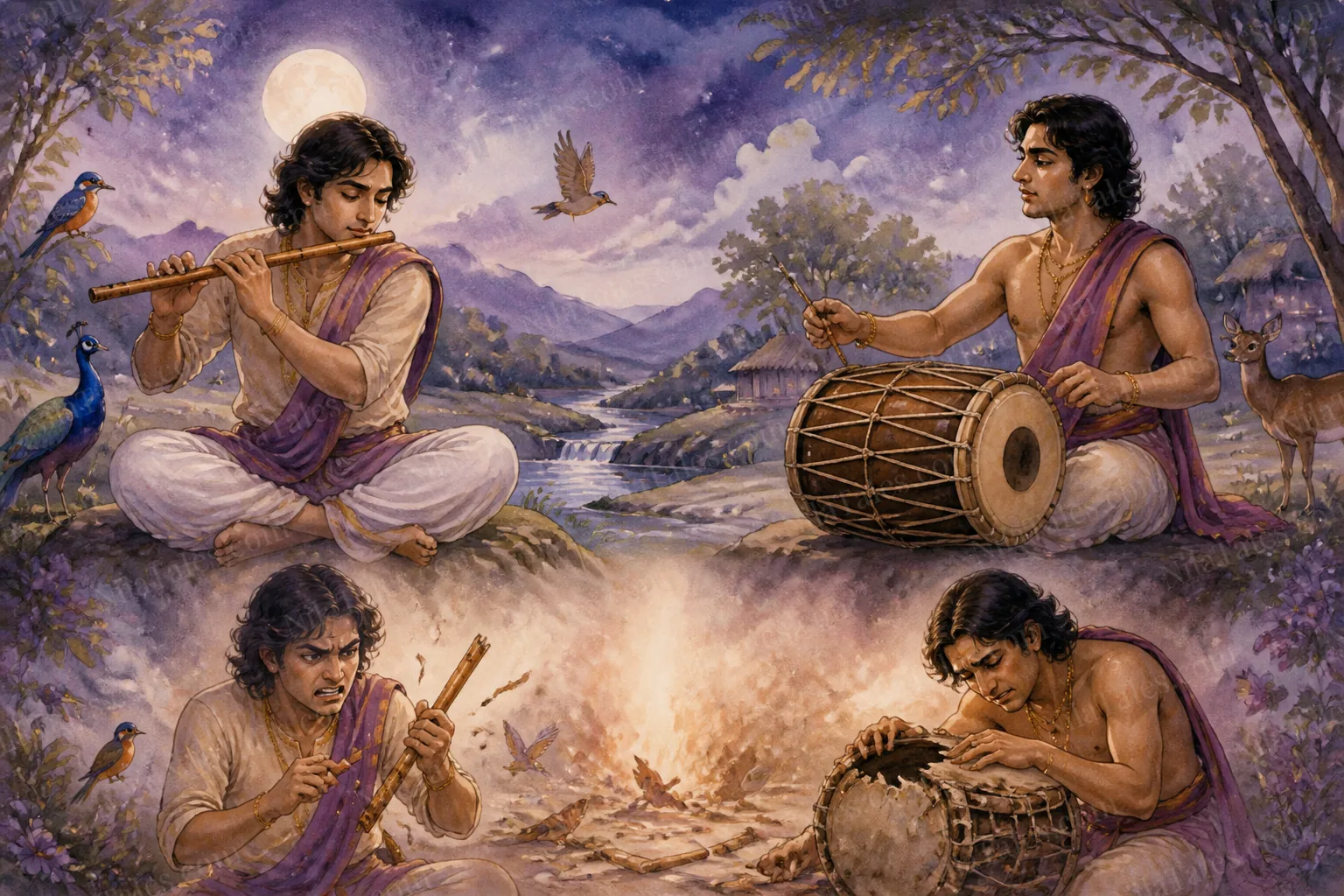
The Flute, the Drum, and the Bitter Rivalry
In a peaceful valley, two musicians named Kavi and Mani lived side by side. Kavi was a master of the flute, able to mimic the songs of birds, while Mani was a brilliant drummer, making the earth vibra…
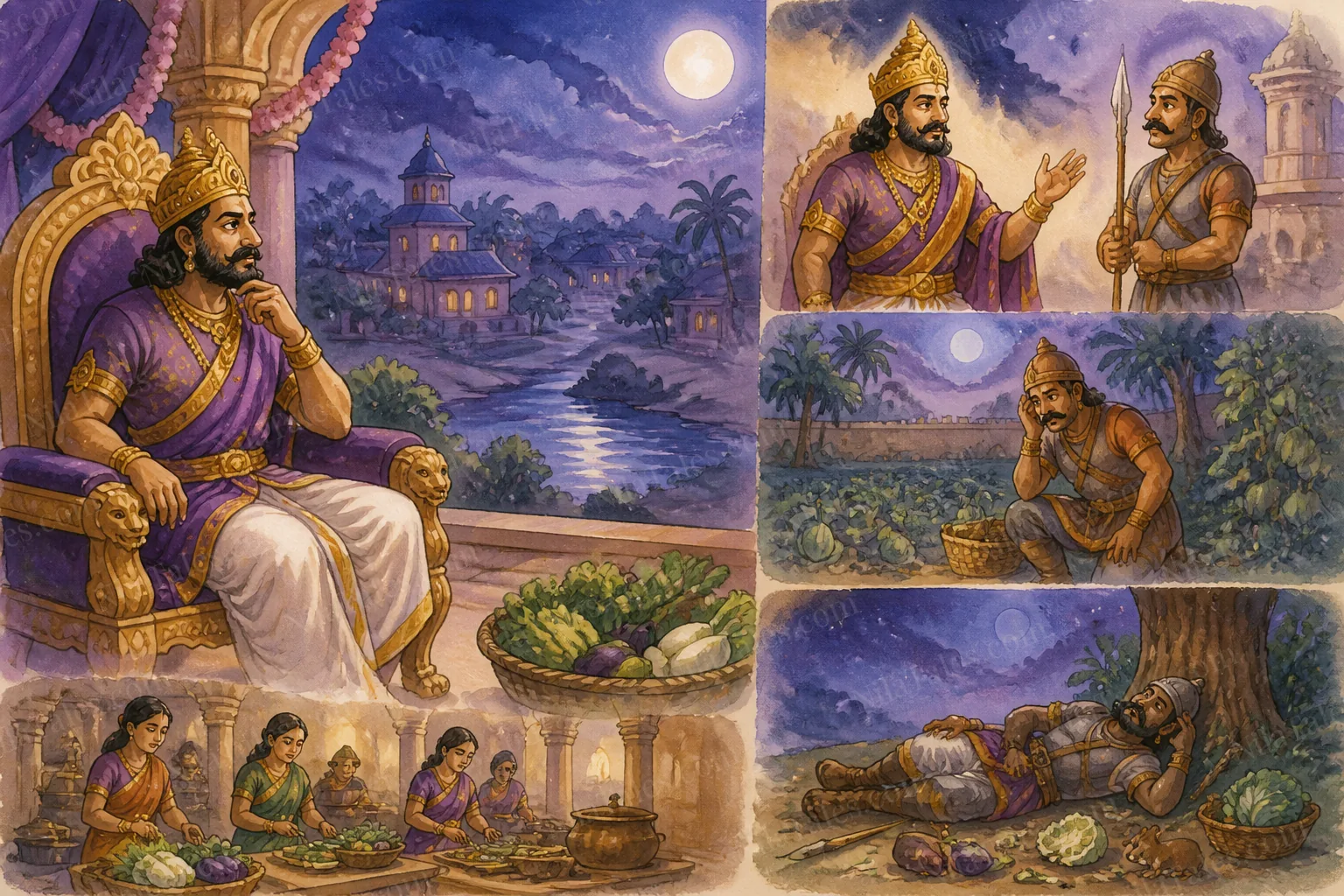
The King and the Careless Guard
Long ago, there ruled a wise king named Dharmavarma. Under his reign, the kingdom flourished, and no one ever went hungry. To ensure his palace kitchens always had fresh vegetables, the king decided t…
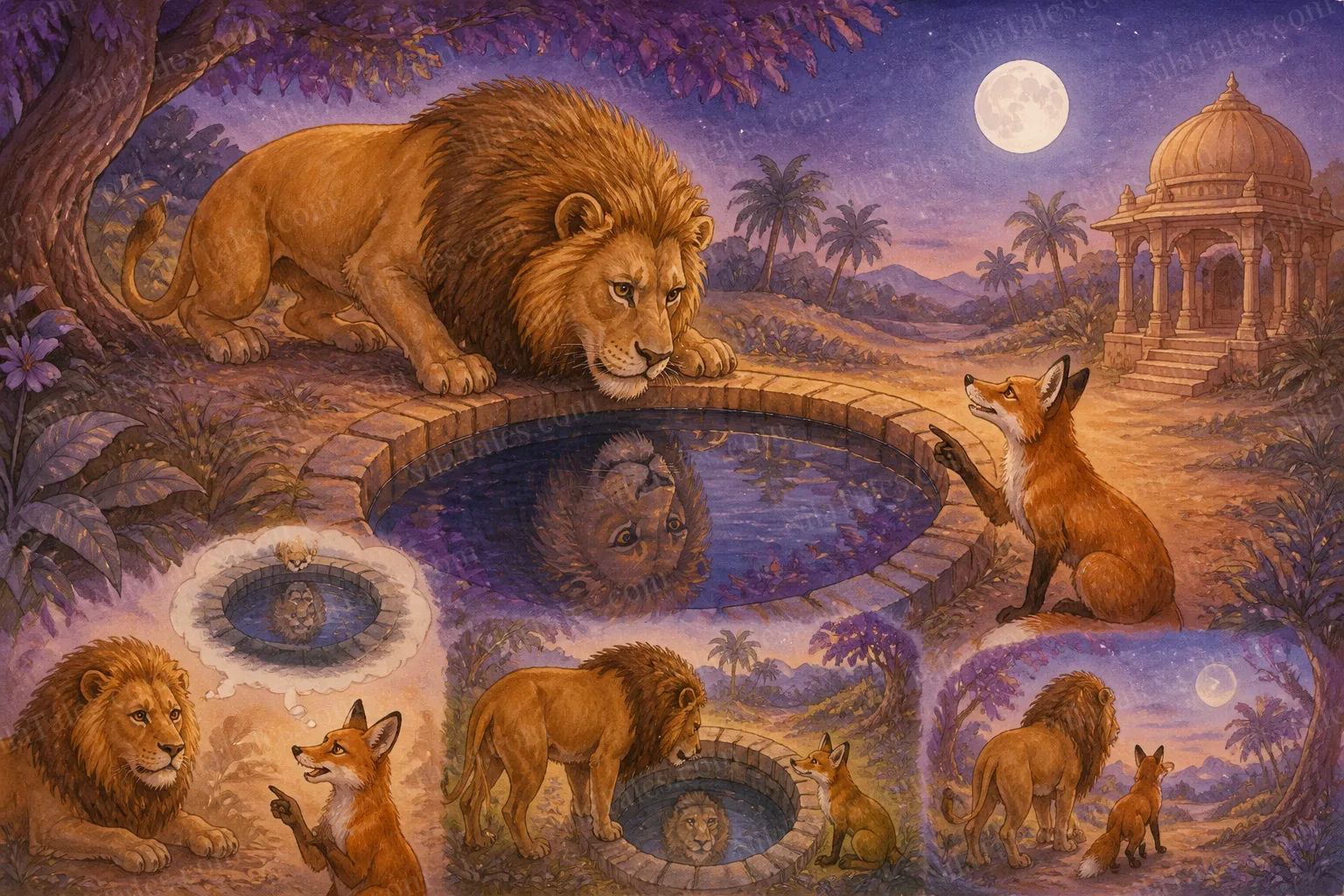
The Lion and the Wise Fox
In a vast, golden jungle, there lived a mighty lion named Leo. One scorching summer afternoon, Leo felt an intense thirst that drove him to search for water. After wandering for miles, he stumbled upo…
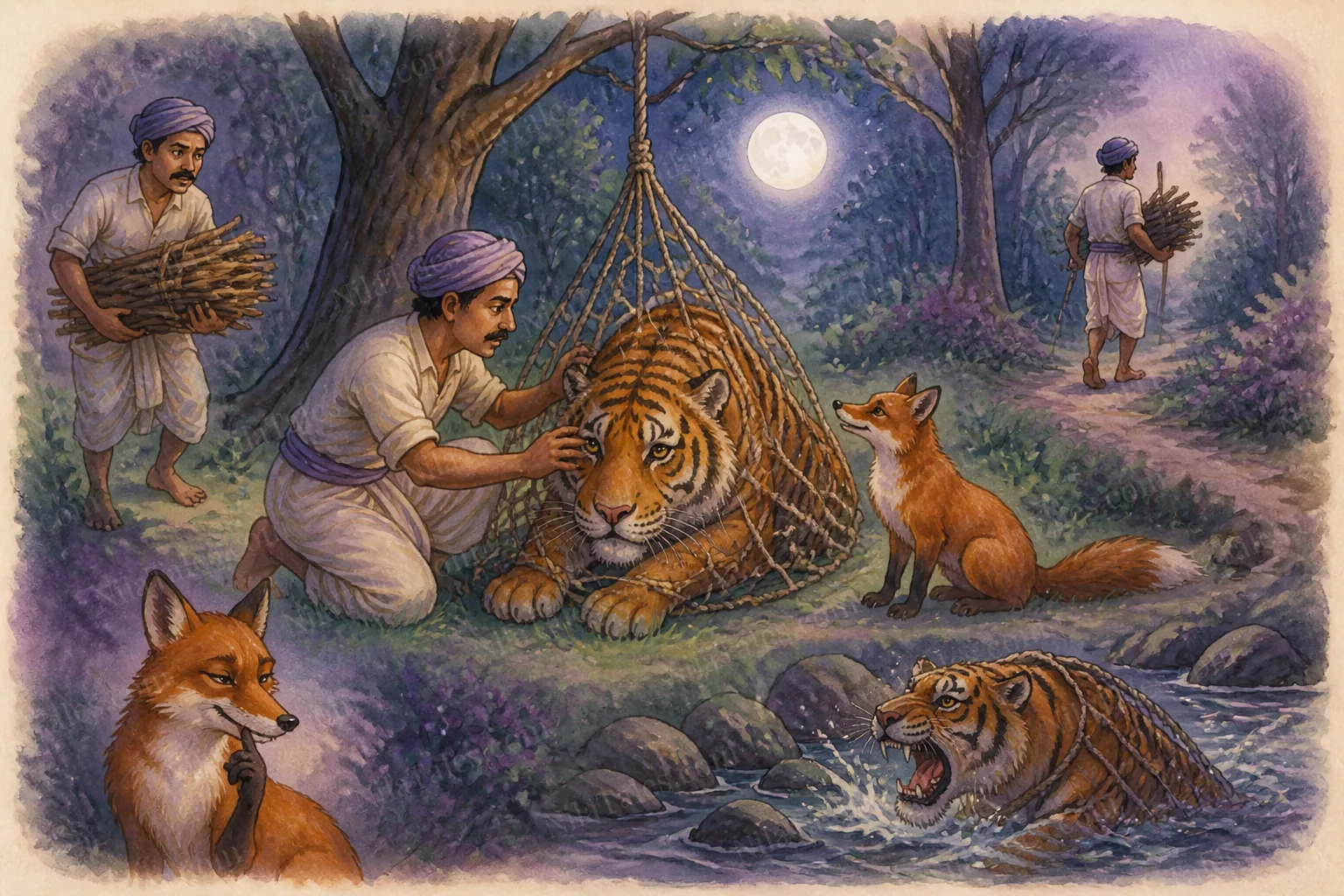
The Ungrateful Tiger and the Clever Fox
In the heart of a lush green forest, a woodcutter named Kavi was busy gathering branches. Suddenly, a low, rhythmic thumping sound caught his attention. Following the noise, he stumbled upon a heavy i…
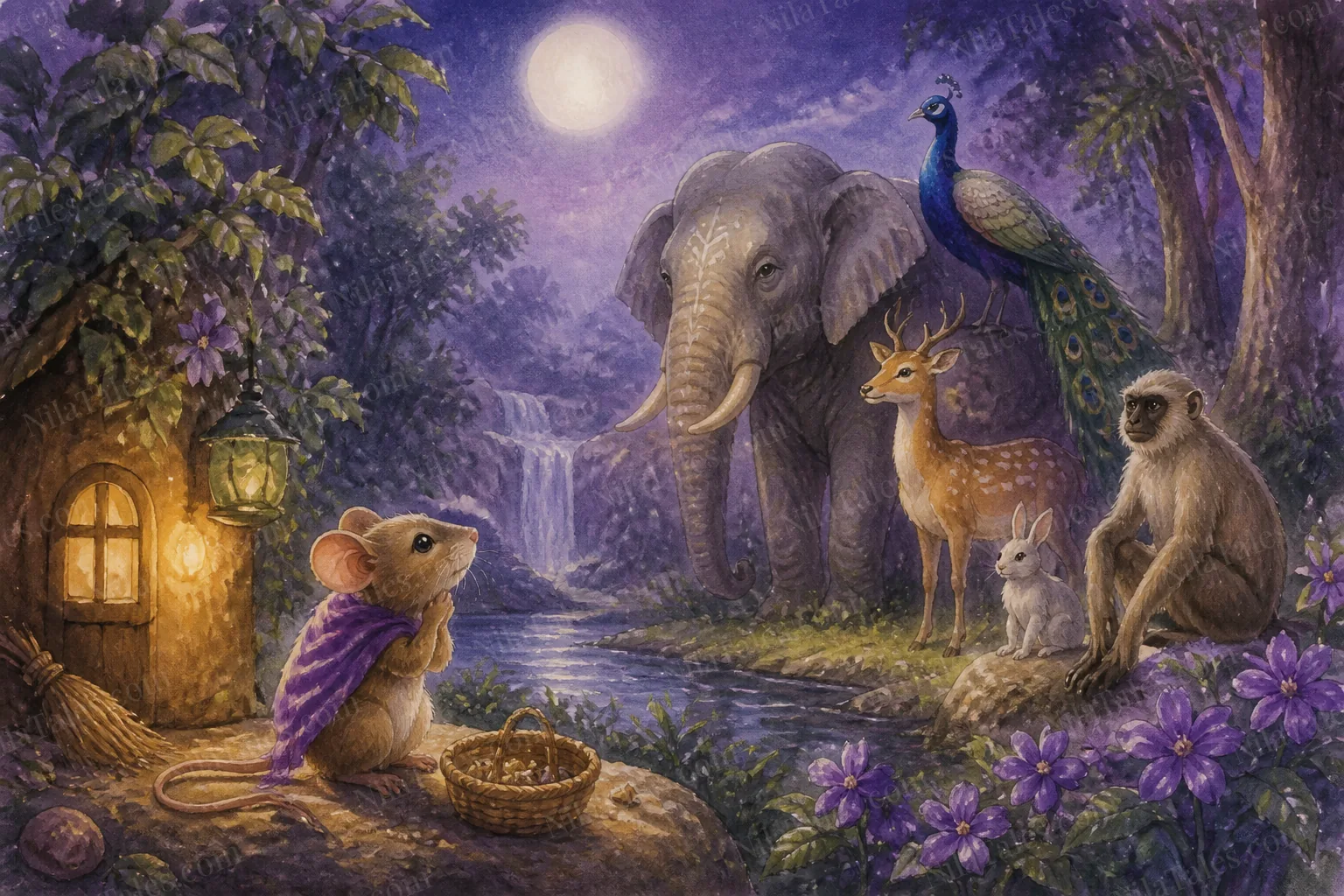
Chippi and the Gift of Being Small
In a lush green forest lived a tiny mouse named Chippi. Chippi was very hardworking, but she had one big problem: she was never happy with herself. She spent most of her time looking at other animals…
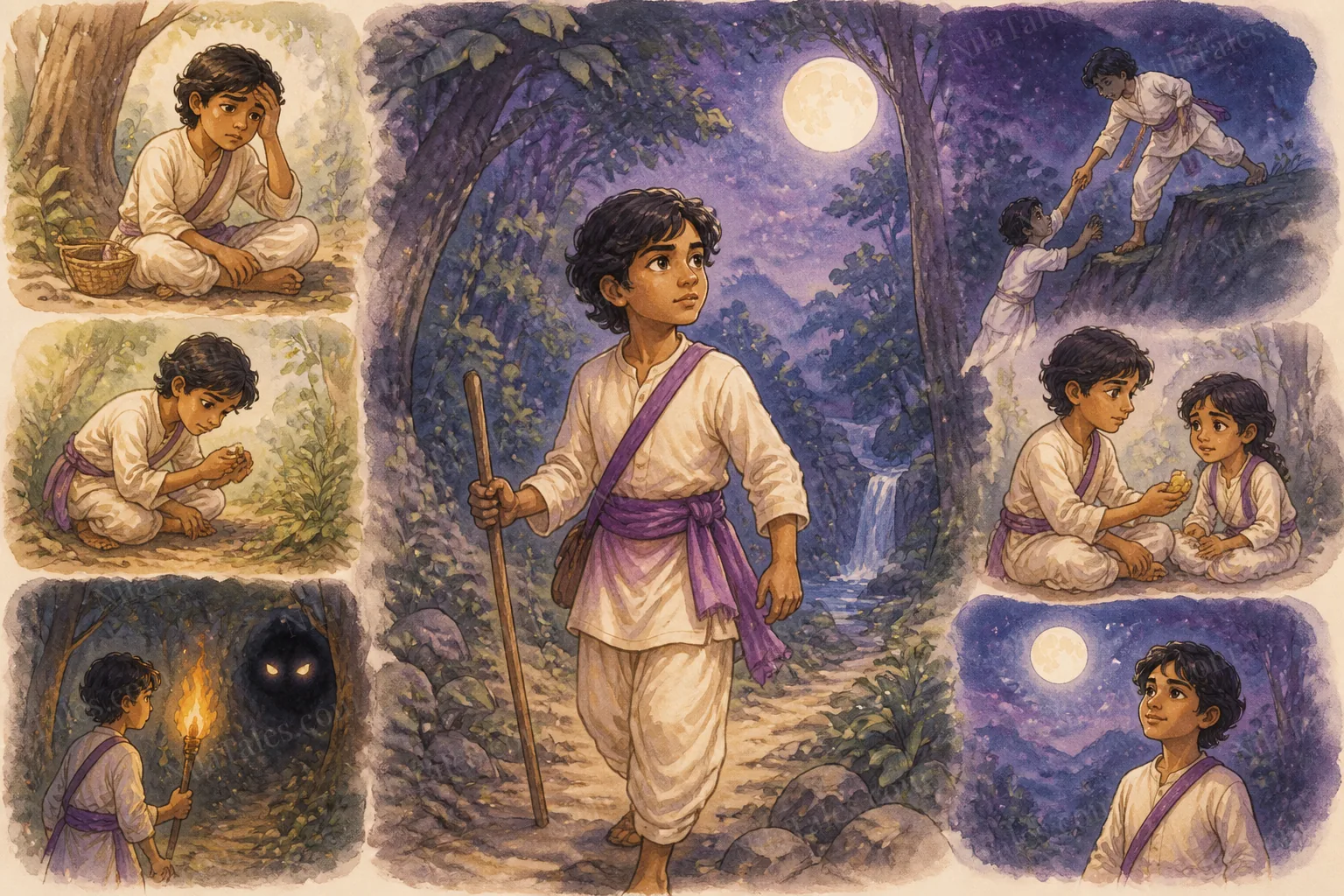
The Boy and the Spark of Courage
Arjun was trekking through a dense, sun-drenched forest. As the afternoon progressed, a gnawing hunger began to grow in his stomach. He searched everywhere for something to eat, but the forest floor o…
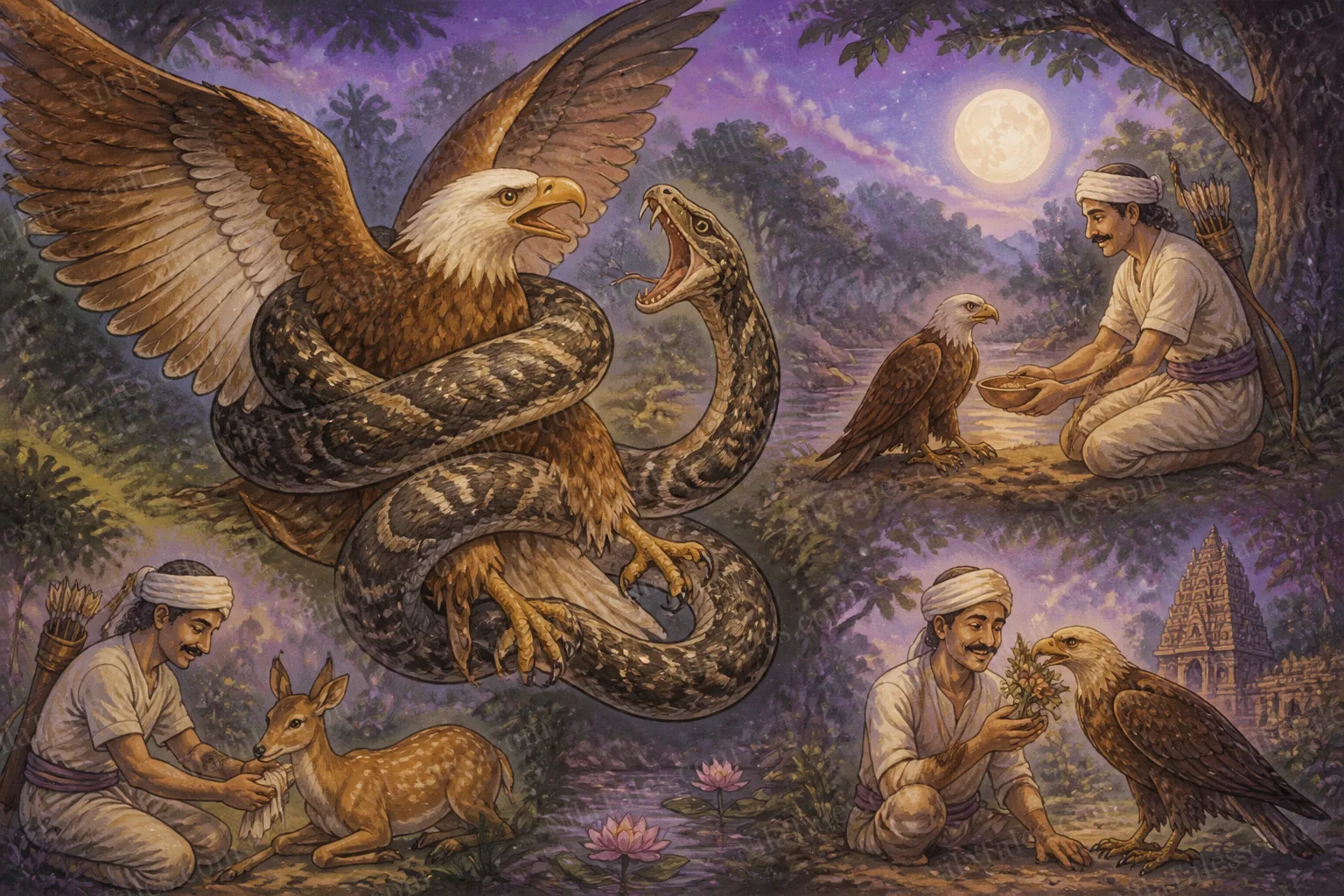
The Sky Guardian and the Kind Hunter
In a vast, green forest lived a majestic eagle named Sky. Sky was known for his strength, but one afternoon, while soaring through the trees, a thick, venomous python lunged at him. The snake coiled t…
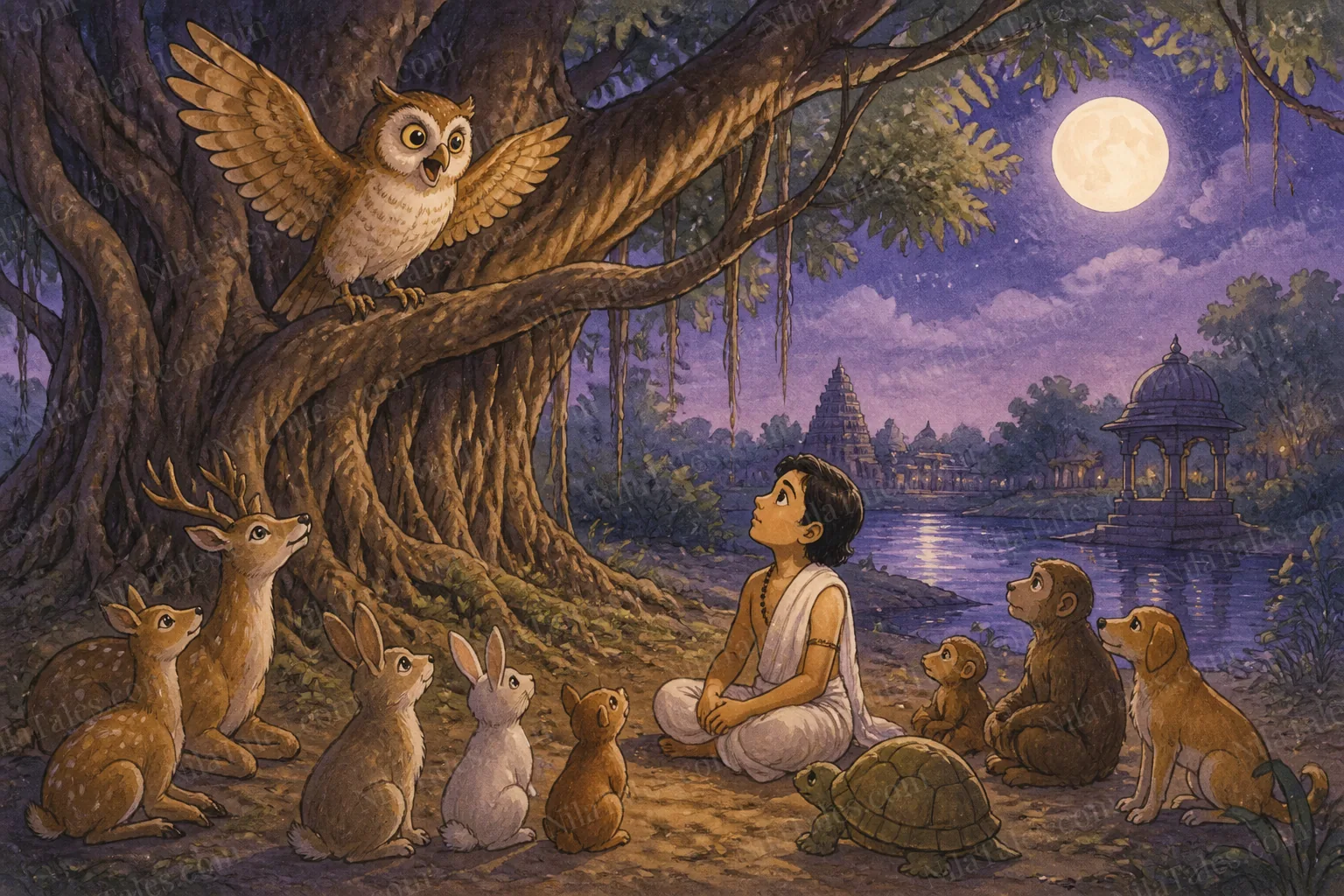
The Secret of Silence
In the heart of a lush forest stood a massive banyan tree. High in its branches lived an owl named Chandra. Chandra was energetic, but she had one big flaw: she could never stop hooting. Whenever othe…
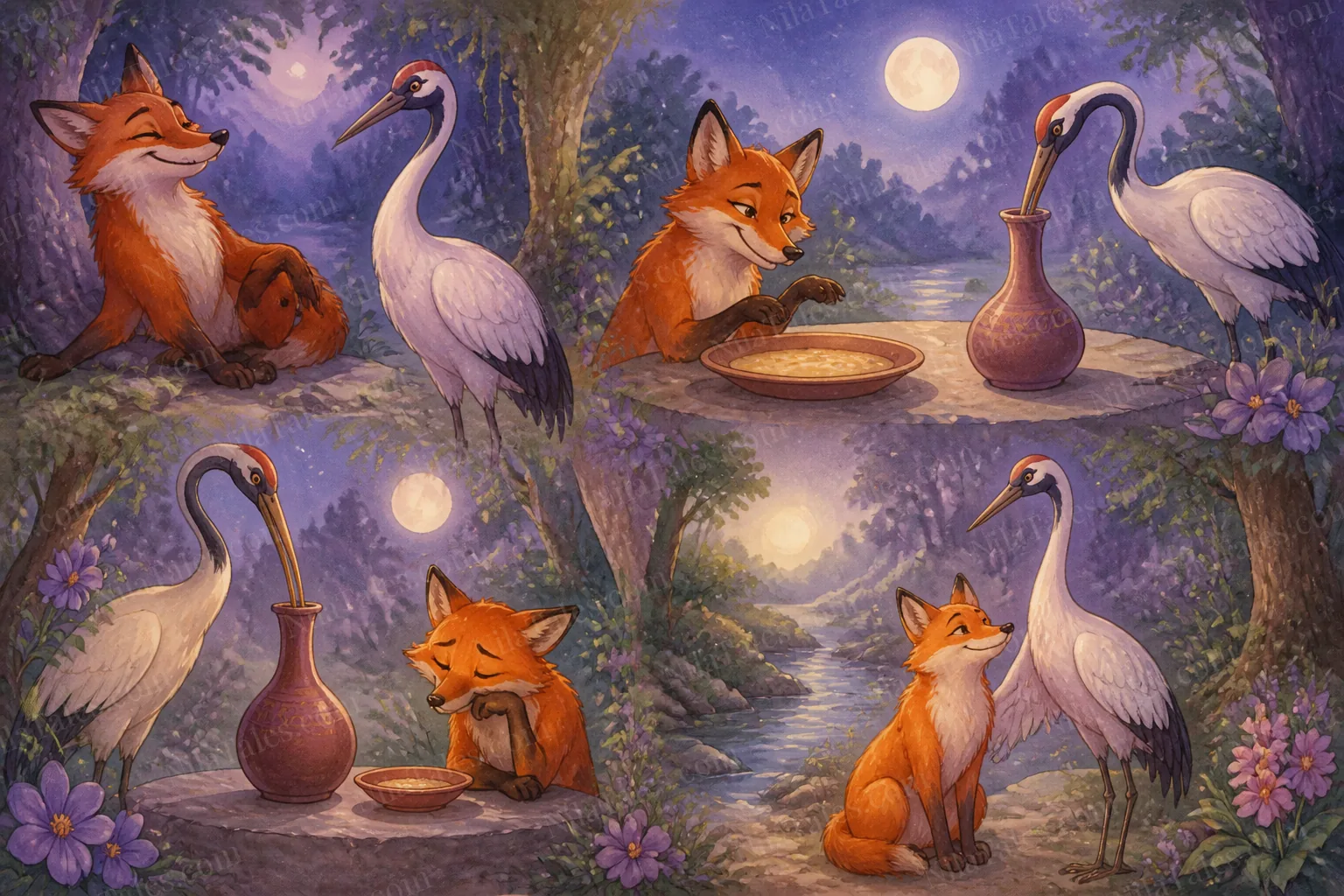
The Fox's Trick and the Crane's Lesson
In a lush, green forest lived a fox named Sinabu and a crane named Kavin. They were friends, but Sinabu was very proud and thought he was the cleverest animal in the woods. He often enjoyed playing sm…

The Clever Donkey and the Hungry Fox
In a dense green forest, there lived a fox named Somu. One afternoon, Somu was feeling extremely hungry. He searched behind every bush and under every rock for a snack, but he couldn't find anything t…
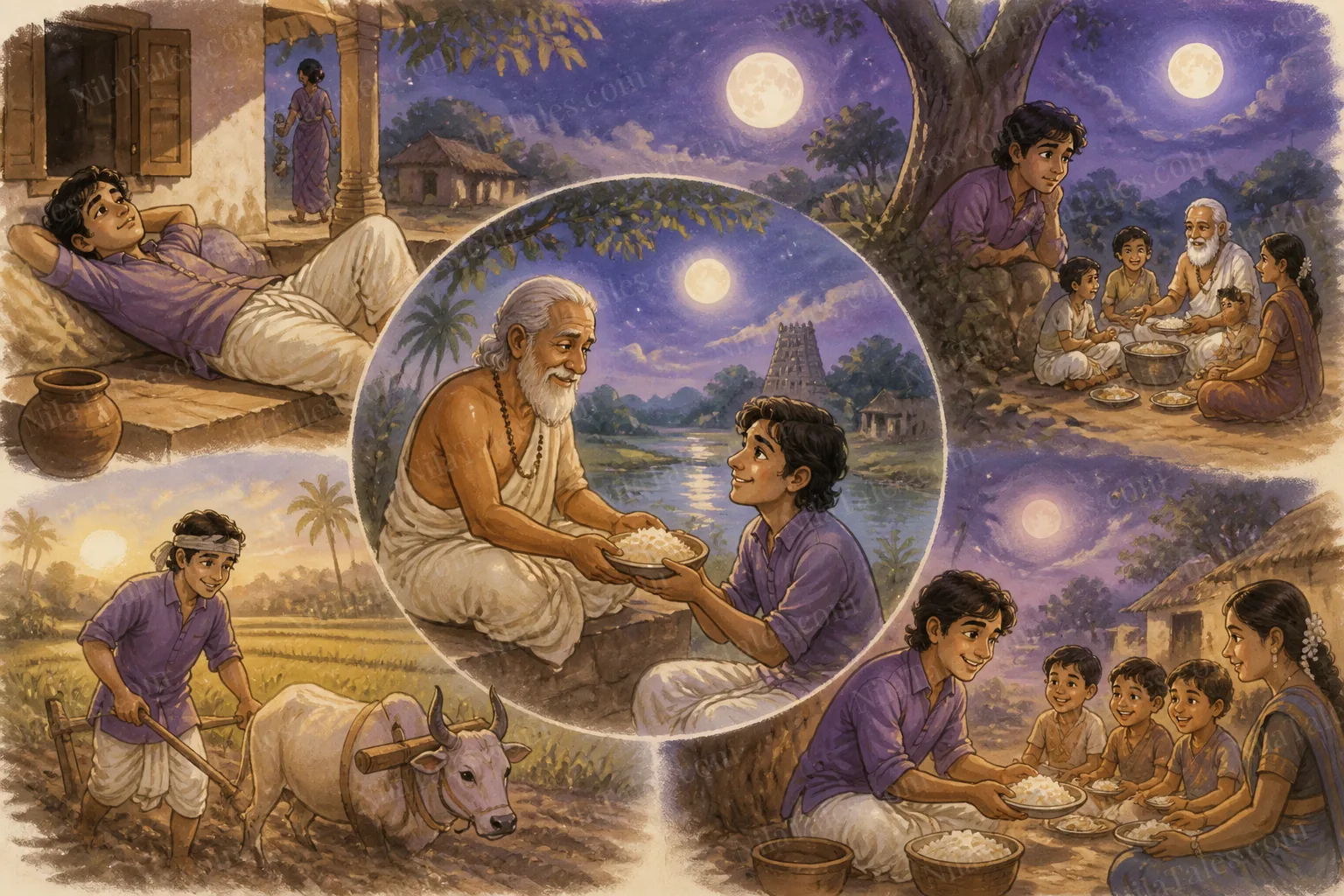
The Lesson of the Sharing Heart
In a peaceful village lived a young man named Kavin. Kavin was quite lazy; he preferred waiting for others to bring him food rather than working in the fields. One afternoon, driven by hunger, he spot…
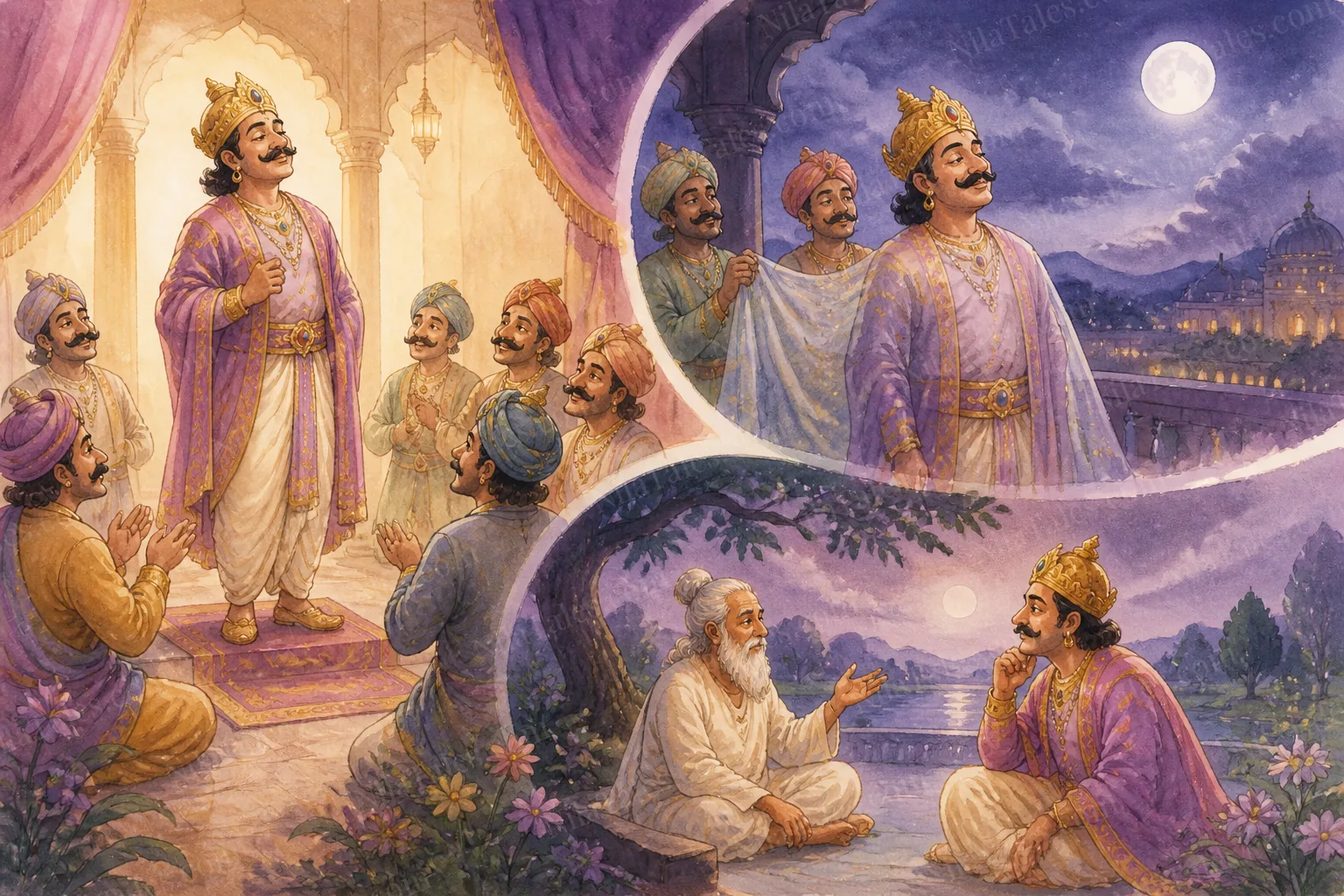
The Invisible Cloak and the Wise King
Once upon a time, King Vikram ruled over a prosperous-looking kingdom. However, Vikram had a flaw: he loved being praised. His ministers, wanting to stay in his good graces, constantly flattered him,…
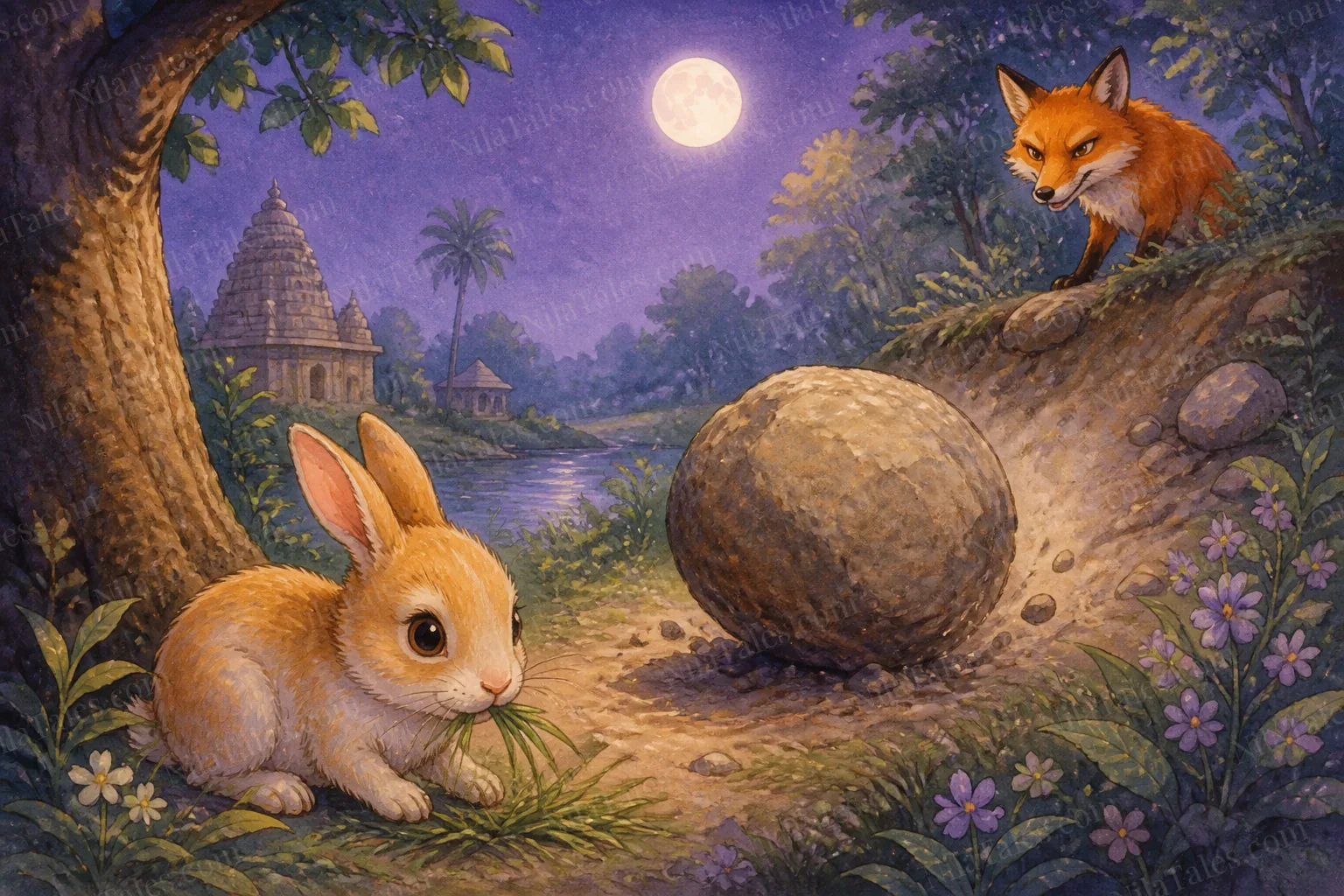
Chinnu Rabbit and the Fox's Trick
In a lush green forest, there lived a tiny rabbit named Chinnu. One sunny afternoon, while Chinnu was nibbling on some sweet grass, a large rock suddenly tumbled from a nearby hill and crashed near hi…

The Clever Fox and the Panicked Birds
In the heart of a deep forest stood a magnificent banyan tree. High among its sturdy branches lived a flock of colorful pheasants. One calm, moonlit night, the birds were resting peacefully, enjoying…
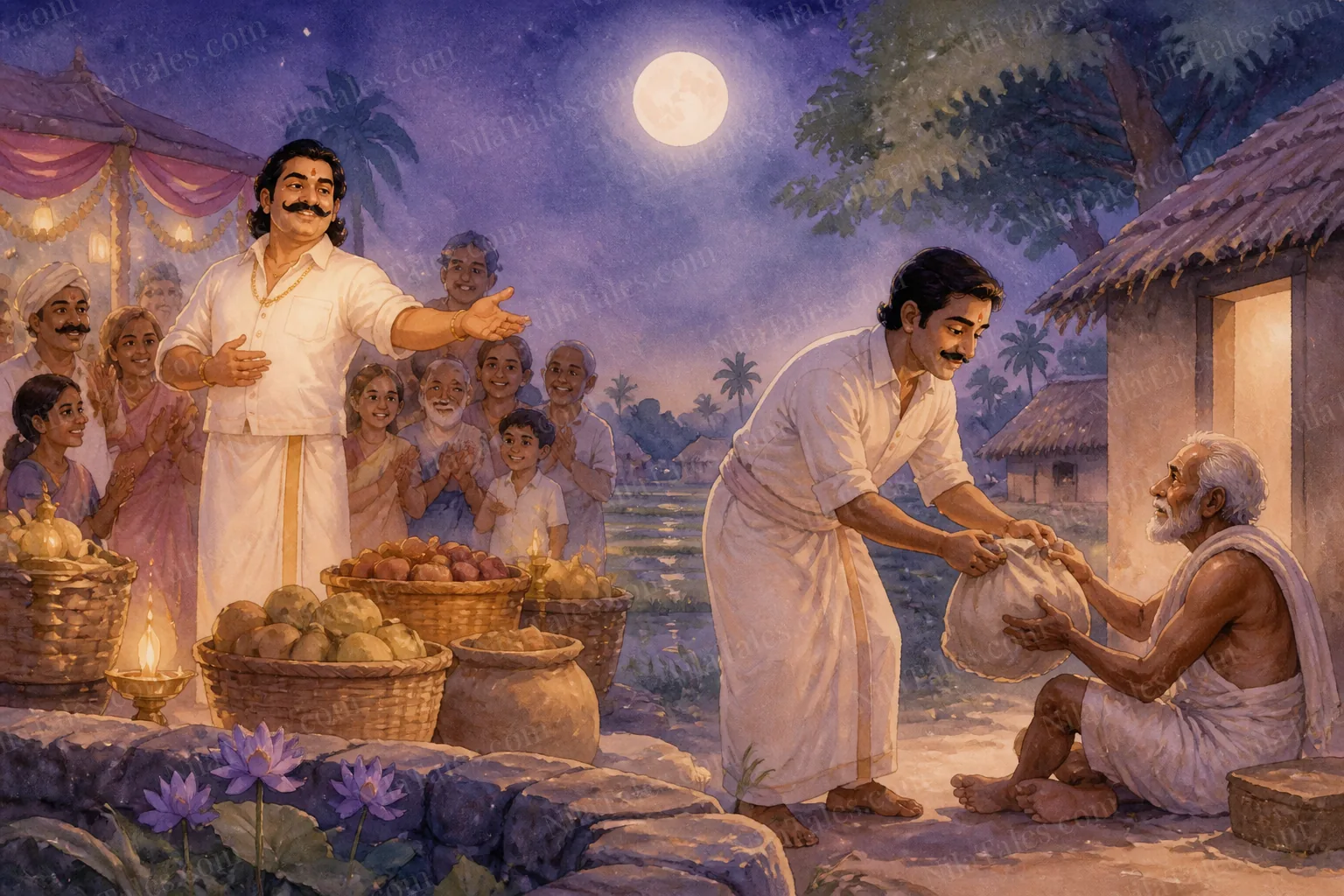
The Heart of Giving
In a peaceful village lived two close friends, Somu and Ramu. Both were prosperous farmers, known for their generosity. However, their reasons for giving were very different. Somu loved being the cent…

The Mighty Crocodile and the Clever Spiders
In the heart of a lush jungle, a wide, blue river flowed steadily. Living in this river was a powerful crocodile named Karikalan. While Karikalan was incredibly strong, he had one major weakness: he w…
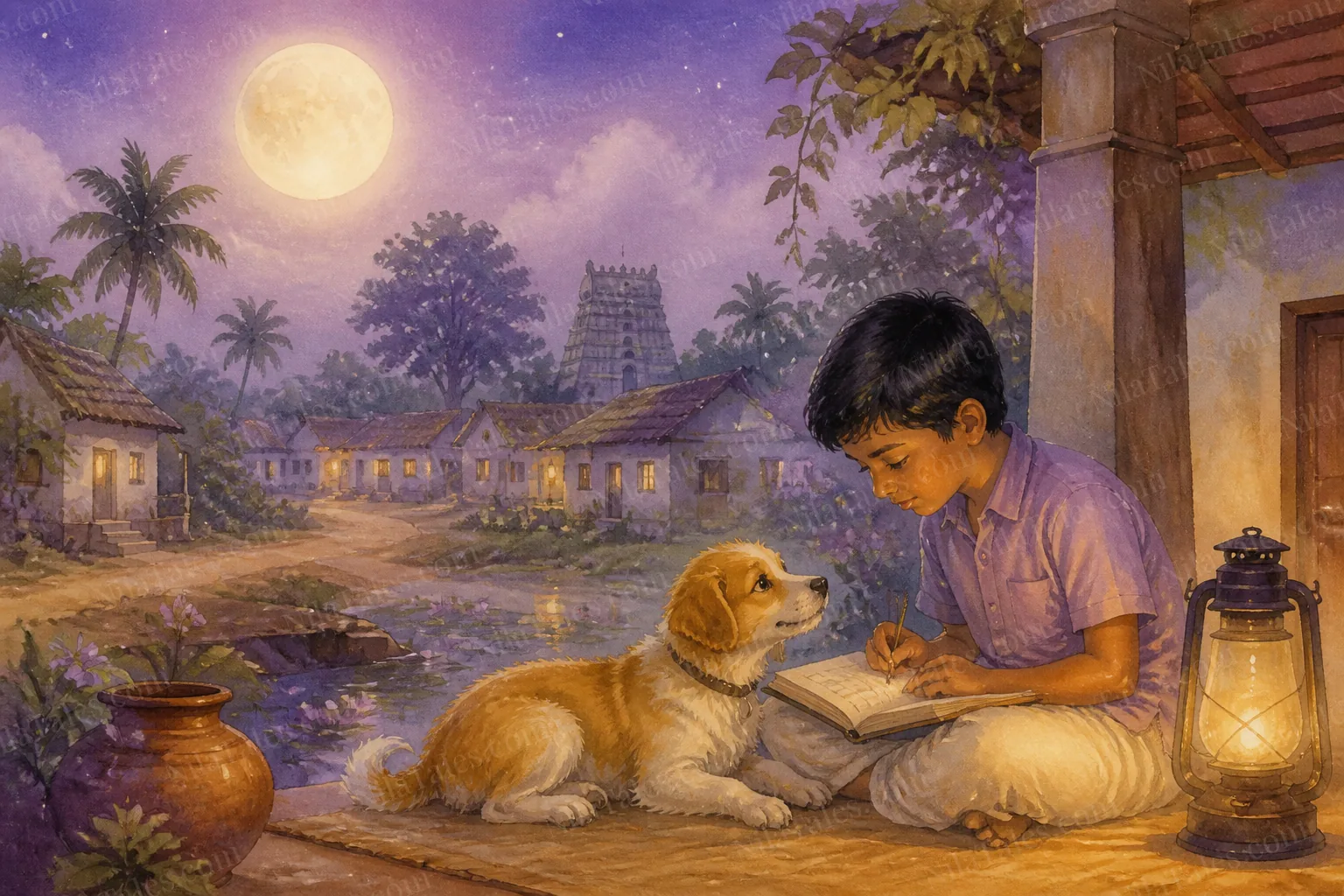
Mani's Loyal Heart
In a peaceful little village, there lived a small, energetic puppy named Mani. Mani was more than just a pet; he was the best friend of a young boy named Kavin. Every evening, as Kavin studied his les…
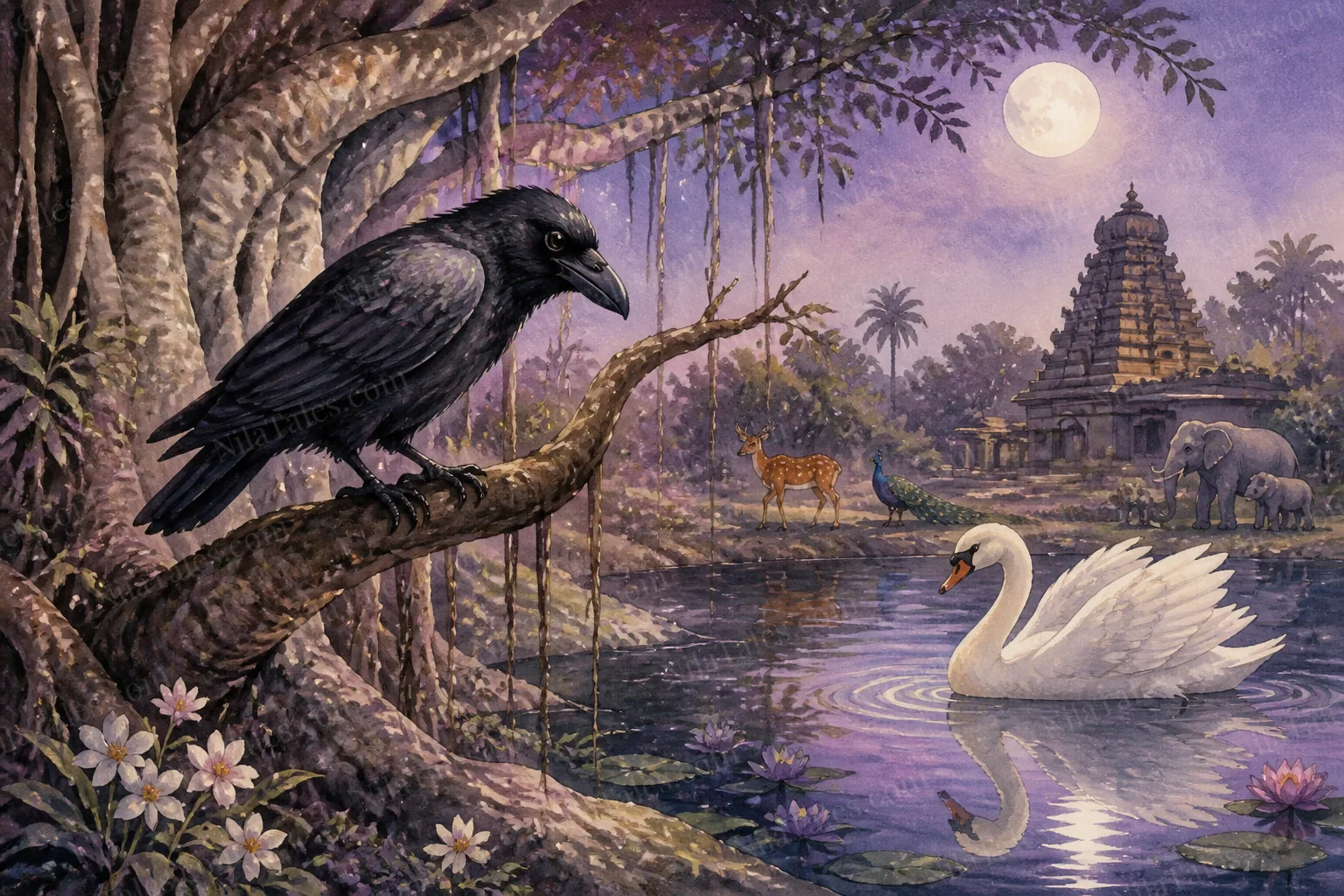
The Crow and the Swan's Reflection
In a sprawling banyan tree, there lived a crow named Kalu. Kalu was a clever bird, but he had a heavy heart filled with envy. He spent most of his days watching the animals around him, wishing he coul…
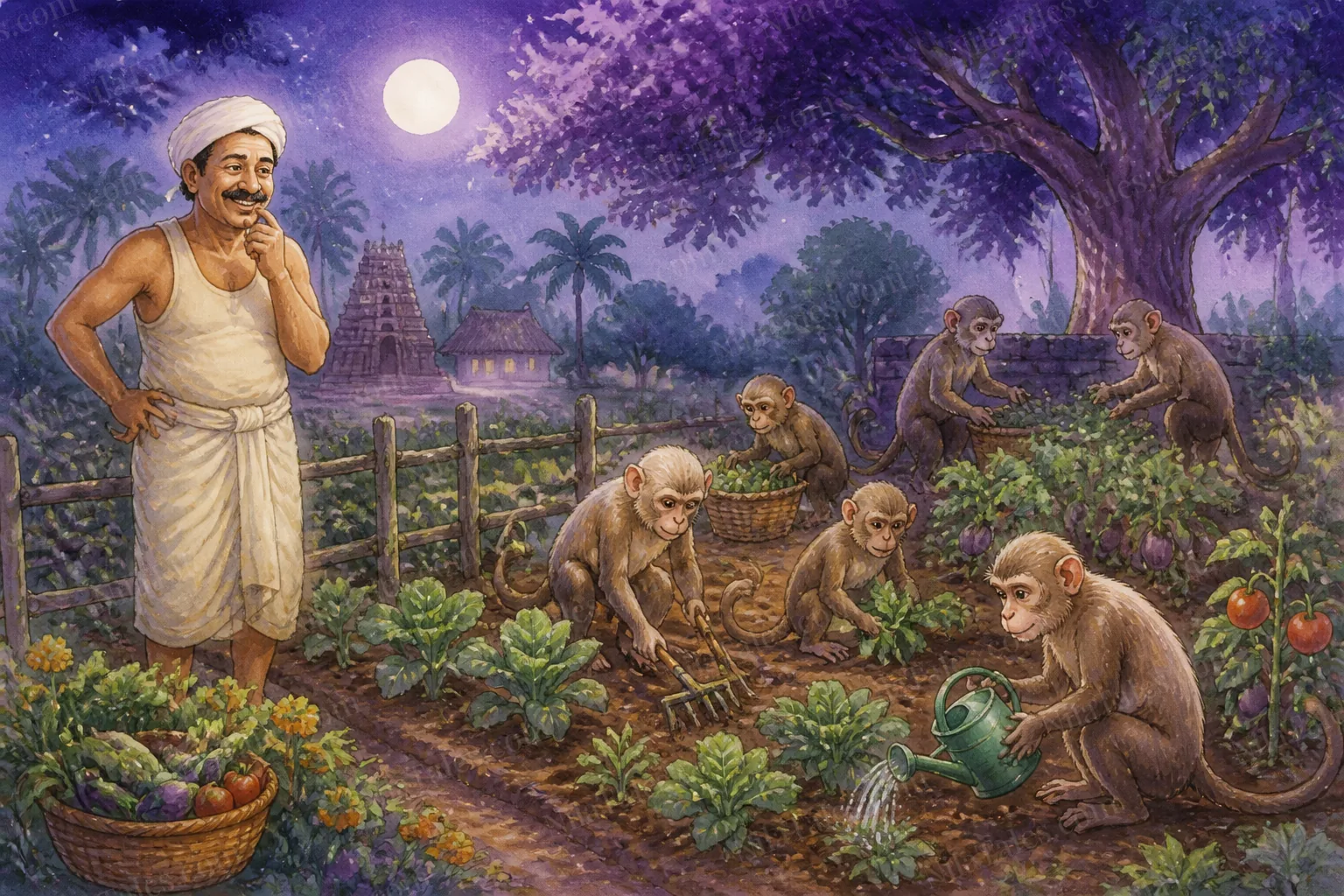
The Diligent Monkeys and the Messy Garden
Near the edge of a lush green forest lived a gardener named Somu. He took great pride in his vegetable garden, which was the most beautiful in the village. A group of clever monkeys living in the near…
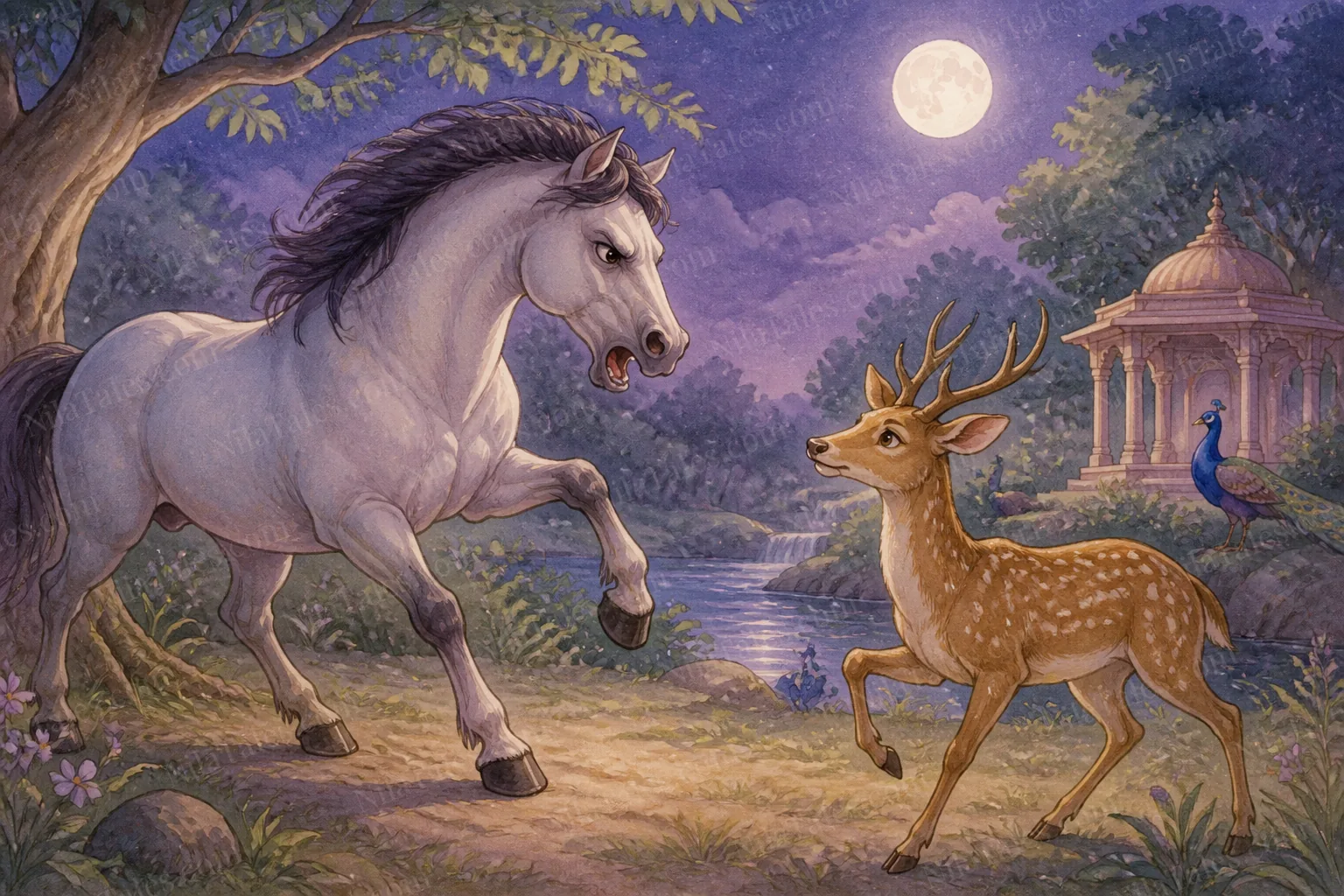
The Horse's Mistake
In a lush green forest lived a powerful horse named Kabilan. Kabilan was strong and fast, but he had a restless and angry temper. One afternoon, he got into a heated argument with a gentle deer named…
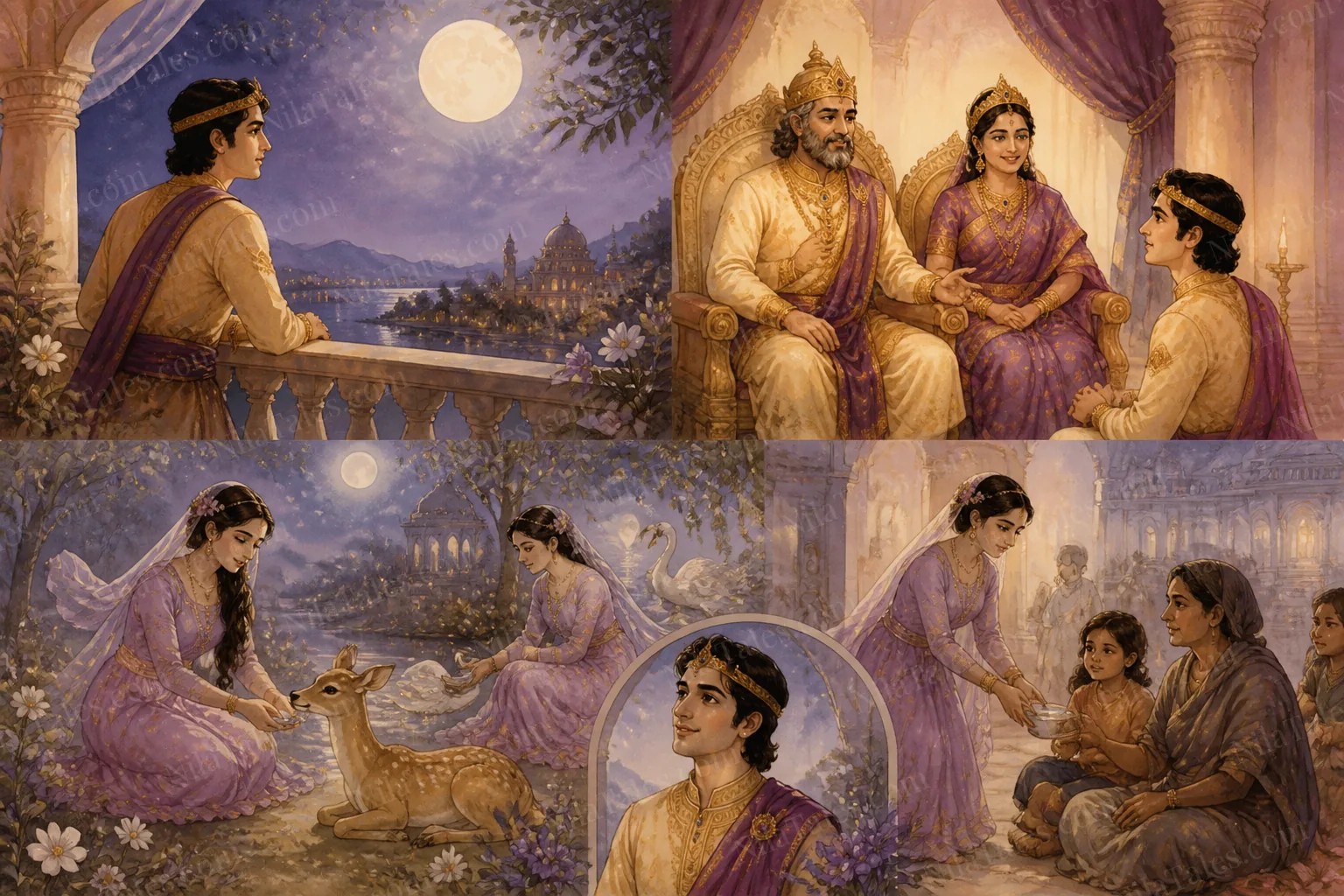
The Princess of Gentle Grace
In a prosperous kingdom, lived Prince Vikram. He was a kind-hearted ruler, but his heart felt lonely because he had not yet found a partner who truly understood his gentle nature. The King and Queen t…

The Jealous Songbird
On the edge of a lush green forest stood a magnificent banyan tree. A bright green parrot named Pip lived among its branches. Pip was a cheerful bird, but he had one secret flaw: he felt a sting of je…
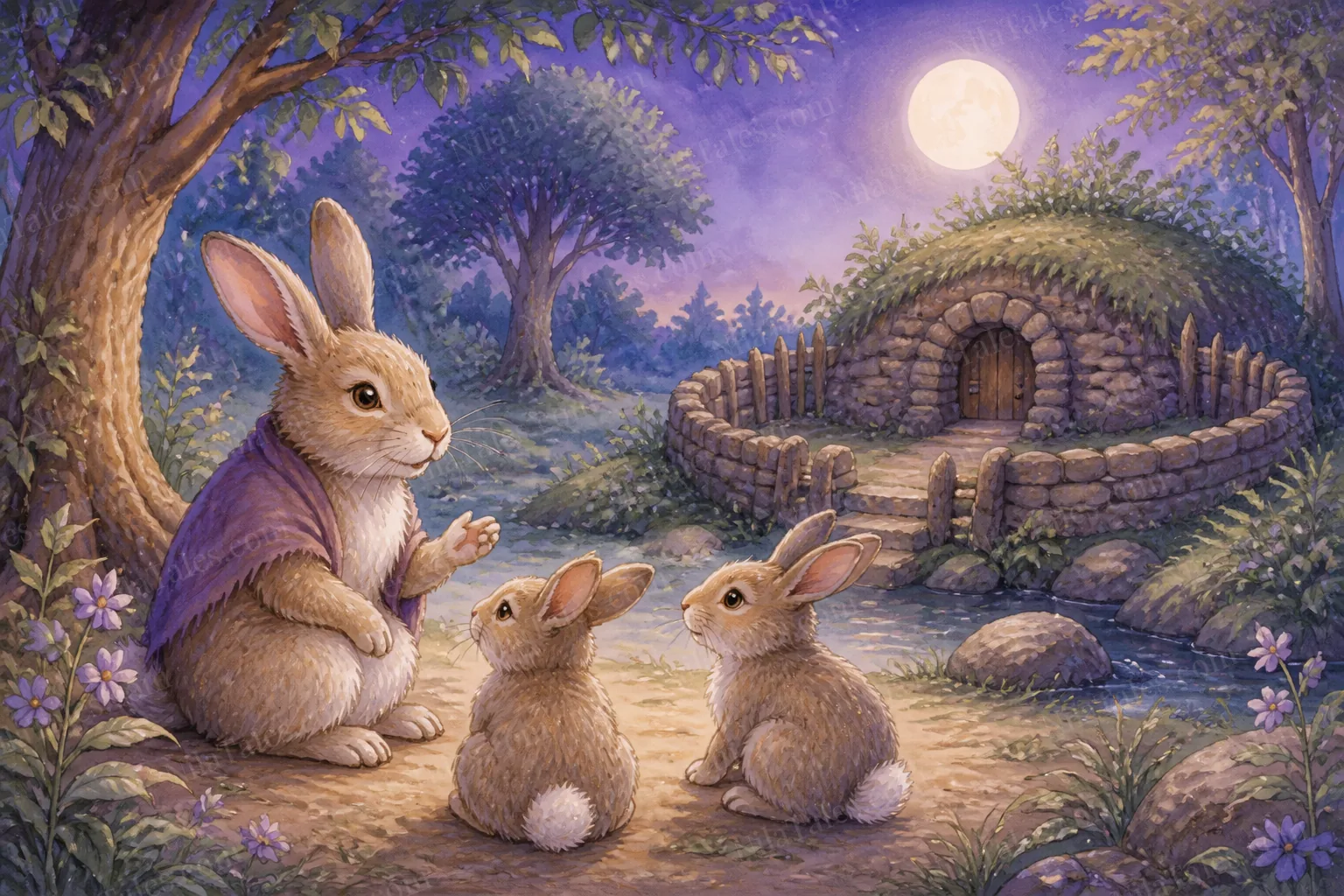
The Three Rabbits and the Strong Fortress
In the heart of a lush green forest, an old mother rabbit lived with her three young rabbits. As the little ones grew into strong adults, the mother rabbit called them for a special talk.
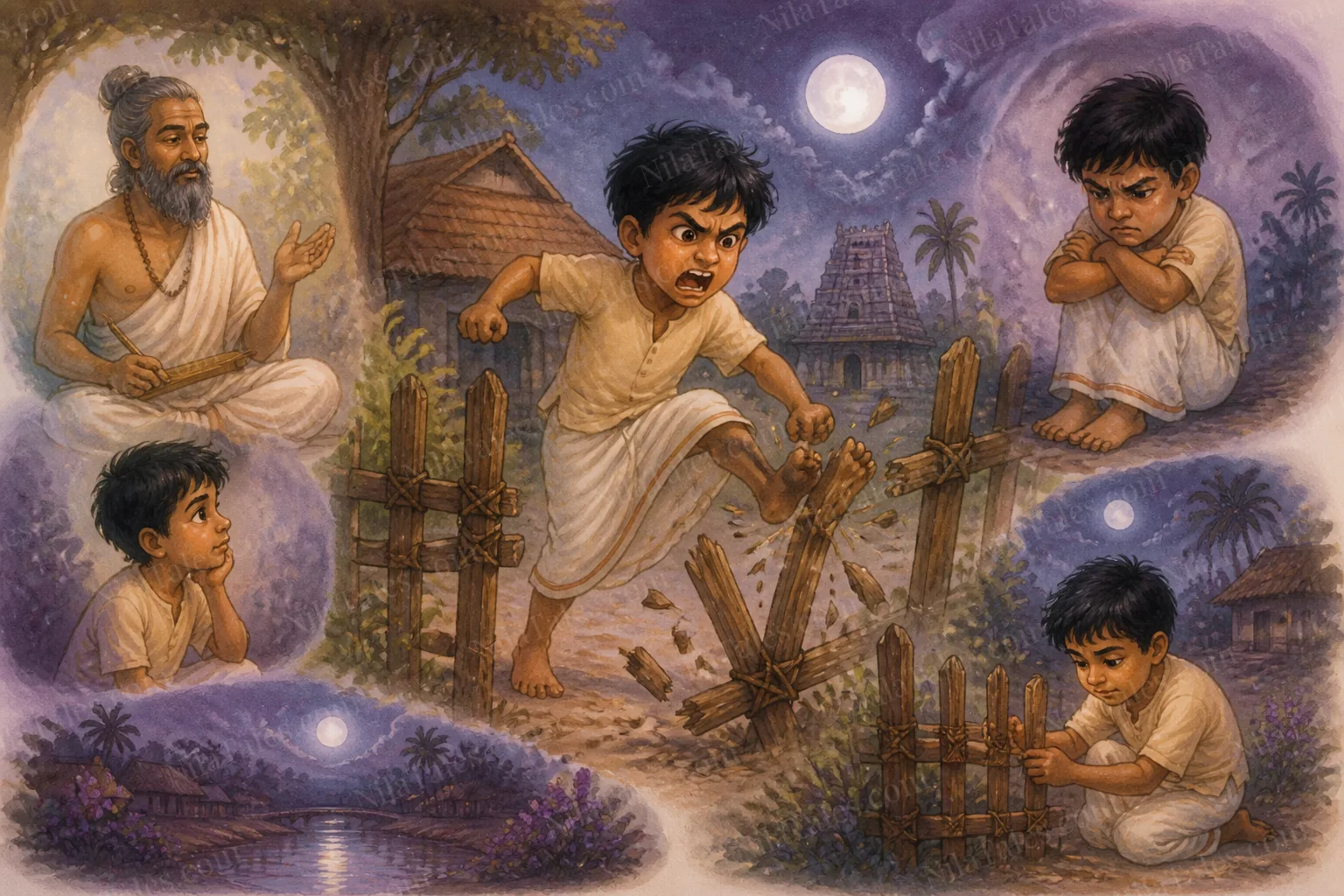
Kavin and the Wooden Fence
In a peaceful village lived a young boy named Kavin. Kavin was bright and energetic, but he had one major flaw: a very short temper. Whenever things didn't go his way, Kavin would lose control. He wou…