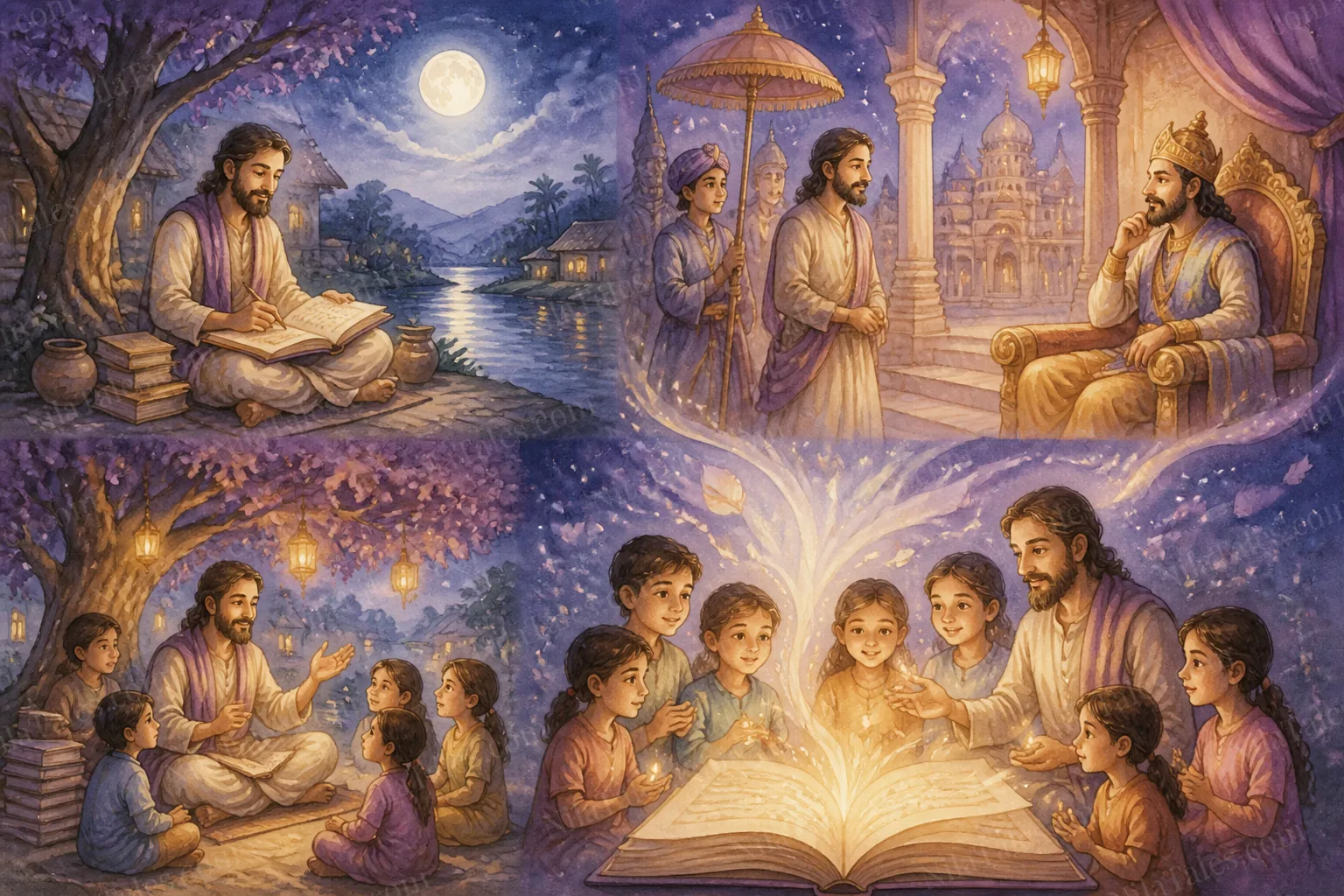
In a peaceful village lived a wise scholar named Madhavan. He was known not just for his poetry, but for his deep understanding of life. One day, the King invited Madhavan to the capital to share his wisdom during a grand festival. To ensure Madhavan had everything he needed, the King provided him with a generous purse of gold coins.
Before he left, his wife, Lakshmi, handed him a small list. "Please, Madhavan, bring back some grains for our kitchen and a new silk saree for me," she said with a gentle smile. Madhavan promised to return with everything she asked for.
Weeks passed, and Madhavan finally returned. As he walked through the village gates, Lakshmi ran to meet him. She noticed he was carrying two heavy bundles instead of the usual sacks of grain. "Where are our supplies, Madhavan?" she asked, a hint of worry in her voice.
Madhavan sat her down and carefully opened the bundles. Instead of food, the bundles were filled with beautifully bound books—ancient legends, philosophy, and collections of wisdom. "Lakshmi," Madhavan said softly, "the gold the King gave us could buy many bags of grain, but grain is eaten and gone. It could buy many clothes, but clothes wear out with time. I chose to buy these books because the knowledge within them will never fade. This is a treasure that our children and grandchildren can use forever."
He then reached into a small pouch and pulled out a neatly folded silk saree. "After buying these precious books, I had just a little bit of gold left. With that, I bought this saree for you. Did I do something wrong?"
Lakshmi looked at the mountain of books and then at her husband’s sincere eyes. Her worry melted into immense pride. She realized that while grain fills the stomach, knowledge fills the soul. "You have brought us a wealth that no thief can steal," she replied, smiling brightly.
Moral
Knowledge is a treasure that grows with use and never fades away.